Most of what gets written about poodle health testing assumes you already have a result in hand and need to know what it means, or that you already know your lab and need help choosing between two of them. Neither is the question a breeder setting up a program for the first time is actually asking. That breeder is asking something narrower and more practical: what do I actually need to test, in what order, and by what age, before this dog has a litter?
This is that checklist. It does not explain how to read a genotype line, once you have one, that is how to read a dog DNA health panel, line by line, and it does not compare laboratories, that is Embark vs. UC Davis VGL vs. Wisdom Panel. This is what goes on the order form and the calendar before either of those questions comes up.
Start With Variety, Not a Generic List
The single biggest mistake a new breeder makes is testing off a generic "poodle health tests" list. The three varieties do not share one CHIC requirement, and the differences are not symmetrical:
- PRA-prcd DNA testing is required for a CHIC number in the Toy and Miniature, but not the Standard.
- Patellar luxation evaluation is required in the Toy and Miniature, but not the Standard.
- Hip evaluation is required in the Miniature and Standard, but not the Toy.
- Only the Standard carries a "choose at least one" elective structure, picking one of four options.
So the first item on this checklist is not a test at all. It is confirming which variety's requirements apply to the dog in front of you, and checking that against the current CHIC listing on our health testing reference, which is verified directly against OFA's live breed pages rather than against a generic breed database.
Step 1: The DNA Panel
Order this before the dog's first breeding, not after a scare. What belongs on it depends on variety.
| Priority | Test | Applies to | Why it's on the panel |
|---|---|---|---|
| CHIC-required | PRA-prcd | Toy, Miniature (required); optional in Standard | Progressive retinal degeneration. The one DNA test the parent club actually mandates for these two varieties. |
| Variety-exclusive | GM2 Gangliosidosis | Toy | A fatal lysosomal storage disease confined to the Toy (Tamura et al., 2010; Rahman et al., 2012). Missed entirely by a generic breed list. |
| Variety-exclusive | Osteochondrodysplasia (skeletal dwarfism) | Miniature | Documented in the Miniature at meaningful frequency, around 9.7 to 10 percent of carriers in the sampled population (Neff et al., 2012). |
| Variety-exclusive | Neonatal Encephalopathy with Seizures (NEwS) | Standard | A Standard-specific disease (Chen et al., 2008); affected puppies rarely survive the first weeks. |
| Variety-exclusive | Day Blindness with Retinal Degeneration (SPATA7) | Standard | Blindness in bright light from puppyhood, progressing further. Standard-specific. |
| Widely useful | PRA-rcd4, Degenerative Myelopathy (SOD1), vWD1 | All, patterns vary | Not CHIC-required anywhere, but worth having on file. DM is at-risk-not-affected due to incomplete penetrance; vWD1's inheritance model varies by lab, ask before you act on a result. |
| Toy & Miniature specifically | CDDY | Reported more often in Toy and Miniature than Standard; no peer-reviewed poodle-specific frequency has been published | A dominant result, not a carrier state (Brown et al., 2017; Batcher et al., 2019). The variant segregates in poodles rather than being fixed, but it is common enough in Toy and Miniature lines that a positive should not surprise you. Read why the panic is misplaced before this line changes a pairing decision. |
| Will appear regardless | Copper toxicosis (ATP7B/ATP7A), ALT activity | Appears on extended panels for any variety | Labrador and Doberman variants with no established poodle relevance. They will be on the panel because the panel tests every dog for everything it offers. Record them, don't react to them. |
Everything at the "not-validated in poodles" tier, MDR1, hereditary cataracts (HSF4), Chondrodysplasia (CDPA), among others, doesn't need to be sought out. If your chosen panel includes it, file the result; it is not worth paying extra for a lab that offers more of it. The full tier breakdown, with the poodle-specific evidence behind each line, is on the health testing reference.
Step 2: The Physical Screenings, and Their Minimum Ages
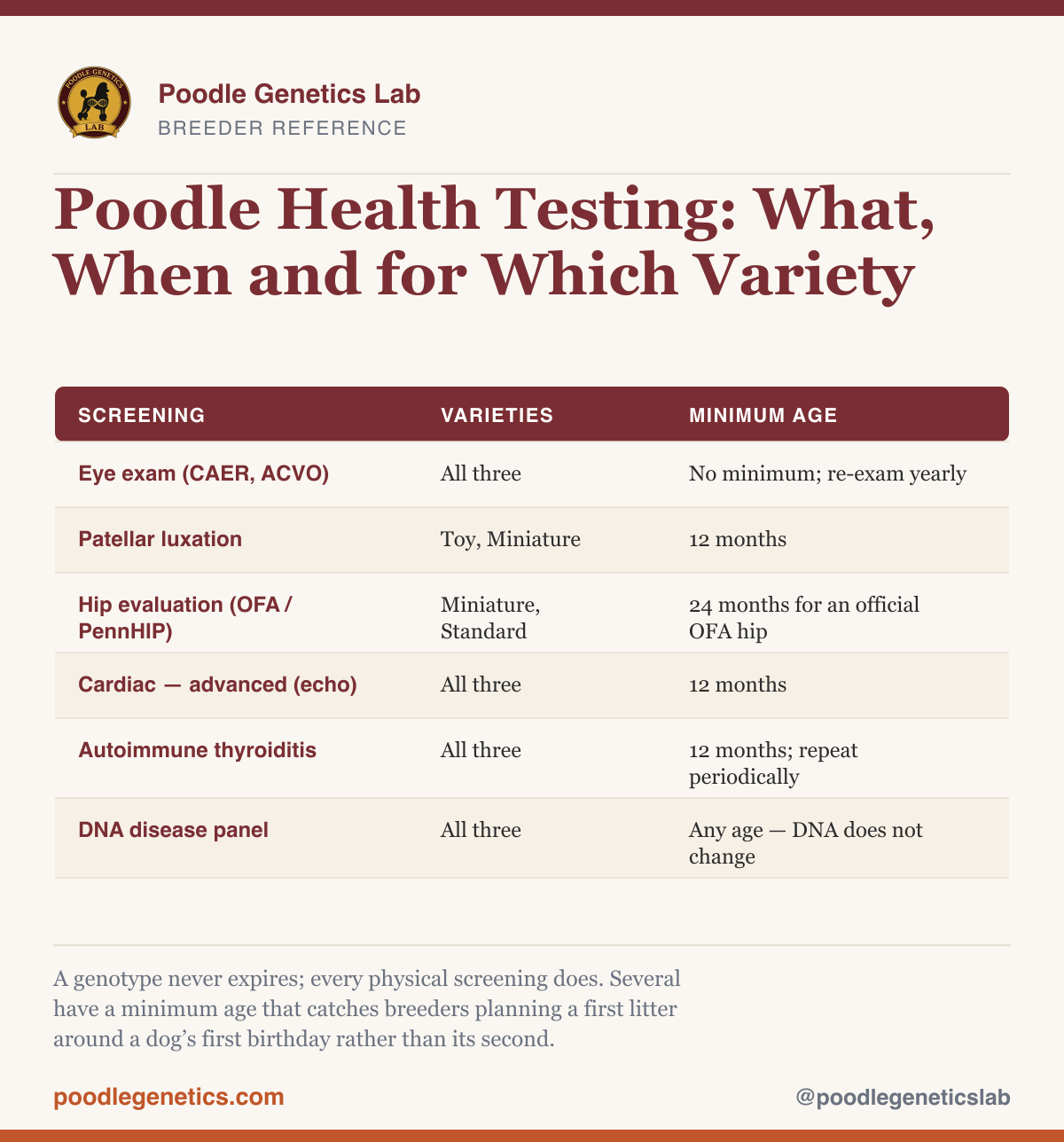
DNA does not change, so a genotype result never expires. Every physical screening below does, and several have a minimum age that catches new breeders planning a first litter around a dog's second birthday rather than its first.
| Screening | Required for | Minimum age | Valid for |
|---|---|---|---|
| Eye examination (CAER, by a board-certified ACVO ophthalmologist) | All three varieties | No OFA minimum; annual re-exam recommended | 12 months from exam date |
| Patellar luxation | Toy, Miniature | 12 months (younger exams are consultations only) | Permanent |
| Hip evaluation (OFA or PennHIP) | Miniature, Standard | No CHIC minimum; 24 months for an official OFA certification | Permanent once certified |
| Cardiac, basic (auscultation) | Standard (one of four electives) | 12 months | 12 months |
| Cardiac, advanced (echocardiography) | Standard (one of four electives) | 12 months | Permanent if congenital; 12 months if adult-onset |
| Autoimmune thyroiditis | Standard (one of four electives) | 12 months | Re-test periodically; OFA recommends ages 2, 3, 4, 6, and 8 |
| Sebaceous adenitis (skin biopsy) | Standard (one of four electives) | 12 months | Re-test every 1 to 2 years for breeding dogs |
Two details trip up new breeders specifically. First, CHIC does not itself impose a 24-month hip minimum, that figure belongs to an official OFA certification; a dog screened younger gets a preliminary evaluation, which is useful information but not a certification. Second, a hip evaluation can be booked well before a first litter is planned, while an official certified result cannot, so plan the appointment around the dog's second birthday, not around the breeding itself.
Step 3: Meet Your Variety's CHIC Bar
Once the panel is ordered and the screenings are booked, this is the minimum bar for a CHIC number, variety by variety:
- Toy: PRA-prcd DNA test, annual eye exam, patellar evaluation at 12 months.
- Miniature: the same three, plus a hip evaluation.
- Standard: hip evaluation, annual eye exam, and at least one of: autoimmune thyroiditis, sebaceous adenitis, basic cardiac, or advanced cardiac.
A CHIC number records that this testing was done and the results were made public. It is not a health guarantee, and it is not itself a breeding recommendation, it is a documentation standard, and clearing it is the floor for a new program, not the ceiling.
Step 4: Sequence It Across the Dog's First Two Years
Put the two steps above on an actual timeline rather than treating them as one undifferentiated pile:
- Any age, including as a puppy: the DNA panel. It never expires, so there's no reason to wait.
- At 12 months: patellar evaluation (Toy, Miniature), the first CAER eye exam (all varieties), and, for a Standard pursuing the elective route, whichever of thyroid, sebaceous adenitis, or cardiac screening you've chosen.
- At 24 months: an official OFA hip certification (Miniature, Standard). A preliminary evaluation can happen earlier if you want an early read, but it isn't a certification.
- Ongoing, for the life of the breeding dog: annual CAER re-exams, thyroid re-testing on OFA's recommended schedule (2, 3, 4, 6, 8 years), and sebaceous adenitis re-testing every one to two years if that's the elective you chose.
Step 5: Don't Stop the Checklist at Single-Gene Results
A panel full of clears and a folder of passed screenings still leaves one thing unmeasured: how related the specific pairing you're planning actually is. That's a population-level question a genotype line cannot answer, and it's worth having a coefficient of inbreeding figure in hand, calculated over real pedigree depth or from a genomic diversity panel, before a first litter rather than after. What COI actually measures, and what the Standard-Poodle-specific research does and doesn't show it predicts, is the fuller treatment of that sixth item.
What This Checklist Doesn't Do
It doesn't tell you what a "carrier" or an "at-risk" result actually licenses you to conclude once it comes back, that's reading a DNA health panel, line by line. It doesn't tell you which lab to order any of this from, that's the lab-by-lab coverage comparison. And it doesn't turn a stack of clean results into a pairing decision, a clean panel and a full set of passed screenings are inputs, not a verdict, and the breeding-decision framework is where genotype, phenotype, pedigree, population context, and overall merit actually get weighed against each other. Once you have two dogs' results in hand, the health calculator will run the arithmetic on whichever lines support it.
The Bottom Line
Test by variety, not by a generic list, order the DNA panel early since it never expires, book physical screenings against their real minimum ages rather than around the litter date, meet your variety's actual CHIC bar, and add a population-diversity figure to the file before you call the workup complete. That sequence is the floor a new program should clear before a first breeding, everything after it, reading what the results mean and deciding what to do about them, is a separate set of questions with their own guides.
This article is educational and is not veterinary advice. Testing requirements and screening protocols change; confirm current CHIC requirements directly against ofa.org and discuss your program's testing plan with your veterinarian before your first litter. How we source and label claims across the site is set out in our editorial standards. Download the Poodle Health Panel Worksheet for a printable summary.
Built on identified genes and validated tests. The claims here are supported by the peer-reviewed literature listed below.
- Published
- August 27, 2026
- Last reviewed
- September 5, 2026
References
- Tamura S, Tamura Y, Uchida K, et al. (2010). GM2 gangliosidosis variant 0 (Sandhoff-like disease) in a family of toy poodles. Journal of Veterinary Internal Medicine 24(5): 1013–1019. doi:10.1111/j.1939-1676.2010.0564.x
- Rahman MM, Chang HS, Mizukami K, et al. (2012). A frameshift mutation in the canine HEXB gene in toy poodles with GM2 gangliosidosis variant 0 (Sandhoff disease). The Veterinary Journal 194(3): 412–416. doi:10.1016/j.tvjl.2012.05.021
- Neff MW, Beck JS, Koeman JM, et al. (2012). Partial deletion of the sulfate transporter SLC13A1 is associated with an osteochondrodysplasia in the Miniature Poodle breed. PLoS ONE 7(12): e51917. doi:10.1371/journal.pone.0051917
- Chen X, Johnson GS, Schnabel RD, et al. (2008). A neonatal encephalopathy with seizures in standard poodle dogs with a missense mutation in the canine ortholog of ATF2. Neurogenetics 9(1): 41–49. doi:10.1007/s10048-007-0112-2
- Murgiano L, Niggel JK, Takahashi K, et al. (2025). Two genes, one culprit: a functional candidate validation of a SPATA7 deletion in dogs with day blindness/retinal degeneration. PLOS Genetics 21(12): e1011961. doi:10.1371/journal.pgen.1011961
- Zeng R, Coates JR, Johnson GC, et al. (2014). Breed distribution of SOD1 alleles previously associated with canine degenerative myelopathy. Journal of Veterinary Internal Medicine 28(2): 515–521. doi:10.1111/jvim.12317
- Awano T, Johnson GS, Wade CM, et al. (2009). Genome-wide association analysis reveals a SOD1 mutation in canine degenerative myelopathy that resembles amyotrophic lateral sclerosis. Proceedings of the National Academy of Sciences USA 106(8): 2794–2799. doi:10.1073/pnas.0812297106
- Brown EA, Dickinson PJ, Mansour T, et al. (2017). FGF4 retrogene on CFA12 is responsible for chondrodystrophy and intervertebral disc disease in dogs. Proceedings of the National Academy of Sciences USA 114(43): 11476–11481. doi:10.1073/pnas.1709082114
- Batcher K, Dickinson P, Giuffrida M, et al. (2019). Phenotypic effects of FGF4 retrogenes on intervertebral disc disease in dogs. Genes 10(6): 435. doi:10.3390/genes10060435
- Parker HG, VonHoldt BM, Quignon P, et al. (2009). An expressed Fgf4 retrogene is associated with breed-defining chondrodysplasia in domestic dogs. Science 325(5943): 995–998. doi:10.1126/science.1173275
- Fieten H, Gill Y, Martin AJ, et al. (2016). The Menkes and Wilson disease genes counteract in copper toxicosis in Labrador retrievers: a new canine model for copper-metabolism disorders. Disease Models & Mechanisms 9(1): 25–38. doi:10.1242/dmm.020263
- Pindar S, Ramirez C (2019). Predicting copper toxicosis: relationship between the ATP7A and ATP7B gene mutations and hepatic copper quantification in dogs. Human Genetics 138(5): 541–546. doi:10.1007/s00439-019-02010-y
- Kim C, Loftus JP, Huson HJ (2023). Low alanine aminotransferase activity gene variant in a Siberian Husky with copper-associated hepatopathy. BMC Veterinary Research 19(1): 111. doi:10.1186/s12917-023-03681-6
Free Tool
Apply This Knowledge
Put two parents’ DNA panel results through the calculator and see the odds, line by line.