A health panel answers a narrower question than most breeders think it does. It tells you which variants, from a fixed list, a particular dog carries. For a handful of lines that does settle whether the dog will become ill. For most of them it does not, and the formatting gives you no way to tell those two groups apart.
Two things sit in the gap between those sentences, and neither is printed on the report. The first is penetrance: how reliably a genotype produces the disease it is associated with. The second is evidence tier: how much work has been done in your breed to establish that the variant means anything here at all. A line can be perfectly accurate about the DNA and still tell you almost nothing about the dog.
Colour results are read by a different set of rules, and they have their own guide: the locus-by-locus colour panel walkthrough. This article is about the health half of the report.
The habit worth building is this. A health report is not one kind of line repeated twenty times. It is at least four different kinds of line wearing identical formatting.
| Line type | What it licenses you to conclude | Example |
|---|---|---|
| Clean recessive disease | Real carrier and affected status, and honest litter arithmetic | PRA-prcd, PRA-rcd4, NEwS, GM2, skeletal dwarfism, DB/RD |
| Risk factor whose strength is breed-dependent | A population probability in the breeds where the association is established. Within poodles it is not | CDDY |
| Non-disease trait | Nothing about this dog's health | ALT activity |
| Clinical-context marker | How a future veterinary test should be read, or a misdiagnosis avoided | ALT activity, macrothrombocytopenia |
Cutting across all four is the distinction our own health calculator is built on, stated in the source file itself:
Recording a test result and predicting a litter's risk are different acts, and this file keeps them apart.
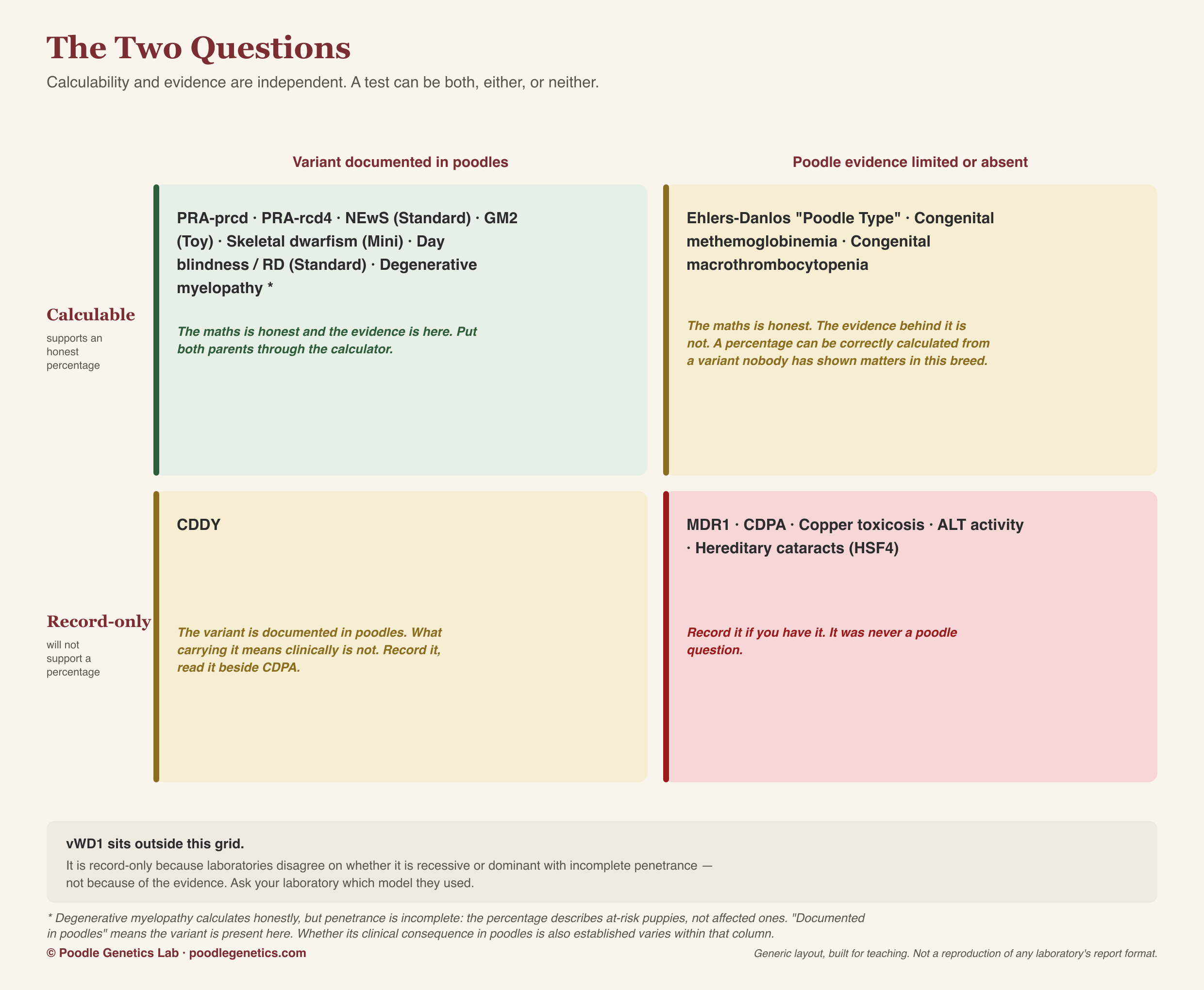
Some traits are calculable: clean, single-gene, unambiguously recessive, so two parent genotypes give an honest percentage. Others are record-only: real tests a breeder pays for and needs on file, whose inheritance will not support a percentage. Every line is one or the other, and the report will not tell you which.
One trap to disarm early, because it costs breeders real decisions: calculable does not mean trustworthy. It is a statement about the arithmetic, not about the evidence. Ehlers-Danlos, methemoglobinemia and macrothrombocytopenia are all clean recessives, so the maths is honest — while the poodle evidence behind them rests on extrapolation rather than confirmed poodle cases. A percentage can be correctly calculated from a variant nobody has shown matters in this breed. The two questions are independent, and you have to ask both.
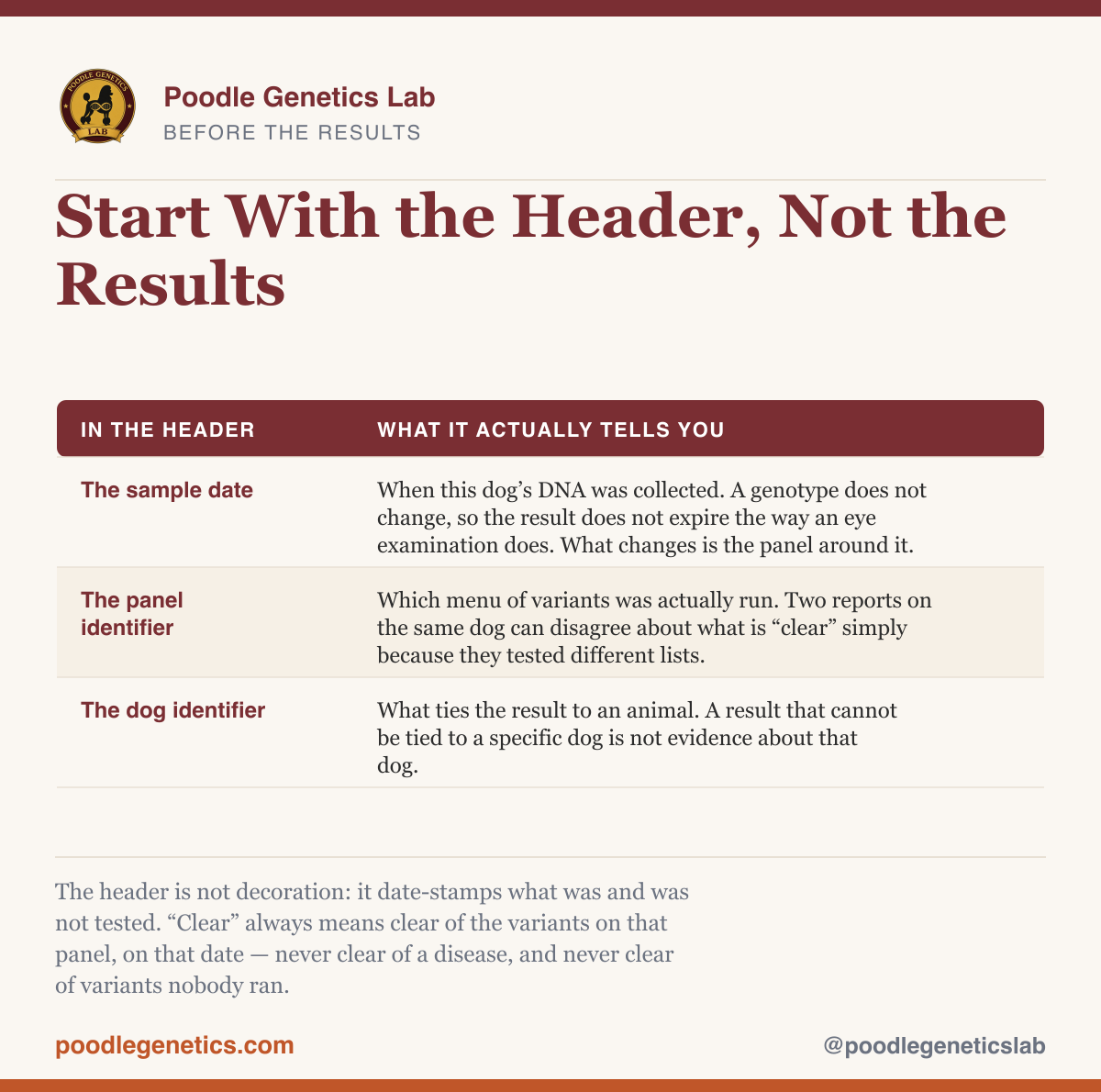
Start With the Header, Not the Results
The block at the top of the report is not decoration. It date-stamps what was and was not tested.
The sample date tells you when this dog's DNA was collected. A genotype does not change, so the result does not expire the way an eye examination does. What changes is the panel around it.
The panel identifier tells you which menu of variants was run. Two reports on the same dog, years apart, can disagree in content without either being wrong, because the second looked for things the first never tested. When you compare two dogs, you are comparing two menus as much as two dogs.
The dog identifier ties the result to an animal. A result that cannot be tied to a specific dog is not a result about any dog. If you are relying on a report you did not commission, ask your laboratory to confirm the sample behind it.
What a Genotype Line Is Actually Saying
Every result line carries three separate pieces of information, and breeders routinely collapse them into one.
- Which variant was tested. A named position in a named gene. Not the gene, and not the disease.
- How many copies this dog has. Zero, one, or two. This is the measurement. It is the part least likely to be wrong.
- The laboratory's interpretive label. Clear, carrier, at-risk, affected. This is not a measurement. It is a judgement about what the copy count means, and it is where reports diverge and breeders get misled.
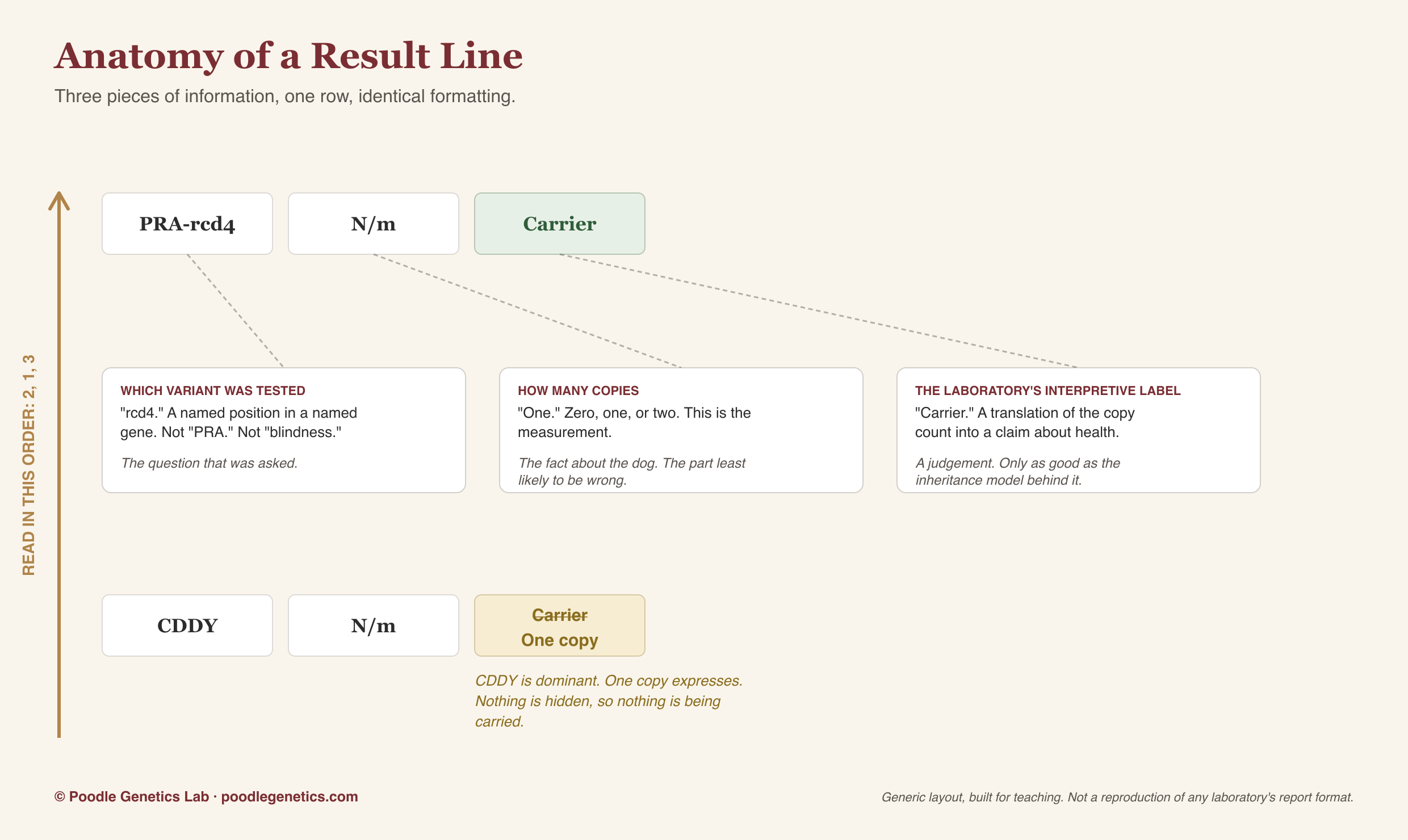
Points 2 and 3 are not the same information. The copy count is a fact about the dog. The label is a translation of that fact into a claim about health, and it is only as good as the inheritance model behind it. Read the copy count first, then decide whether the label deserves the weight you were about to give it.
The Notation Families, and How They Line Up
Laboratories express the same copy count in several ways. The mapping is straightforward.
| Copies | N-notation | Copy count | Word, clean recessive | Word when it is not a clean recessive |
|---|---|---|---|---|
| 0 | N/N | 0 copies | Clear, or Normal | Clear, meaning simply "no copies" |
| 1 | N/m | 1 copy | Carrier | "Carrier" is wrong here. Say "one copy". |
| 2 | m/m | 2 copies | Affected | "Two copies", or "At-risk" where penetrance is incomplete |
The left three columns are interchangeable. The right two are not, and the whole difficulty of reading a health panel lives in that last column.
The Four Places the Label Misleads
1. "Carrier" printed on a line that is not recessive. For a clean recessive, carrier is a precise word: the dog is healthy, the variant is hidden, and only the mate matters. Applied to a dominant variant it becomes actively false. A dog with one copy of CDDY is not carrying anything hidden; one copy expresses. Our health calculator overrides the default label to "One copy" and "Two copies" for CDDY, MDR1, CDPA, copper toxicosis, and ALT activity for exactly this reason. In the small varieties CDDY is a dominant result that is the norm, not a warning.
2. "Affected" where penetrance is incomplete. Degenerative myelopathy is the standing example. A dog with two copies of the SOD1 variant is reported at-risk, not affected, because incomplete penetrance means many such dogs never develop clinical signs. An at-risk result is not a diagnosis. Labels that flatten this into "affected" are promising a certainty the biology does not supply.
3. "Clear" read as clear of the disease. N/N means zero copies of one tested
variant. It does not mean the dog cannot develop the condition that variant is
named after. The HSF4 hereditary cataract line, where a panel carries it, makes the
point cleanly: cataracts do
occur in poodles, but this particular variant is not the reason, which is why the
annual eye examination matters more here than the DNA line does.
4. A label read without its mode of inheritance. The same word means different things two lines apart on the same page. "Clear" on a recessive line is meaningful news about what the dog can produce. "Clear" on a variant with no poodle validation is news about nothing.
Modes of Inheritance, as They Appear on Reports
Autosomal recessive. Two copies to be affected, one copy to carry silently. This is the mode with the best-worked poodle exemplars, and they are the reason health panels are worth buying: PRA-prcd, PRA-rcd4, neonatal encephalopathy with seizures in the Standard, GM2 gangliosidosis in the Toy, skeletal dwarfism in the Miniature, day blindness with retinal degeneration in the Standard. The Poodle Club of America has reported that roughly one in ten Miniatures carries the skeletal dwarfism variant. Details of each are on our health testing reference. These lines are calculable: you can put two parents' results through the health calculator and read how those odds are calculated.
Dominant. One copy expresses. Carrier is not an available concept.
Incomplete or codominant. One copy does something, two copies do more. Copper toxicosis via ATP7B and ALT activity both behave this way.
X-linked. Effect depends on sex, because males have one X chromosome and females two. The attenuating copper variant ATP7A is X-linked.
Recessive with incomplete penetrance. Two copies raise risk without guaranteeing disease. Degenerative myelopathy sits here.
The honest note to attach to that list: autosomal recessive is the mode poodle panels are really built on, and the only one where a result arrives with an established poodle disease association behind it. CDDY is the case worth naming precisely, because it is documented in this breed without that documentation amounting to a disease association. The variant itself is documented in this breed. What is not established here is what carrying it means clinically, which is why it sits in the risk-factor row of the table above rather than the disease row. The remaining modes appear on poodle reports because the variants exist in dogs, not because they were characterised in poodles. That distinction is the subject of the next section.
Six Things a Result Does Not Tell You
1. Anything about untested variants. A panel screens a menu. A clear panel describes the menu, not the dog. The report is silent, not reassuring, about every variant it did not look for.
2. Anything about other variants in a gene it did test. A gene can carry many disease-causing changes; a test looks for specific ones. PRA is the model case every breeder actually holds: zero copies of the tested prcd variant says nothing about rcd4, or about any other inherited retinal disease. Zero copies of the tested HSF4 variant is likewise not a statement about cataract risk in general.
3. Anything with no validated test. The dog mapping literature draws a clean line in principle: single-gene traits map to single loci and yield direct tests (Karlsson et al., 2007), while complex disease and morphology map across many loci of small effect (Hayward et al., 2016).
Where individual poodle conditions fall on that line is a separate question, and for several of the ones breeders care most about the honest answer is that nobody has settled it. Sebaceous adenitis, Addison's disease, bloat and gastric torsion, and idiopathic epilepsy have no validated DNA test — which is not the same as saying all four are polygenic. Some are described as having a genetic predisposition whose mode is not established. What they share is that no panel line exists for them, so their absence from your report tells you nothing about your dog. See our health testing reference for what each of them actually requires instead.
4. Whether an at-risk dog will become an ill dog. See penetrance, above.
5. Whether the test is direct or linkage-based. A direct test detects the disease-causing variant itself. A linkage test detects a nearby marker that travels with it, and a marker can separate from the variant it was standing in for. The two are read with different confidence. Which one you are holding is a question for your laboratory, and it is worth asking before a result changes a pairing.
6. Whether the variant was ever validated in your breed. This is the large one. The principle, as we have put it elsewhere: a test offered for your breed is not evidence that the variant has been validated in your breed. A commercial panel reports a variant in any dog that carries it, because the test detects DNA and DNA does not care what breed it is in.
Two of the newer lines on poodle reports show what that means in practice. Copper toxicosis was characterised in the Labrador Retriever, where the accumulating and attenuating genes were shown to counteract each other (Fieten et al., 2016), with hepatic copper quantification later used to test the genotype's predictive value (Pindar and Ramirez, 2019). The low-ALT activity variant reached the clinical literature through a single Siberian Husky (Kim et al., 2023). Both are real findings. Neither is a poodle finding. We have written separately on a variant characterised in a breed that is not yours.
Relevance Beats Breadth
A longer panel is not automatically a better one. What determines the value of a line is whether the variant is present in your breed at a frequency that matters, and whether anyone has demonstrated what it does there.
That question has three answers, not two, and the report prints none of them. Our health testing reference sorts every extended-panel test into one of three tiers:
| Tier | What it means | Examples |
|---|---|---|
| Documented in poodles | The variant is genuinely present in the breed, with published evidence behind it. What a positive means still varies by variety and condition | CDDY, day blindness (SPATA7) |
| On poodle panels, evidence limited | Sold for poodles, but the poodle-specific case rests on allele frequency or extrapolation rather than confirmed poodle cases | Ehlers-Danlos, methemoglobinemia, macrothrombocytopenia |
| Not validated in poodles | No published poodle frequency, no confirmed poodle case. Often present only because the panel tests every dog for everything it offers | MDR1, CDPA, copper toxicosis, ALT activity, hereditary cataracts |
Note what the top tier does not guarantee. "Documented in poodles" means the variant is here. Whether its clinical consequence in poodles is also established varies within the tier: for day blindness it is, and affected Standards lose sight in bright light from puppyhood. For CDDY it is not.
CDDY is the clearest worked case of the scope problem. Across dog breeds generally, the CFA12 FGF4 retrogene is associated with chondrodystrophy and intervertebral disc disease, with a dose effect (Brown et al., 2017; Batcher et al., 2019), and the separate CFA18 retrogene behind the classic short-legged outline is breed-defining in dogs like the dachshund (Parker et al., 2009). Within the poodle, the picture is different: one copy is not established to raise IVDD risk within the breed, and in most cases two copies are not either. The across-breeds finding and the within-breed conclusion are two different claims, and the report gives you only the first.
At the other end sit variants with no poodle standing at all. MDR1 is a herding breed variant; no poodle appears in the published breed frequency studies. Our calculator's source file puts the consequence plainly: a profile is not less complete for lacking an MDR1 result that means nothing in this breed. A blank line is not a gap when the line was never a poodle question.
Which tests your variety actually needs is set out on the health testing reference. Choosing between the labs worth using, and where a test tells you little is a separate question, and worth settling before you buy.
One last point on notation, borrowed from the colour side because it applies here too: numbers beat words. Where a test reports a measured value rather than a category, the value is the result. On merle, a positive with no base-pair length is not a usable result. And because the labs do not agree on notation, two reports using the same letters are not necessarily saying the same thing.
A Worked Example, Line by Line
⚠️ FICTIONAL SAMPLE — NOT A REAL DOG, NOT A REAL REPORT
This is a composite teaching example built by Poodle Genetics Lab. The dog does not exist. The layout is generic and is not a reproduction of any laboratory's report format. Every test named is real and every mode of inheritance is as documented on our health testing reference; the results were chosen to teach, not observed.
Dog: "Juniper" · Standard Poodle · female · 26 months · panel run 2026
| Line | Result | What it licenses |
|---|---|---|
| PRA-prcd | Clear | Zero copies. Cannot produce an affected puppy from her side. |
| PRA-rcd4 | Carrier | One copy, healthy dog. Her mate's status now matters. |
| NEwS | Clear | Zero copies of a Standard Poodle disease. Genuinely good news. |
| DM (SOD1) | At-risk, 2 copies | Raised risk, not a diagnosis. |
| vWD1 | One copy (reported as "Carrier") | Meaning depends on the laboratory. See below. |
| CDDY | 1 copy | A dominant result, not a carrier state. |
| CDPA | Clear | Expected in a poodle. Read alongside CDDY. |
| Copper, ATP7B | Clear | A Labrador and Doberman variant. |
| Copper, ATP7A | 1 copy, favourable, X-linked | Attenuating, and only relevant with ATP7B. |
| ALT activity | 1 copy, lower baseline | Not a disease. Clinical context. |
| MDR1 | Clear | Never a poodle question. |
| EDS (TNXB) | Clear / Clear | Both variants must be read, not one. Evidence limited in poodles: no confirmed poodle case is published, so a clear here settles little. |
Five of those lines deserve more than a table cell.
PRA-rcd4 carrier is the easiest result on the page to manage. She is healthy and will stay healthy for this variant. Bred to a clear mate, no puppy is affected. The arithmetic is real, and the health calculator will do it for you.
DM at-risk with two copies is the line most likely to be misread as a verdict. It is not one. Incomplete penetrance means many at-risk dogs never develop signs, and there is no way to tell from the report which dog this is. What the result changes is what her veterinarian should watch for and when, which makes this a conversation with your veterinarian rather than a decision made from a page.
The vWD1 line is the one nobody can resolve for you. Some laboratories describe vWD1 as autosomal recessive; others as autosomal dominant with incomplete penetrance. Those two models give different answers for the same dog and the same mate. This is precisely why our health calculator refuses to print a vWD1 percentage: a calculator cannot respect a disagreement it does not know exists, and a confident number here would be false precision. Ask your laboratory how they interpret a carrier result before acting on it.
CDDY, one copy is a dominant result. She is not a carrier and there is nothing hidden. One copy is not established to raise IVDD risk within the breed, and in most cases two copies are not either. Read it beside her clear CDPA rather than alone, and treat it as one input among structure, temperament, and diversity.
ATP7A one copy with ALT one copy is a pair worth naming, then setting down. The ATP7A result is attenuating, which is favourable, and it only matters in a dog that also carries ATP7B, which she does not. The ALT result is not a disease; it means her baseline liver enzyme sits naturally low, which is context her veterinarian should have on file before any future bloodwork is read.
Read as a whole: a well-tested Standard with two clean clears that matter, one carrier status that is easy to manage, one at-risk result needing veterinary context rather than a decision, one result her laboratory must interpret before anyone acts, and five lines that were never poodle questions in the first place.
What Is Not on the Page
The absence of a line is itself information, and it is the information breeders most often forget to look for.
No DNA panel reports hips, eye examination findings, thyroid status, sebaceous adenitis, Addison's disease, epilepsy, or bloat risk. Some have no DNA test because the genetics are complex rather than single-gene. Others are assessed by examination, radiograph, biopsy, or bloodwork, on a schedule, by a veterinarian, and the result can change over a dog's life in a way a genotype never does.
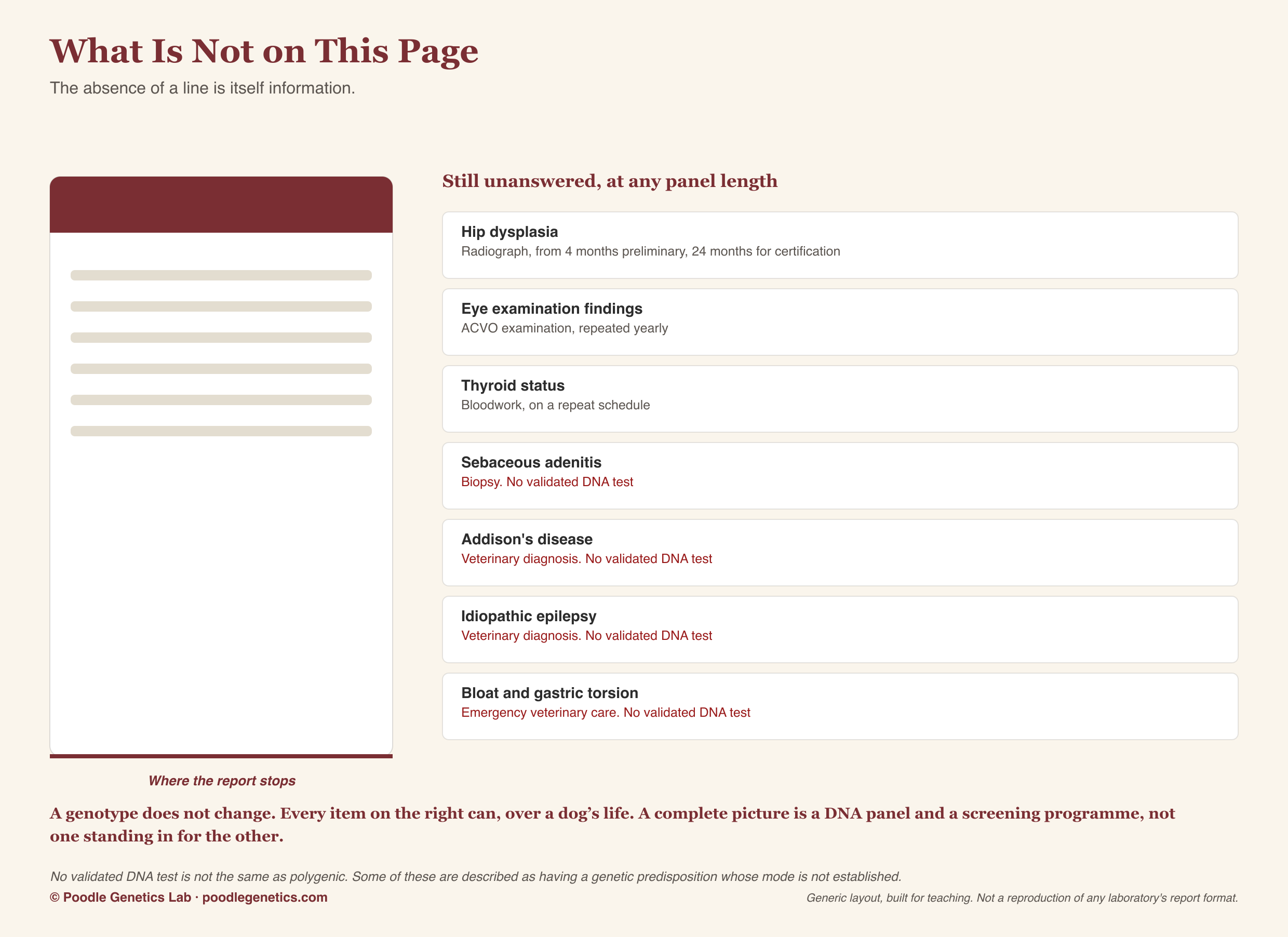
A complete health picture is a DNA panel and a screening programme, not one standing in for the other. The health testing reference sets out which screenings apply to which variety, at what age, and how long each stays valid.
Glossary
| On the report | In plain English |
|---|---|
Clear, Normal, N/N | Zero copies of the tested variant. Says nothing about untested variants. |
Carrier, N/m | One copy. Meaningful only where the variant is recessive. |
Affected, m/m | Two copies of a recessive variant, expected to produce the condition. |
| At-risk | Two copies, but penetrance is incomplete. Not a diagnosis. |
| One copy / Two copies | Copy count with no health claim attached. Used where "carrier" would mislead. |
| Penetrance | How reliably a genotype produces the associated condition. |
| Mode of inheritance | The rule that converts a copy count into a meaning. |
| Direct test | Detects the disease-causing variant itself. |
| Linkage test | Detects a nearby marker travelling with the variant. Can separate from it. |
| Validated in breed | Someone has demonstrated what this variant does in your breed. |
The Bottom Line
Read the copy count before the label. Read the mode of inheritance before you trust the label. Ask which breed the variant was established in before you let the line change a pairing. And keep the two acts separate: recording a result is something you can do from the page, while predicting a litter is something only some of these lines will honestly support.
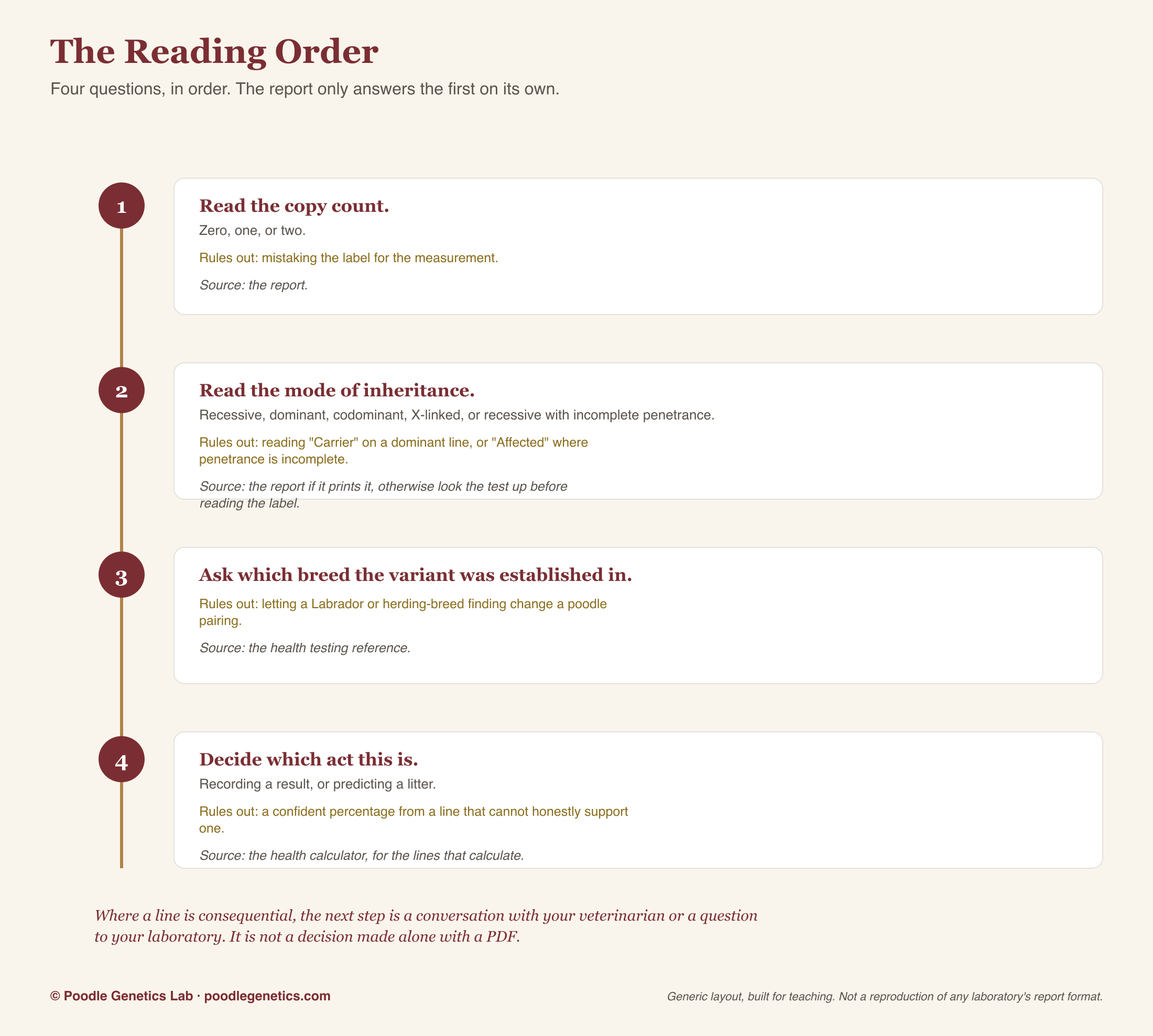
Where a line is consequential, the next step is a conversation with your veterinarian or a question to your laboratory, not a decision made alone with a PDF.
This article is educational and is not veterinary advice. It has been through our scientific review. Several poodle-specific disease facts in it are drawn from our own health testing reference rather than from a cited paper, which is why it is labelled supported but incomplete rather than established. How we source and label claims is set out in our editorial standards.
Download the Poodle Health Panel Worksheet for a printable summary.
Credible evidence supports what is described here, but the mechanism, the population studied, or its application to Poodles still has limits. The literature below is real and cited in full; where it stops short, the article says so rather than rounding up.
- Published
- August 6, 2026
- Last reviewed
- September 8, 2026
References
- Brown EA, Dickinson PJ, Mansour T, et al. (2017). FGF4 retrogene on CFA12 is responsible for chondrodystrophy and intervertebral disc disease in dogs. Proceedings of the National Academy of Sciences USA 114(43): 11476–11481. doi:10.1073/pnas.1709082114
- Batcher K, Dickinson P, Giuffrida M, et al. (2019). Phenotypic effects of FGF4 retrogenes on intervertebral disc disease in dogs. Genes 10(6): 435. doi:10.3390/genes10060435
- Parker HG, VonHoldt BM, Quignon P, et al. (2009). An expressed Fgf4 retrogene is associated with breed-defining chondrodysplasia in domestic dogs. Science 325(5943): 995–998. doi:10.1126/science.1173275
- Fieten H, Gill Y, Martin AJ, et al. (2016). The Menkes and Wilson disease genes counteract in copper toxicosis in Labrador retrievers: a new canine model for copper-metabolism disorders. Disease Models & Mechanisms 9(1): 25–38. doi:10.1242/dmm.020263
- Pindar S, Ramirez C (2019). Predicting copper toxicosis: relationship between the ATP7A and ATP7B gene mutations and hepatic copper quantification in dogs. Human Genetics 138(5): 541–546. doi:10.1007/s00439-019-02010-y
- Kim C, Loftus JP, Huson HJ (2023). Low alanine aminotransferase activity gene variant in a Siberian Husky with copper-associated hepatopathy. BMC Veterinary Research 19(1): 111. doi:10.1186/s12917-023-03681-6
- Hayward JJ, Castelhano MG, Oliveira KC, et al. (2016). Complex disease and phenotype mapping in the domestic dog. Nature Communications 7: 10460. doi:10.1038/ncomms10460
- Karlsson EK, Baranowska I, Wade CM, et al. (2007). Efficient mapping of mendelian traits in dogs through genome-wide association. Nature Genetics 39(11):1321–1328. doi:10.1038/ng.2007.10
Free Tool
Apply This Knowledge
Put two parents’ DNA panel results through the calculator and see the odds, line by line.