What Makes a Parti Poodle?
A parti poodle has a coat with at least 50% white, with random patches of another color (black, brown, red, apricot, or any other poodle color). The white patches have no specific anatomical location, unlike phantom tan points, parti white can appear anywhere. The color patches are irregular in shape and highly variable between individual dogs.
This pattern is governed by the S locus, the piebald or white-spotting locus, which controls whether melanocytes successfully migrate throughout the skin during embryonic development.
The S Locus: MITF and Melanocyte Migration
The S locus gene is MITF (Microphthalmia-Associated Transcription Factor), located on canine chromosome 20. MITF is a master regulator of melanocyte development, it controls differentiation, migration, and survival of melanocytes.
During embryonic development, melanocytes originate from the neural crest and must migrate outward across the entire body to populate the skin and hair follicles. Where MITF signaling is disrupted, melanocytes fail to migrate to certain regions, and those areas lack pigment-producing cells, resulting in white fur.
The S locus alleles in dogs:
- S (dominant solid): Normal MITF function. Melanocytes migrate successfully throughout the body. Dog has a solid-colored coat.
- sp (piebald): Reduced MITF function in a heterozygous or homozygous state. Melanocyte migration is disrupted, leaving areas without pigment.
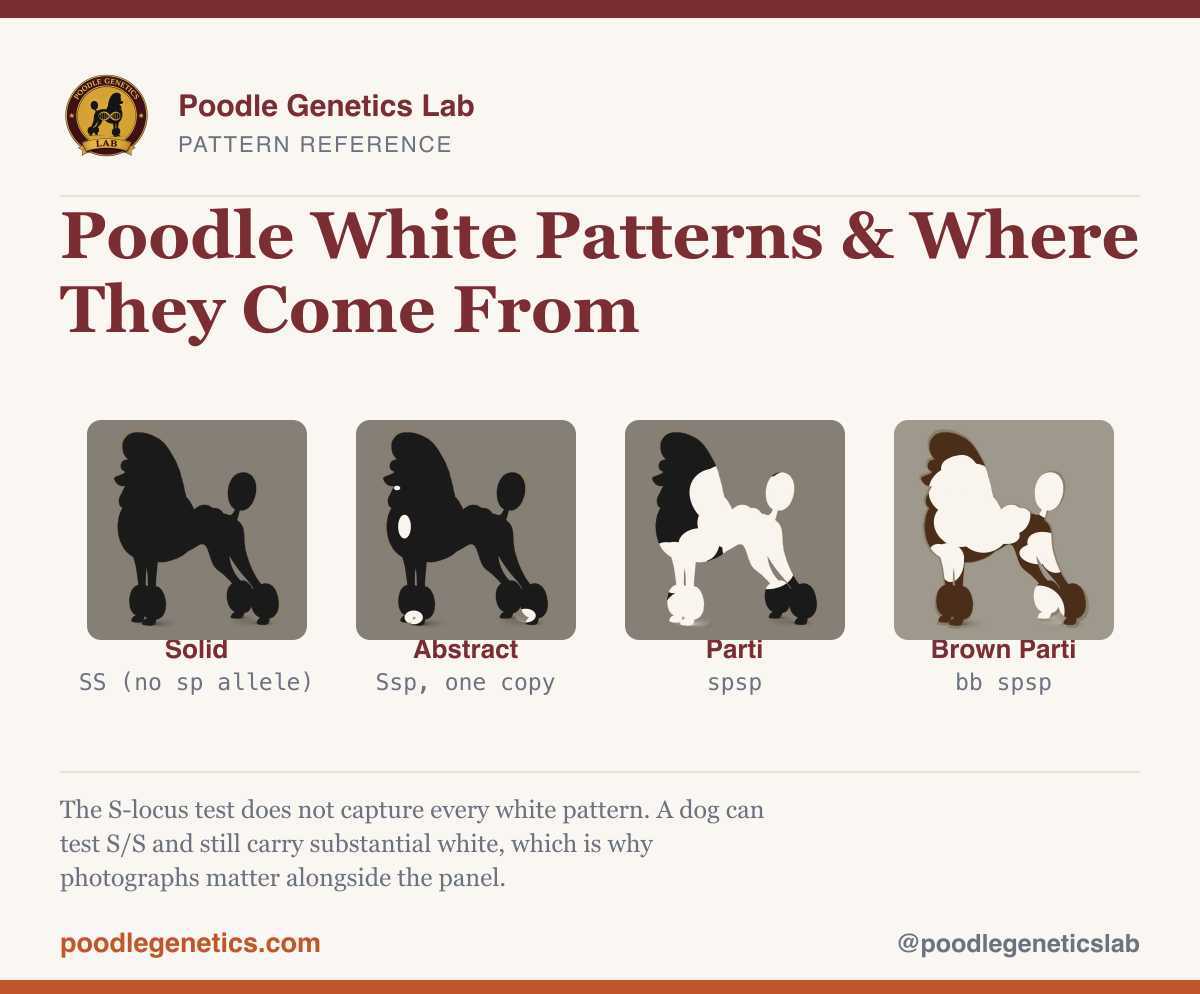
Dogs with two copies of S (SS) are solid-colored. Dogs with one copy of each (Ssp) are typically solid-colored or may have minor white patches (flash markings), they are carriers. Dogs with two copies of sp (spsp) are parti-colored.
The Three S Locus Genotypes
SS, Solid, Non-Carrier
A SS dog has full MITF function at both chromosomes. Melanocytes migrate completely throughout the body. The dog is solid-colored, and it cannot pass an sp allele to offspring. Breeding two SS dogs cannot produce parti puppies.
Ssp, Solid with Parti Gene (Carrier)
A Ssp dog has one functional and one reduced-function MITF copy. Most carriers are phenotypically solid-colored, but some show small areas of white, particularly at the chest (a "flash" or "mismark"), on the toes, or a small white blaze or chin spot. These minor white markings are sometimes called "abstract" markings.
The presence of any white flash on an otherwise solid-colored poodle strongly suggests Ssp carrier status, though this is not perfectly reliable, some SS dogs have minor white from other causes, and some Ssp carriers have no visible white at all.
Carriers are important in breeding because an Ssp × Ssp cross produces:
- 25% SS (solid non-carrier)
- 50% Ssp (solid carrier)
- 25% spsp (parti)
spsp, Parti
A spsp dog has two reduced-function MITF copies — reduced, not null, which is why the pattern varies so much rather than producing an all-white dog. Melanocyte migration is significantly disrupted. The result is a coat with extensive areas of white where no melanocytes arrived during development, interspersed with patches where melanocytes did establish successfully.
The patches retain full pigmentation from whatever other loci the dog carries, a parti dog's colored patches can be black, brown, red, apricot, blue, or any other poodle color.
Why Do Parti Patterns Vary So Much?
Two dogs that are both spsp can look completely different: one might be 80% white with a few small color patches; another might be 50% color and 50% white with large, distinct patches. This variation is not explained by the S locus alone.
The extent and pattern of white spotting is influenced by modifier genes, a poorly-characterized set of polygenic factors that modulate MITF expression, melanocyte migration efficiency, and the ultimate distribution of pigment in spsp dogs. These modifiers are inherited separately from the sp allele and can produce a wide range of phenotypic expression from the same S locus genotype.
This means:
- Breeding spsp × spsp does not guarantee consistent patterning in offspring
- The modifier landscape of a breeding line affects how "patchy" or "evenly distributed" the white will be
- Selective breeding for specific parti patterns (symmetrical, heavily patched, etc.) is possible but requires evaluating modifiers across multiple generations
Additionally, ticking (the R locus — a few older reports still call it the T/ticking locus) adds small colored flecks in white areas and is inherited independently. A parti poodle with ticking will show colored spots within its white areas, a distinct look sometimes called "abstract ticking" or "flecked."
Parti Genetics and Breeding
Producing Parti Puppies Reliably
The most reliable approach is spsp × spsp (parti × parti). Every puppy from this cross will be parti. The pattern and extent of white will vary due to modifiers, but all will be at least 50% white.
If one parent is spsp and the other is Ssp (carrier):
- 50% of puppies will be spsp (parti)
- 50% will be Ssp (solid carrier)
If both parents are Ssp carriers:
- 25% spsp (parti)
- 50% Ssp (carrier solid)
- 25% SS (solid non-carrier)
The Carrier Identification Problem
As with the B locus, solid-coloured poodles can carry the sp allele with little or no visible sign — though a white flash on the chest or toes is a strong hint, and worth looking for. A black poodle with a small white chest flash may be Ssp, but a black poodle without any white marks might also be Ssp, or might be SS. DNA testing is the only certain way to determine carrier status.
This matters significantly for:
- Solid poodle breeders who want to avoid accidental parti production
- Parti breeders who need to identify solid-colored offspring as SS or Ssp for future breeding planning
- Breeders evaluating new stock of unknown pedigree
DNA testing for the S locus is available through Embark and other major testing laboratories.
The "Abstract" Pattern: Ssp Presentation
The term abstract in poodle breeder usage typically refers to dogs that are Ssp, solid-colored with minor white markings. An abstract poodle might have:
- A white chest splash ("flash")
- White toes or feet
- A white chin or lower jaw
- A small white blaze on the face
- A white tail tip
These dogs are often sold as "solids with mismarks" or "abstract" poodles. Because the AKC poodle standard calls for solid colour in conformation, visible white markings — like full parti — mean a dog is not competitive in the breed ring. That is not the same as being placed in some other class: there is no AKC "parti variety class" to drop into, since AKC poodle varieties are by size, not colour (see the show-ring section below). For breeding purposes, knowing that an abstract dog is Ssp is important for predicting litter outcomes.
Parti Poodles, Registration, and the Show Ring
Parti has a long and contested history with the AKC, and it is worth stating the current position precisely, because it is routinely misreported in both directions.
Parti poodles are registrable. A parti with two registered parents can be registered, the same as any other poodle.
Parti is not a standard colour. The AKC poodle standard calls for solid colour in conformation, so a parti is not competitive in the breed ring (which colours and patterns are eligible). That is a statement about the standard, not about papers — and "not a standard colour" is not the same claim as "cannot be registered". A buyer told a parti "can't be papered" is being told something false.
There is no AKC "parti variety class". Poodle varieties are by size — Toy, Miniature, Standard. Colour does not create a variety. Parti poodles compete in obedience, rally, agility and other performance and companion events like any registered poodle.
The old genetic objection — that sp can hide in solid lines for generations and surface unexpectedly — had some merit before testing existed. It has much less now: the S locus has a validated test, and any programme that wants to know its sp status can simply find out.
Two terms worth keeping straight, both breeder vocabulary rather than AKC categories:
- Parti: at least 50% white, with patches of one other colour.
- Abstract (or "mismark"): a solid base with limited white, typically the single-copy presentation.
Color Interactions With Parti
Parti combines with all other poodle colors. The colored patches on a parti dog express whatever color the dog would otherwise be:
- Black parti: White base with black patches
- Brown parti: White base with brown patches
- Red parti: White base with red patches
- Apricot parti: White base with apricot patches
- Phantom parti (sometimes called "parti phantom" or "abstract phantom"): The colored areas express the phantom/tan-point pattern, very complex and requires appropriate genotypes at A, K, S, E, and other loci simultaneously
- Merle parti: Merle pattern in the colored areas, requires M allele and appropriate care regarding double merle risk (see the merle article for full details)
The parti white areas are simply un-pigmented, they are not caused by bleaching or a separate pigment. They represent areas where no melanocytes successfully established during development.
Ticking in Parti Poodles
The R locus (USH2A) is a separate locus that causes small colored spots to appear in white areas. Ticking is dominant, a single R allele is sufficient to produce ticking. One caution on the genetics: the sequenced USH2A variant behind the lab test was identified for roan (Kawakami et al. 2021, multi-breed cohort), and ticking's own causal variant has not yet been confirmed to be the same one, so an R result is a validated call for roan and a provisional one for ticking. Neither has been validated in Poodles specifically. In parti poodles with the R allele, the white areas are not clean white but instead show small colored flecks or spots.
Ticking appears as the dog matures, puppies are typically born with clean white areas that later develop ticking as the coat grows. The density of ticking varies by R locus genotype and modifiers.
Some parti poodle breeders actively avoid ticking for cleaner white areas; others embrace the look. If avoiding ticking matters, DNA testing for R locus status and selecting against it in breeding stock is the approach.
Summary
| S Genotype | Phenotype | Carrier? | Can Produce spsp? |
|---|---|---|---|
| SS | Solid colored | No | No |
| Ssp | Solid (sometimes with small white marks) | Yes | Yes (25% with another Ssp, 50% with spsp) |
| spsp | Parti, 50%+ white | n/a | Yes (100% with spsp, 50% with Ssp) |
Parti poodle genetics are predictable at the genotype level, but "recessive" is the wrong word for what MITF does. Expression is dosage-dependent: one copy commonly shows as a white flash on the chest, toes or chin, and two copies produce full parti. Calling a single-copy dog a silent "carrier" understates what one copy does — often the dog is telling you, quietly. The challenge is in the phenotypic variability of the pattern itself, which is governed by modifier genes that remain only partially characterized.
For breeders: DNA testing eliminates guesswork about sp allele carrier status and makes parti program planning straightforward. For enthusiasts: the parti pattern is one of the most visually striking in the breed, and understanding its genetics makes the science of its inheritance clear.
Download the Parti Litter Planner for a printable summary.
This article summarises material developed at length in Chapter 6 of Poodle Color Genetics: The Science Behind Poodle Coat Colors (Volume I of the Poodle Genetics series). It is educational and is not veterinary advice. Discuss breeding and clinical decisions with your veterinarian.
Built on identified genes and validated tests. The claims here are supported by the peer-reviewed literature listed below.
- Published
- December 28, 2024
- Last reviewed
- September 5, 2026
References
- Karlsson EK, Baranowska I, Wade CM, et al. (2007). Efficient mapping of mendelian traits in dogs through genome-wide association. Nature Genetics 39(11):1321–1328. doi:10.1038/ng.2007.10
- Baranowska Körberg I, Sundström E, Meadows JRS, et al. (2014). A simple repeat polymorphism in the MITF-M promoter is a key regulator of white spotting in dogs. PLoS ONE 9(8):e104363. doi:10.1371/journal.pone.0104363
Free Tool
Apply This Knowledge
Model any parent pair with our interactive genetics calculator.


