The Puzzle of the Black Puppy That Turns Silver
Few things confuse new poodle breeders more than the silver poodle phenomenon: a puppy born apparently jet-black who, by twelve to eighteen months, has transformed into a gleaming silver dog. Or a "black" poodle that starts showing blue-grey tones in adolescence. Or a brown who slowly fades toward a warm café-au-lait.
These changes are not random. They are not fading from sun damage or age. They are the predictable, genetically-determined result of the G locus, a single dominant factor that reduces the eumelanin laid into each new coat over time. It is not dilution, which is a separate locus and a different dog.
The G Locus: What It Is and What It Does
The gene responsible for progressive greying in poodles has not been definitively identified, and there is currently no validated DNA test for it. (It should not be confused with the merle gene, PMEL, which is a separate factor.) What is well established is the effect: a progressive reduction in the amount of eumelanin deposited into newly grown hair over time. Dogs carrying the greying factor are born with apparently full-colour coats but grey continuously as old hair is shed and new hair grows in with decreasing pigment density. Because there is no test, greying status is judged from the dog and its pedigree, not a lab report.
The two alleles are:
- G (dominant): Progressive greying. One copy is sufficient to cause greying.
- g (recessive): No progressive greying. The dog's coat color will remain stable throughout life (barring other factors like sun bleaching).
Which Colors Are Affected by the G Locus?
The G locus only affects eumelanin, the dark pigment. It has no effect on phaeomelanin (red, apricot, cream). Therefore:
Colors affected by G:
- Black → Blue (one copy) or Silver (two copies)
- Brown → Café-au-Lait (one copy) or Silver Beige (two copies)
Dilution is not involved in any of those. A dog that is born pale because it is dd has taken the other road entirely, and arrives at a different colour with a different name.
Colors not affected by G:
- Red
- Apricot
- Cream
An apricot poodle carrying G will not grey in the same way, their phaeomelanin-based coat is not subject to this locus. However, apricot poodles can fade for other reasons (intensity modifiers, sun exposure), which is a separate mechanism.
The Classic G Locus Colors in Poodles
Silver Poodles
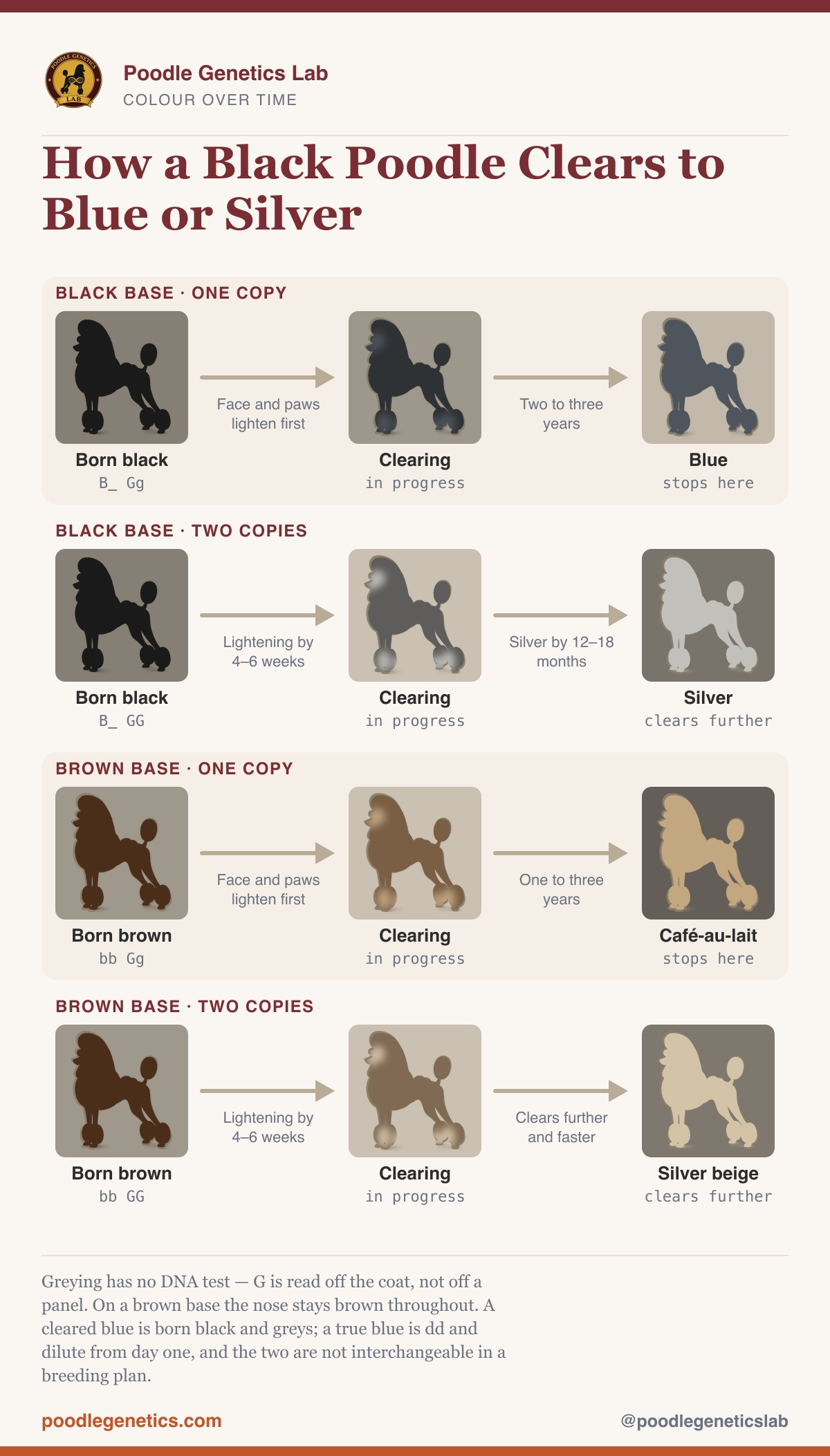
Silver is the most common G locus expression in poodles. A silver poodle is black at birth (or nearly so) and begins showing lighter coloring around the face and paws first, typically by 6–8 weeks. The face and paws clear first because the hair cycles faster in those areas. By 12–18 months, most silver poodles have transitioned to their characteristic light silver coat.
Genetically, a silver poodle is eumelanin-capable (E_), black-based (B_), and GG. The same two copies on a brown base give silver beige instead.
The silver color in a fully-cleared adult can be remarkably pale, almost white in some dogs, or a deeper pewter grey. This range is influenced by modifier genes and the rate of clearing.
Blue Poodles
Blue poodles represent a slower and less complete clearing pattern. While a silver poodle clears to quite light silver by adulthood, a blue poodle holds a darker, slate-blue-grey through most of its life.
The distinction is not cultural and it is not vague. It is dosage. One copy of the greying factor (Gg) clears to blue; two copies (GG) clear further and faster, and land at silver. A GG dog may show lightening on the face by six to eight weeks and be silver by twelve to eighteen months; a Gg dog takes two to three years and stops at blue.
Silver Beige Poodles
Silver beige is greying on a brown (bb) base at two copies — the brown counterpart of silver. A silver beige poodle is born brown and clears to a warm beige with slight silver undertones, face and paws first.
Silver beige requires bb and GG. It does not require dilution.
Café-au-Lait
Café-au-lait is the same road as silver beige, stopped one step earlier. It is greying on a brown base at one copy (bb with Gg): the dog is born dark brown and clears over one to three years. The nose stays brown throughout.
Put plainly, café-au-lait stands to silver beige exactly as blue stands to silver. It is the same mechanism at a lower dose, on brown instead of black.
Fading vs. Clearing vs. Greying: Terminology
These three words are used interchangeably in breeder communities but have distinct meanings in genetics:
Fading (general term): Any lightening of coat color over time, from any cause. Can include G locus greying, sun bleaching, nutritional factors, or intensity modifier effects in phaeomelanin-based coats.
Clearing (G locus term): The progressive G locus greying process, specifically as it applies to the transition from a dark puppy coat to a lighter adult coat. Silver poodles "clear" to silver.
Greying (G locus term): The ongoing process of eumelanin reduction in new hair growth. A dog that is "greying" due to the G locus is different from a dog that is grey due to age, though old dogs can grey for both reasons simultaneously.
Predicting Adult Color in G Locus Dogs
The Face/Paws Test
The most reliable early indicator that a puppy carries the G allele is lightening around the face and paws by 6–8 weeks of age. These areas have faster hair cycles and show G locus clearing first. A puppy showing lighter colouring around the muzzle and feet is very likely to have the greying factor.
It is not certain. A slow-clearing dog may not show obvious face and paw lightening until later. But it is the best tool there is, because there is no other.
There Is No DNA Test
The gene has not been identified, so there is nothing to test for. No laboratory offers a validated greying test, and any panel that claims to report the G locus is selling an inference, not a result.
This is worth stating plainly because it changes how the whole locus is handled. Every other colour locus on this site can be settled with a swab. This one is settled by looking at the dog, and by looking at its relatives:
- A dog that has cleared by maturity has the factor.
- A dog that has held its colour to maturity does not.
- A line that repeatedly throws clearing dogs carries it, whether or not anyone has written it down.
The dosage — one copy or two — is read the same way, from the endpoint and the speed. It is an inference, and this site labels it as one.
GG and Gg are not a matter of degree. Dosage sets the endpoint: one copy clears to blue, two clear to silver.
Predicting From Pedigree
If the adults in a pedigree are known, the inference is usually straightforward. Read the grown dogs, not the puppies — a puppy has not had time to tell you anything yet.
Note what dosage implies for the cross. Silver is GG, so a silver bred to a non-clearing black (gg) gives every puppy exactly one copy: they clear to blue, not silver. Two silvers bred together give silver. A blue × blue cross (Gg × Gg) is the one that can throw a black that never clears at all.
Breeding Strategies for G Locus Colors
Breeding for Silver Poodles
To reliably produce silver puppies:
- GG × any dog: 100% of puppies carry G, all will be silver/blue if eumelanin-capable
- Gg × Gg: 75% of puppies carry at least one G (25% GG, 50% Gg, 25% gg)
- Gg × gg: 50% of puppies carry G
The practical challenge is that many silver poodles in breeding programs have not been formally G-tested, and their GG vs. Gg status is unknown. When a silver × silver breeding produces some black puppies, this indicates that at least one or both parents were Gg rather than GG.
Silver Beige Programs
Silver beige requires both bb and G. The cleanest approach:
- Identify dogs that are bb (confirmed brown) and G (confirmed greying)
- Breed these together for reliable silver beige production
- Alternatively, breed silver beige × brown, you get 50% silver beige (if brown parent is gg) or up to 100% if brown parent also carries G
| G Genotype | Effect on Eumelanin | Black base | Brown base |
|---|---|---|---|
| gg | No clearing; the birth colour holds | Black | Brown |
| Gg | Clears one step (2–3 years on black, 1–3 years on brown) | Blue | Café-au-Lait |
| GG | Clears two steps, faster and further | Silver | Silver Beige |
Dilution is a separate mechanism and is not in this table. A dog that is dd is born blue (black base) or lilac (brown base), whatever its G genotype.
Why Does This Matter for Non-Silver Breeders?
Even breeders not targeting silver or blue should understand the G locus, for one reason: a black line can be holding the greying factor without anyone having named it.
Note the word to avoid here. There is no such thing as a hidden greying carrier. Greying is dominant — a dog with one copy is not carrying anything, it is a blue that has not finished. A slow-clearing dog can look like a stable black for a long time before the blue-grey tinge arrives, so the factor gets missed. It was never hidden; it just wasn't waited out.
There is no test to settle this. What settles it is looking at the mature dogs in the line, and being honest about what you see. If a "black" adult is going blue-grey at the muzzle, that is the answer.
The G Locus and Show Conformation
AKC and other kennel clubs recognize silver and blue as distinct colors. For show purposes, the distinction matters:
- Silver poodles are expected to have a clear, even silver coat by adulthood
- Blue poodles are expected to have a uniform blue-grey coat
- Dogs shown as black that are actually slowly clearing blues may fall outside the standard
Judges and breeders evaluating show prospects for these colors should understand the G locus clearing process and the expected timeline for adult color development.
Summary
The G locus is one of poodles' most visually dramatic genetic features, it transforms what appears to be a black puppy into a silver adult through a predictable, genetically-determined clearing process. For how G locus outcomes combine with the B, D, and E loci across a full breeding program, see Volume I of the Poodle Genetics series (the book). Key takeaways:
- G acts on eumelanin only. Red, apricot and cream coats are not affected
- One copy causes clearing; the dosage sets where it stops. G/g clears to blue, G/G to silver
- Face and paw clearing by 6–8 weeks is the earliest reliable indicator
- There is no test for greying. It is observed from the adult coat, never predicted from a lab report
- Blue, Silver, Café-au-Lait and Silver Beige are all the greying route
- Dilution is the other road: dd is born blue or lilac, and never passes through black or brown
- There are no hidden greying carriers — only dogs nobody watched long enough
Download the Silver & Blue Prediction Guide for a printable summary.
This article is educational and is not veterinary advice. Discuss breeding and clinical decisions with your veterinarian.
Built on identified genes and validated tests. The claims here are supported by the peer-reviewed literature listed below.
- Published
- December 1, 2024
- Last reviewed
- September 8, 2026
References
- Drögemüller C, Philipp U, Haase B, Günzel-Apel A-R, Leeb T (2007). A noncoding melanophilin gene (MLPH) SNP at the splice donor of exon 1 represents a candidate causal mutation for coat color dilution in dogs. Journal of Heredity 98(5):468–473. doi:10.1093/jhered/esm021
Free Tool
Apply This Knowledge
Model any parent pair with our interactive genetics calculator.