What Is a Phantom Poodle?
A phantom poodle displays a distinctive two-tone pattern: a darker base color (typically black, brown, blue, or silver) with specific tan or apricot markings at defined anatomical locations. These markings appear:
- Above each eye (eyebrow spots)
- On the sides of the muzzle
- On the throat/chest
- On the lower legs and paws
- Under the tail
This pattern is biologically identical to the "tan point" or "black and tan" pattern seen in Dobermanns, Gordon Setters, Rottweilers, and many other breeds. In poodles, the pattern is called "phantom", a purely cosmetic and cultural naming choice, not a reflection of any genetic difference.
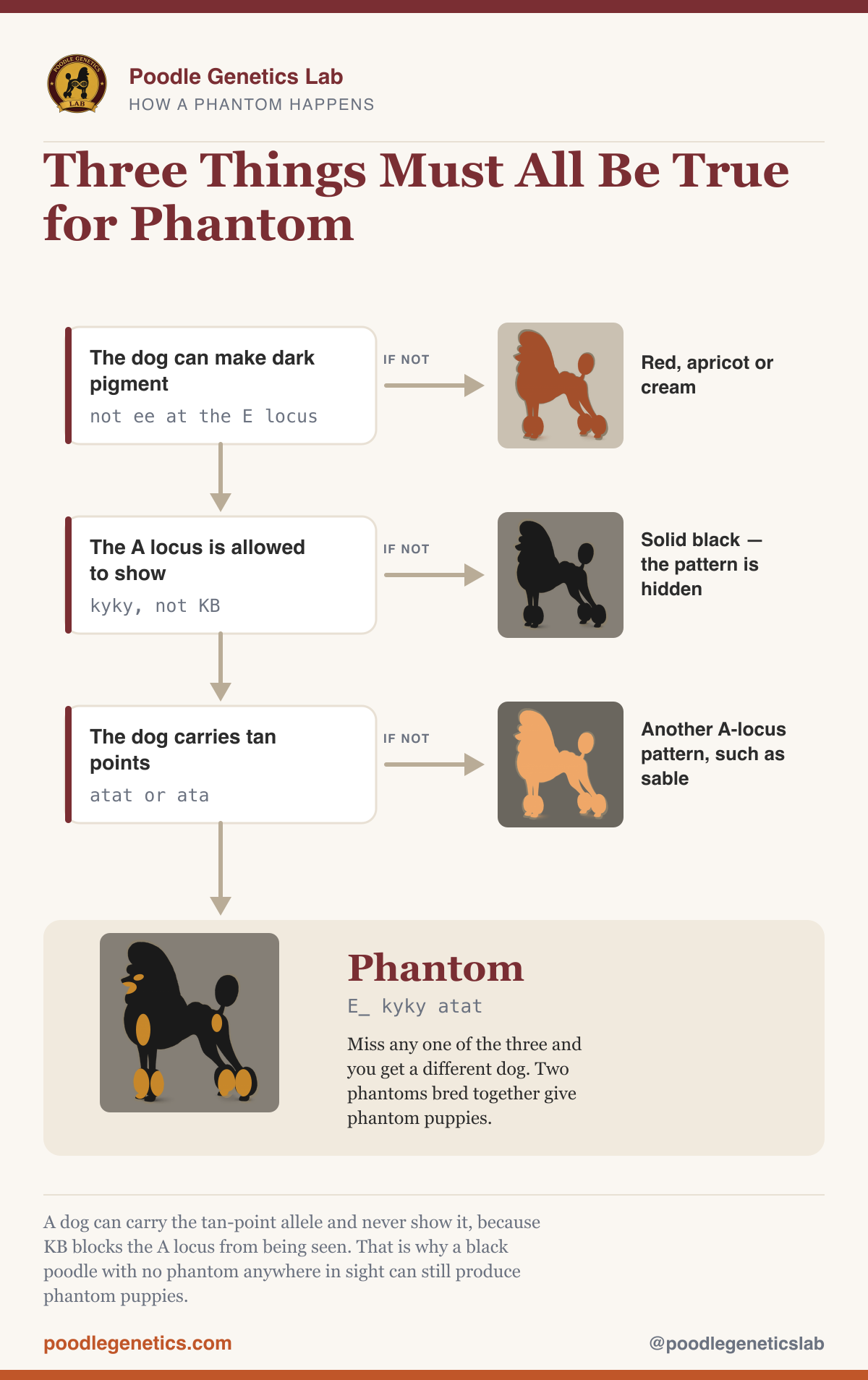
The genetics of the phantom pattern involve two separate loci working together: the A locus (specifically the atat genotype) and the K locus (specifically the kyky genotype). Both must be in the right configuration for phantom markings to express.
The A Locus: Agouti Signaling Protein
The A locus gene is ASIP (Agouti Signaling Protein), located on canine chromosome 24. ASIP is a signaling molecule that interacts with MC1R (the E locus gene product) to influence which pigment a melanocyte produces at any given moment. Specifically, ASIP signaling promotes phaeomelanin production. Where ASIP signaling is strong, melanocytes produce yellow-red phaeomelanin. Where ASIP signaling is absent, melanocytes produce eumelanin (assuming the E locus permits it).
The current framework for the A locus is the haplotype model of Bannasch and colleagues (2021). It resolves ASIP variation not into a series of alternative alleles but into a modular system of two regulatory regions: a ventral promoter (VP), which governs how far up the body phaeomelanin extends, and a hair cycle promoter (HCP), which governs the banding within each hair. A dog carries one of two ventral variants and one of five hair cycle variants, and the pairing — the haplotype — determines the pattern.
In order of dominance:
- DY (dominant yellow; part of legacy Ay): the cleared sable — high ASIP expression across the coat.
- SY (shaded yellow; also part of legacy Ay): shaded sable, retaining the dark tipping.
- AG (agouti; legacy aw): banded hairs alternating phaeomelanin and eumelanin zones. Uncommon in poodles. The correspondence is imperfect: legacy aw calls were made with older marker assays, and a haplotype test may reclassify some of them as black back. Treat a legacy aw result as provisional until confirmed by haplotype testing.
- BS (black saddle; part of legacy at): tan points with the eumelanin receding to a saddle over the back as the dog matures. This phenotype description matches what the poodle community calls creeping tan, and black saddle is the most likely explanation, but no published series has haplotyped creeping-tan poodles, so the mapping is probable rather than confirmed. Either way, it is not the canonical phantom.
- BB1–BB3 (black back; also part of legacy at): the phantom pattern proper. Eumelanin over the back, phaeomelanin at the defined points. Three subtypes, differing in the hair-cycle promoter they carry.
- a (recessive black): solid eumelanin, a loss-of-function variant. Rare in poodles.
For most pairings dominance runs DY > SY > AG > BS > BB > a, since the more active ventral variant and the more active hair-cycle variant each usually pull the same haplotype to the top. Two combinations are exceptions: a shaded yellow paired with a black saddle carries the dominant-yellow promoter combination and is expected to clear rather than hold its shading, and an agouti paired with a black saddle produces a promoter combination Bannasch and colleagues never described as a distinct pattern, so no phenotype is predicted for it. See the haplotype crosswalk article for the full explanation.
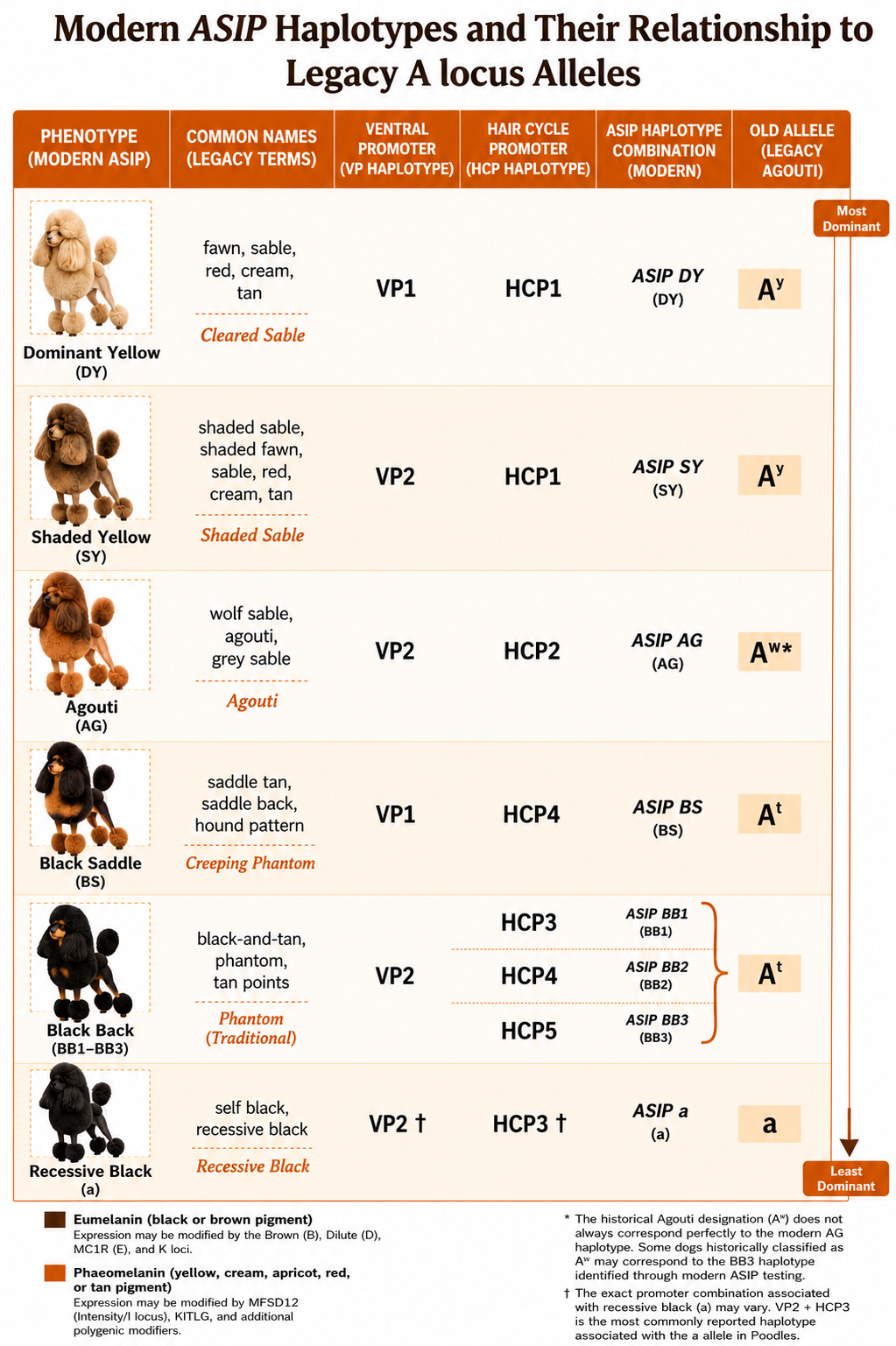
The single most useful thing in that table is the right-hand column. The legacy allele at — the one your lab report almost certainly prints — covers two haplotypes, not one: black back, which is the phantom, and black saddle, which is the creeping tan whose markings expand as the dog matures. Told those are the same allele behaving inconsistently, a breeder is being told something false. They are different haplotypes with different behaviour, and a haplotype-level test can tell them apart where the legacy four-allele test cannot. For the full walkthrough of the A locus haplotype model and how it maps onto every legacy allele, see Volume I of the Poodle Genetics series.
What This Means for Phantom Genetics
For phantom markings to appear, a dog needs a phantom haplotype and nothing more dominant sitting above it. That is the point people get wrong: it does not require two copies. Because at is dominant over a, an ata dog is a phantom just as an atat dog is. Discarding a phantom producer for being "only a carrier" throws away a perfectly good dog.
What does suppress the pattern is anything more dominant at A (Ay or aw), or — far more commonly — a KB at the K locus, which masks the A locus outright.
Importantly, all A locus alleles are silent in ee dogs (red/apricot/cream). The ASIP protein only modulates the eumelanin/phaeomelanin balance, but an ee dog has no eumelanin to modulate, the whole coat is phaeomelanin regardless. This means an ee dog can be atat and carry the tan point genetics without ever showing them in their own coat. Their offspring, however, may express the pattern if they have eumelanin capability.
The K Locus: Why Phantom Still Won't Show Without kyky
The A locus story is incomplete without the K locus, and this is where most phantom genetics explanations fall short.
The K locus gene is CBD103 (beta-defensin 103), on canine chromosome 16. The dominant K allele codes for a protein that acts as a constitutive agonist of MC1R, it locks the receptor in "eumelanin mode" regardless of ASIP signals. When K is present (at least one copy), the MC1R is continuously signaled to produce eumelanin, and ASIP has no effect.
The K locus alleles:
- K (dominant black): One copy (KB or sometimes written K) overrides ASIP entirely, solid eumelanin expression throughout. This is why many black poodles are phenotypically solid black even if they carry at alleles, the K allele is masking the A locus.
- kbr (brindle): Produces a brindle pattern, eumelanin stripes on a phaeomelanin background. Present in some breeds; its status in poodles is debated but appears to be present at low frequency.
- ky (non-solid/allows A expression): The recessive ky allele does NOT continuously activate MC1R. This means ASIP can actually do its job, it can signal melanocytes to switch between pigment types based on location in the coat.
For tan points (phantom markings) to express, the dog must be kyky at the K locus. With two ky alleles, ASIP/MC1R interaction is fully operational, and the at allele pattern can be displayed.
The Interaction Summary
| A Locus | K Locus | Result |
|---|---|---|
| atat or ata | K_ (at least one K) | Solid eumelanin, tan points masked |
| atat or ata | kyky | Phantom pattern expressed |
| Ayat or AyAy | kyky | Sable/fawn pattern (Ay dominates) |
| atat or ata | kyky + ee | Appears solid red/cream (A locus moot) |
A dog that is atat or ata, plus kyky, with eumelanin capability will express phantom markings — one copy of at is enough, the same dominance logic as everywhere else on this site. The specific color of the base and the markings depends on the other loci (B, D, G).
Color Combinations in Phantom Poodles
The phantom pattern sits on top of whatever eumelanin color the dog has:
- Black and tan phantom: B_ base, dark black with tan/apricot points. Most common.
- Brown and tan phantom: bb base, brown body with tan points.
- Blue and tan phantom: two different dogs share this name. A true blue phantom is dd on a black base — dilute from birth. A cleared blue phantom is a black-based dog carrying the greying factor at one dose, born black and greying to blue. Greying is observed, never tested.
- Silver and tan phantom: black base + greying at two doses, silver body with tan points.
- Silver beige and tan phantom: bb base + greying at two doses, silver beige body with tan points.
The tan point color itself can range from rich apricot to cream depending on phaeomelanin intensity modifiers, the same polygenic factors that influence apricot/cream depth in ee dogs.
Breeding for Phantom Puppies
What Both Parents Must Contribute
For a phantom puppy, the puppy must:
- Carry at least one at allele with nothing more dominant (Ay or aw) on the other chromosome — atat or ata. One copy is enough: at is dominant over a, the same way one copy of any dominant allele is enough everywhere else on this site.
- Be kyky (two ky alleles, one from each parent)
- Have eumelanin capability (E_, at least one E allele at the E locus)
This means at least one parent must carry and pass on an at allele, and both parents must carry at least one ky allele.
Common Scenarios
Scenario 1: Phantom × Phantom Both parents are atat kyky
- 100% of puppies will be atat kyky, all will be phantom (if eumelanin-capable)
- Most reliable method
Scenario 2: Phantom × Black Carrier One parent phantom (atat, kyky), other parent is solid black but carries (ky)(at)
- Variable outcomes depending on exact parent genotypes
- DNA testing essential for planning
Scenario 3: Sable × Phantom If one parent is Ay_, even if the phantom parent is atat, any puppy inheriting Ay will be sable, not phantom. Ay masks at in the dominance hierarchy.
The key challenge is that many black poodles carry at and/or ky without expressing any visible pattern (because K masks A). Without DNA testing, you cannot reliably know whether a solid black poodle is a phantom carrier.
The Role of DNA Testing in Phantom Programs
DNA testing for the A locus (ASIP) is available from UC Davis and Embark. Most panels still report the legacy letters (Ay, aw, at, a), which map imperfectly onto the haplotypes above — at in particular covers both phantom and creeping tan. Haplotype-level ASIP testing resolves the difference and is worth the cost if a phantom line is throwing dogs whose markings expand with age. K locus testing is also available and identifies K, kbr, and ky alleles.
For reliable phantom breeding, testing both parents for both A and K locus status is essential. Otherwise, you are producing litters and hoping, rather than predicting.
Phantom vs. Other Patterned Poodle Colors
Phantom vs. Parti
Phantom and parti are completely different genetic patterns with no direct relationship:
- Phantom: Tan/phaeomelanin markings in specific anatomical locations. A locus + K locus genetics.
- Parti: Large areas of white (loss of pigment), any random distribution. S locus (piebald) genetics.
A poodle can theoretically be both phantom-patterned AND parti (parti-phantom or "abstract phantom"), though this requires appropriate genotype at A, K, S, and other loci simultaneously.
Phantom vs. Brindle
Brindle (kbr) produces eumelanin stripes on a phaeomelanin background. Phantom (atat kyky) produces eumelanin base with phaeomelanin markings at specific sites. These are distinct patterns from different K locus alleles.
The Term "Phantom" in Poodle Culture
"Phantom" is used exclusively for the tan-point pattern in poodles. In some other breeds, "phantom" has been used loosely to mean any unusual color or pattern. In the context of poodle genetics, it refers specifically to the atat or ata, kyky phenotype as described here.
Registration and the Breed Standard Are Different Things
Two claims get run together here, and separating them saves a lot of argument.
Registration. A phantom poodle with two registered parents is registrable with the AKC, exactly as any other poodle is. Colour does not gate registration.
The standard. The AKC poodle standard calls for solid colour in conformation. Phantom is not a solid colour, so a phantom is not competitive in the conformation ring — the same position parti occupies.
What does not exist is a "phantom variety" or a "parti variety" class. AKC poodle varieties are by size — Toy, Miniature, Standard — and not by colour. Phantom and parti dogs are eligible for obedience, rally, agility and the other performance and companion events on the same footing as any registered poodle.
Quick Genetics Summary
For breeders:
| Requirement | What to Test For |
|---|---|
| at allele (≥1, nothing more dominant) | A locus, need atat or ata genotype |
| ky allele (x2) | K locus, need kyky genotype |
| E (at least one) | E locus, needs eumelanin capability |
| B, D | Determines the base coat colour of the phantom |
| G (greying) | Not testable — observed from the adult coat |
Understanding phantom genetics requires understanding that two separate loci must cooperate: the A locus provides the pattern template, and the K locus decides whether that template is allowed to express. Many genetic guides for poodle breeders overlook the K locus entirely, which is why phantom breeding results can be surprising when the K locus status of "solid" dogs is unknown.
Download the Phantom Breeding Matrix for a printable summary.
This article is educational and is not veterinary advice. Discuss breeding and clinical decisions with your veterinarian.
Built on identified genes and validated tests. The claims here are supported by the peer-reviewed literature listed below.
- Published
- December 18, 2024
- Last reviewed
- September 5, 2026
References
- Bannasch DL, Kaelin CB, Letko A, et al. (2021). Dog colour patterns explained by modular promoters of ancient canid origin. Nature Ecology & Evolution 5(10):1415–1423. doi:10.1038/s41559-021-01524-x
- Candille SI, Kaelin CB, Cattanach BM, et al. (2007). A β-defensin mutation causes black coat color in domestic dogs. Science 318(5855):1418–1423. doi:10.1126/science.1147880
Free Tool
Apply This Knowledge
Model any parent pair with our interactive genetics calculator.


