What Is Ticking?
Ticking is small, colored flecks that appear inside the white areas of a parti or abstract poodle's coat. A parti poodle with ticking doesn't have clean white patches, the white is scattered with tiny spots of whatever color the dog's other loci produce. Roan is a related but visually distinct effect: instead of discrete spots, pigmented and unpigmented hairs are finely intermixed, giving the white areas an overall greyed or "salted" look rather than a scattering of dots.
Both are controlled by the R locus, and both only ever show up where the S locus has already produced white to act on. This article covers the R locus specifically, if you haven't already, read Parti Poodles and the S Locus first for how that white gets there in the first place, the mechanics of white spotting aren't repeated here.
The R Locus and USH2A
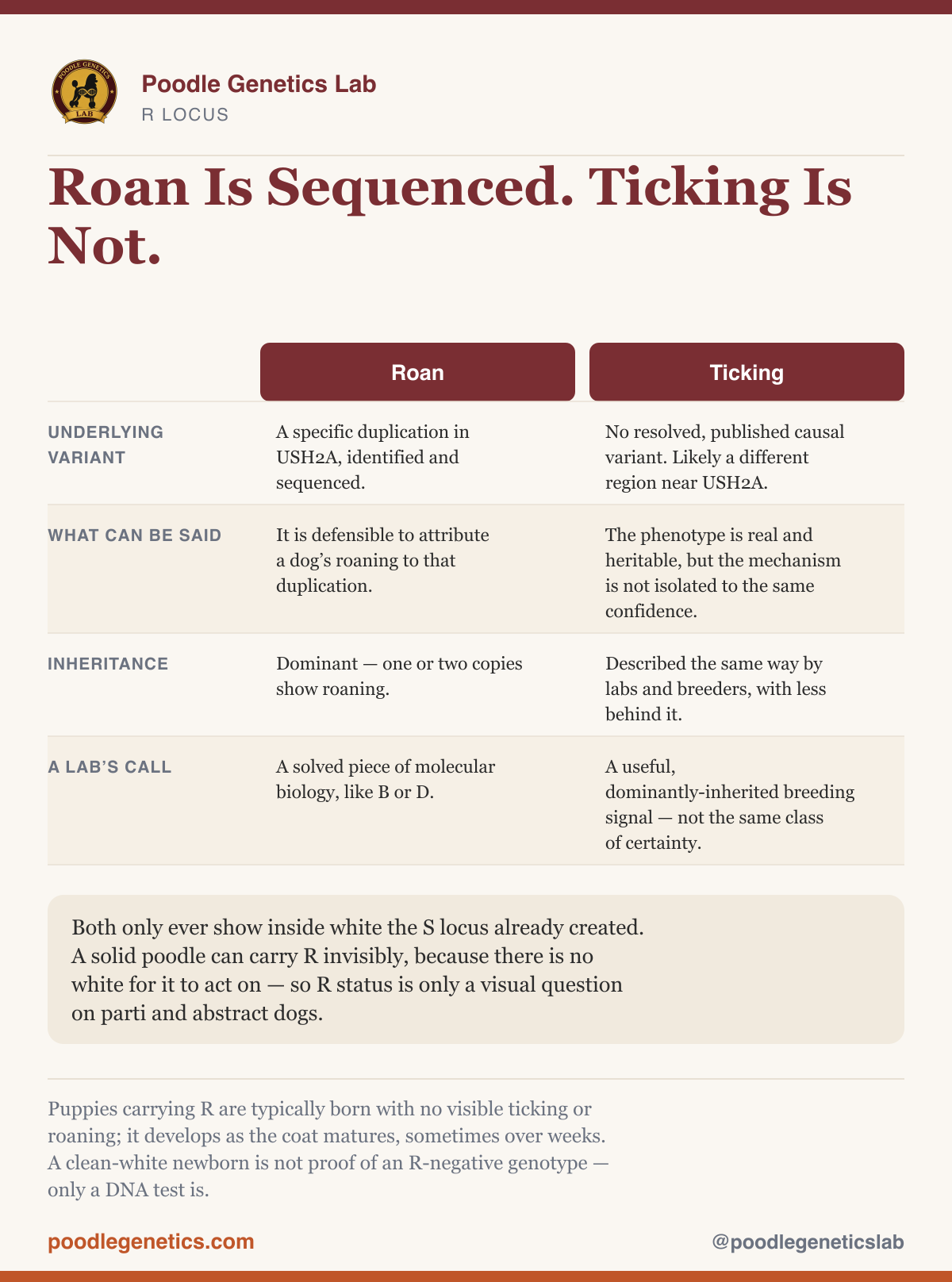
The gene behind roan is USH2A (usherin), on canine chromosome 38. The causal variant was identified by Kawakami and colleagues in a 2021 genome-wide association study across more than 1,500 dogs: an 11-kilobase tandem duplication sitting in an intron of USH2A, present in roaned dogs and absent from non-roaned dogs. The same duplication also turned out to be the marker underlying Dalmatian spotting, a finding the researchers didn't expect going in.
That's a real, sequence-level, published result, not an inferred or hypothesized association. It's about as solid as canine coat-color genetics gets.
Ticking is a different story, and it's worth being precise about the difference rather than blurring it.
Roan and Ticking: Related, Not Identical
The USH2A duplication study also looked for a marker for ticking, and did not find one with the same strength of association. The paper's own framing is that roan and ticking are "likely" caused by variants in different regions near USH2A, not that this has been nailed down the way the roan duplication has. In other words: the field's current best evidence says roan and ticking probably aren't the same underlying variant, but there is not yet a resolved, published causal variant for ticking the way there is for roan.
That distinction matters for what a breeder can actually be told. It is defensible to say a dog's roaning is caused by a specific, sequenced duplication in USH2A. It is not yet defensible to say the same about a dog's ticking, the phenotype is real and heritable, but science hasn't isolated its exact mechanism to the same level of confidence.
Why Only in White Areas
Ticking and roan aren't independent colors, they're a modification of pigmentation within areas that are already white because of the S locus. A solid-colored poodle can carry the R allele invisibly: there's no white for it to act on, so nothing shows. The pattern only becomes visible once a dog also carries at least one sp allele at the S locus, whether that produces the limited white of an abstract dog or the extensive white of a full parti.
This is exactly why the R locus can't be assessed from looking at a solid poodle's coat, and why R-locus status is really only a meaningful visual question for parti and abstract dogs.
Born Clear, Ticking Develops Later
One of the more consistent findings across the roan/ticking literature: puppies with the R allele are typically born without visible ticking or roaning. The pattern isn't there at birth, it develops progressively as the coat matures, sometimes taking weeks to become apparent. A newborn parti puppy with perfectly clean white patches can still carry R and go on to develop ticking as it grows.
For a breeder evaluating a litter, that means a clear-white puppy at birth is not proof of an R-negative genotype. If avoiding ticking matters to a breeding program, DNA testing is the only way to know status before the coat has had time to show it.
Inheritance
The USH2A duplication behind roan behaves as a dominant: dogs with one or two copies show roaning, and the researchers describe the effect as dominant rather than requiring two copies to express. Breeders and commercial labs generally describe ticking the same way, present with a single copy, though as noted above the precise causal variant for ticking hasn't been pinned down with the same rigor as roan's.
R Locus and the Poodle Genetics Calculator
The Poodle Color Genetics Calculator includes the R locus as a selectable pair (R/r), and will flag "Ticking" as a predicted pattern when a dog inherits at least one R allele alongside an sp allele at the S locus. That's a deliberate simplification: the calculator models R as a single dominant/recessive pair and doesn't attempt to separately distinguish a roan phenotype from a ticking phenotype, which matches where the underlying science currently stands, roan and ticking are not yet cleanly separable into two independently testable loci for prediction purposes.
Testing Coverage Is Uneven
Not every lab reports the R locus, and where they do, coverage varies. See the DNA lab comparison for the full picture: Embark currently reports R locus results, while UC Davis VGL and Wisdom Panel offer only limited coverage. If ticking or roan specifically matters to your breeding decisions, which lab you choose is the one place in a standard color panel where that choice actually changes what you can learn.
Summary
| Question | What's known |
|---|---|
| Gene | USH2A (chromosome 38) |
| Roan's causal variant | Confirmed — 11kb intronic tandem duplication (Kawakami et al. 2021) |
| Ticking's causal variant | Not yet resolved to the same certainty; likely a different, nearby region |
| Are roan and ticking the same allele? | Current evidence says probably not, but this isn't fully settled |
| Where visible | Only within white areas produced by the S locus |
| Visible at birth? | Typically no — develops as the coat matures |
| Inheritance | Dominant (one copy is enough to show) |
| Lab testing | Uneven — Embark reports it; UC Davis VGL and Wisdom Panel offer only limited coverage |
Roan and ticking are a good example of a real, breeder-relevant trait that DNA testing has only partially caught up with. The pattern is heritable, dominant, and only visible in white, and a solid published study has nailed down the mechanism for roan specifically. Ticking is close enough to be treated the same way in practice, but honest reporting means saying plainly that its exact molecular cause is still being worked out.
Download the Parti Litter Planner for a printable summary.
This is educational content, not veterinary advice. Discuss breeding and clinical decisions with your veterinarian.
Credible evidence supports what is described here, but the mechanism, the population studied, or its application to Poodles still has limits. The literature below is real and cited in full; where it stops short, the article says so rather than rounding up.
- Published
- October 16, 2026
- Last reviewed
- August 28, 2026
References
- Kawakami T, Jensen MK, Slavney A, Deane PE, Milano A, Raghavan V, Ford B, Chu ET, Sams AJ, Boyko AR (2021). R-locus for roaned coat is associated with a tandem duplication in an intronic region of USH2A in dogs and also contributes to Dalmatian spotting. PLoS One 16(3): e0248233. doi:10.1371/journal.pone.0248233
Free Tool
Apply This Knowledge
Model any parent pair with our interactive genetics calculator.