What Is the E Locus?
The E locus, formally called the Extension locus, sits on canine chromosome 5 and governs one of the most fundamental decisions in coat color genetics: whether a dog is even capable of producing eumelanin (the dark pigment responsible for black and brown coats) in the hair shaft.
The gene product is MC1R (melanocortin 1 receptor), a protein that sits on the surface of melanocytes, the pigment-producing cells in hair follicles. When MC1R is functional and active, it tells the cell to make eumelanin. When both copies of the gene are non-functional, the cell defaults to phaeomelanin, the warm, reddish-yellow pigment.
The E locus is sometimes called a "master switch" for eumelanin, but that overstates a single gene. MC1R is one determinant among several, and the E locus is not just two alleles: the current framework (Honkanen and colleagues, 2024) describes an allelic series of roughly seven E alleles, including a melanistic mask allele and a recessive grizzle allele, arranged in a dominance hierarchy. What is decisive is the recessive e: a dog that is ee cannot place dark pigment in the hair shaft at all, so ee produces red, apricot, or cream regardless of every other locus. For most poodle breeding decisions the practical split is therefore between an E-series allele that permits eumelanin and the recessive e that does not.
The E Locus Genotypes
The sections below focus on the practical E versus e distinction that drives most poodle colour outcomes; the wider allelic series above becomes relevant mainly for masks and grizzle.
EE, Homozygous Dominant
A dog carrying two functional copies of the E allele (EE) has full MC1R function at both chromosomes. Eumelanin expression in the hair shaft is fully enabled. The dog's actual coat color will then be determined by all the other loci, A, B, D, K, and so on.
An EE poodle could be black, brown, blue, silver, cream, or any other color, but the E locus itself imposes no restriction. These dogs are not "more black" than Ee dogs; the single dominant allele is sufficient.
Ee, Heterozygous (Carrier)
A dog carrying one functional and one non-functional E allele (Ee) looks exactly the same as an EE dog. The dominant E allele fully compensates for the recessive one. An Ee poodle can be black, brown, blue, silver, café-au-lait, or any eumelanin-based color.
The critical difference is in breeding: an Ee dog is a carrier of the recessive e allele. When bred to another carrier or to an ee dog, it can produce red/cream/apricot offspring regardless of what other color genes are present.
Many black poodles in heavily-bred lines carry e without their owners knowing, because the phenotype gives no hint. DNA testing is the only way to know.
ee, Homozygous Recessive
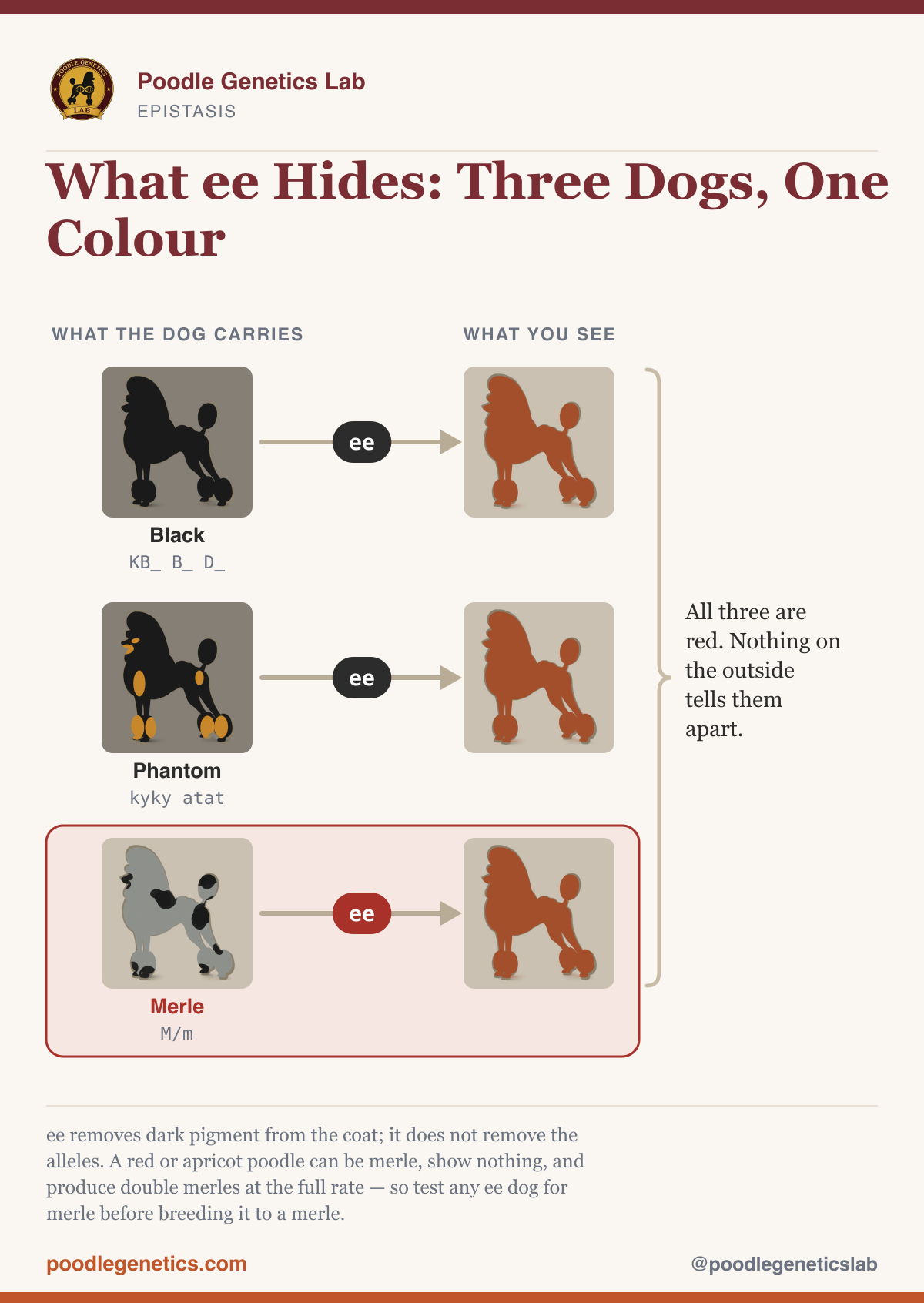
This is the genotype that surprises most new breeders. A dog with two non-functional E alleles (ee) cannot produce eumelanin in the hair shaft at all. Every hair follicle defaults to phaeomelanin. The result: the dog will be some shade of red, apricot, or cream, no exceptions.
It does not matter what genotype the dog carries at the B locus (black vs. brown), the D locus (dilution), the K locus, or the A locus agouti alleles. All of that information becomes invisible — not irrelevant — because there is no dark pigment in the coat for it to modify. This is a textbook case of epistasis: one locus masking the visible effect of others without erasing them. The alleles are all still present, and the dog passes them on exactly as any other dog would.
There is one nuance: ee dogs do retain eumelanin in their nose leather, eye rims, lips, and paw pads. These structures are regulated differently, which is why a cream poodle can have a black nose. An ee dog on a BB or Bb background will have black pigmentation on the nose and eye rims. An ee dog on a bb background (homozygous brown) will have a liver nose and amber eyes. The coat is still red, apricot or cream — ee blocks eumelanin from the hair shaft entirely. This is not café-au-lait, and it should not be described as looking like one: a café-au-lait is a brown dog that has cleared, and its coat is brown pigment.
Why Are ee Dogs Red, Apricot, or Cream?
All three of these colors exist within the ee genotype, and the difference between them is intensity of phaeomelanin, not a different set of pigments.
Phaeomelanin ranges from deep reddish-orange through apricot to very pale cream, almost white. The intensity is controlled by modifier genes, polygenic factors that are still not fully characterized in poodles. Key players include:
- Intensity modifiers (loosely and inaccurately called the "I locus"): red intensity is polygenic, not a single gene, and no single-locus test predicts the shade of a red-based puppy. In poodles specifically the identified contributors include KITLG and a variant linked to GPR22 (Batcher et al., 2022); the MFSD12 dilution variant is present in white poodles but does not by itself explain the range between cream, apricot, and red. Do not write "I/I" or "i/i" genotypes for poodle intensity; they do not correspond to a validated test.
- The A locus: nothing. The A locus distributes eumelanin, and an ee dog has none in its coat. It is carried invisibly and passed on.
- Progressive greying: greying acts on eumelanin only. It does not touch the red spectrum. An apricot that lightens with age is doing something else — intensity, or sun.
Red Poodles
True red poodles are ee with high phaeomelanin intensity. They often appear a rich mahogany-orange at birth and may fade somewhat with age, but retain visible warmth throughout life. Breeding reds consistently is notoriously difficult because intensity is polygenic.
Apricot Poodles
Apricot sits in the middle of the phaeomelanin range, warmer than cream but lighter than red. Many poodles sold as "apricot" as puppies fade toward cream by adulthood. True stable apricot is difficult to maintain across generations without careful selection.
Cream Poodles
Cream poodles have very low phaeomelanin intensity. Some appear almost white but retain a slight warmth that distinguishes them from a true white dog. A cream poodle is an ee dog at the pale end of the phaeomelanin intensity range; the MFSD12 variant is the one intensity factor with a clear role in the whitest of these dogs. This is a different mechanism from the white produced by S-locus spotting, where pigment cells are absent from the coat entirely rather than merely producing very pale phaeomelanin.
E Locus Genotype Table
| Genotype | Eumelanin in Coat | Phaeomelanin Restriction | Visual Effect |
|---|---|---|---|
| EE | Yes, fully enabled | None | Color determined by other loci |
| Ee | Yes, fully enabled | None | Same phenotype as EE; carrier of e |
| ee | No (blocked) | None, only phaeomelanin | Always red, apricot, or cream |
Breeding Implications
Producing ee Offspring
To produce an ee puppy, both parents must carry at least one e allele. The possible crosses:
- Ee × Ee: 25% chance of ee per puppy
- Ee × ee: 50% chance of ee per puppy
- ee × ee: 100% of puppies will be ee (all red/apricot/cream)
Two EE parents cannot produce an ee offspring. If you breed two dogs you believe are both EE and get a red puppy, one or both parents was actually Ee.
The Hidden Carrier Problem
Because Ee dogs are phenotypically identical to EE dogs, the e allele frequently hides in black and dark-colored poodle lines. A breeder producing black poodles may not discover that several of their stud dogs are Ee until a cream or apricot puppy appears in a litter.
This is not a health concern, the e allele carries no known health associations, but it matters for breeders with specific color goals. If you want to reliably avoid producing red or cream puppies from a black breeding program, DNA testing your breeding dogs for E locus status is the only certain approach.
Can You Predict Adult Color From Puppy Color?
For ee dogs: no, not reliably. An apricot puppy may be cream by 18 months. A red puppy may hold its color or fade significantly. The G locus and polygenic intensity modifiers both operate somewhat independently of E locus status. If color stability matters to your program, DNA test for G locus greying and evaluate parents and grandparents for fading patterns.
Common Misconceptions
"My black poodle must be EE, it's too dark to carry red." False. Coat darkness in eumelanin-based colors has nothing to do with E locus carrier status. An intensely black dog can easily be Ee.
"Red poodles are just faded black poodles." Also false. Red and cream poodles have phaeomelanin-based coats from birth. A faded black poodle is typically a blue or silver poodle (G locus greying), the pigment change is eumelanin dilution, not phaeomelanin expression.
"ee dogs can never show any black pigment." Partially incorrect. ee dogs typically have full eumelanin in nose leather, eye rims, and lips (assuming BB or Bb at the B locus). The restriction is specific to the hair shaft.
The Bottom Line
The E locus is binary in its effect: either eumelanin can appear in the coat, or it cannot. An ee dog will always be red, apricot, or cream, full stop. The exact shade within that range is polygenic. The breeder records it by eye; it is not read off a test, and it is not the E locus's doing.
For breeders: test your animals if E locus status matters to your program. For color genetics enthusiasts: understanding E locus status is the first step toward making sense of any poodle's coat color, because it tells you immediately whether the dark-pigment genes even have a chance to express. For the full picture of how E interacts with every other color locus, see Volume I of the Poodle Genetics series (the book).
Download the E & B Locus Quick Reference for a printable summary.
This article is educational and is not veterinary advice. Discuss breeding and clinical decisions with your veterinarian.
Built on identified genes and validated tests. The claims here are supported by the peer-reviewed literature listed below.
- Published
- November 15, 2024
- Last reviewed
- September 8, 2026
References
- Honkanen L, Loechel R, Davison S, Donner J, Anderson H (2024). Canine coat color E locus updates: identification of a new MC1R variant causing ‘sable’ coat color in English Cocker Spaniels and a proposed update to the E locus dominance hierarchy. Animal Genetics 55(2):291–295. doi:10.1111/age.13398
- Weich K, Affolter V, York D, et al. (2020). Pigment intensity in dogs is associated with a copy number variant upstream of KITLG. Genes 11(1):75. doi:10.3390/genes11010075
- Batcher K, Varney S, Affolter VK, Friedenberg SG, Bannasch D (2022). An SNN retrocopy insertion upstream of GPR22 is associated with dark red coat color in Poodles. G3: Genes|Genomes|Genetics 12(11):jkac227. doi:10.1093/g3journal/jkac227
Free Tool
Apply This Knowledge
Model any parent pair with our interactive genetics calculator.

