What "Sable" Actually Means on a Poodle
A sable poodle is a dog whose coat is predominantly phaeomelanin (the red-yellow pigment) with eumelanin (the dark pigment) layered over the top of individual hairs rather than mixed evenly through them. That layering is what separates sable from a plain red or apricot poodle: pull apart the coat and you'll often find dark tipping down the back, along the ears, or through the ruff, sitting on top of a lighter base. A true red or apricot poodle (genotype ee) has none of that tipping to find — it's phaeomelanin end to end.
Genetically, sable in poodles comes from the A locus (the ASIP gene), and specifically from the haplotype the field calls dominant yellow, still printed on most commercial panels under the legacy label Ay. This article assumes you don't need the full mechanism to act on the information in it — if you want the haplotype-level detail (the ventral promoter and hair cycle promoter regions, the VP/HCP notation, how the legacy four-allele system maps onto the current one), that's covered in full in Ay, aw, at, a — and What Replaced Them. This piece picks up where that one leaves off: not the mechanism, but the outcome — why two dogs carrying it can look like they belong to different colors entirely.
The Question Every Sable Breeder Gets Asked
It's the most common message a sable breeder receives: "My puppy doesn't look like the picture." Two puppies out of the same litter, both tested, both showing the same A locus result on paper, and one is a warm, even gold with barely a hint of shading while the other carries visible dark overlay down its back and through its ears well into adulthood. Nothing was mislabeled. Nothing went wrong in the litter. Two separate things are happening at once, and a lab report only speaks to one of them.
Axis One: Cleared vs. Shaded Is a Real Genetic Split
The dominant yellow haplotype isn't one thing — it's two, and the legacy panel can't tell them apart. A dog can carry either variant at the hair cycle promoter region and read identically as Ay on a standard test:
Cleared Sable
Dominant Yellow, hair-cycle variant 1
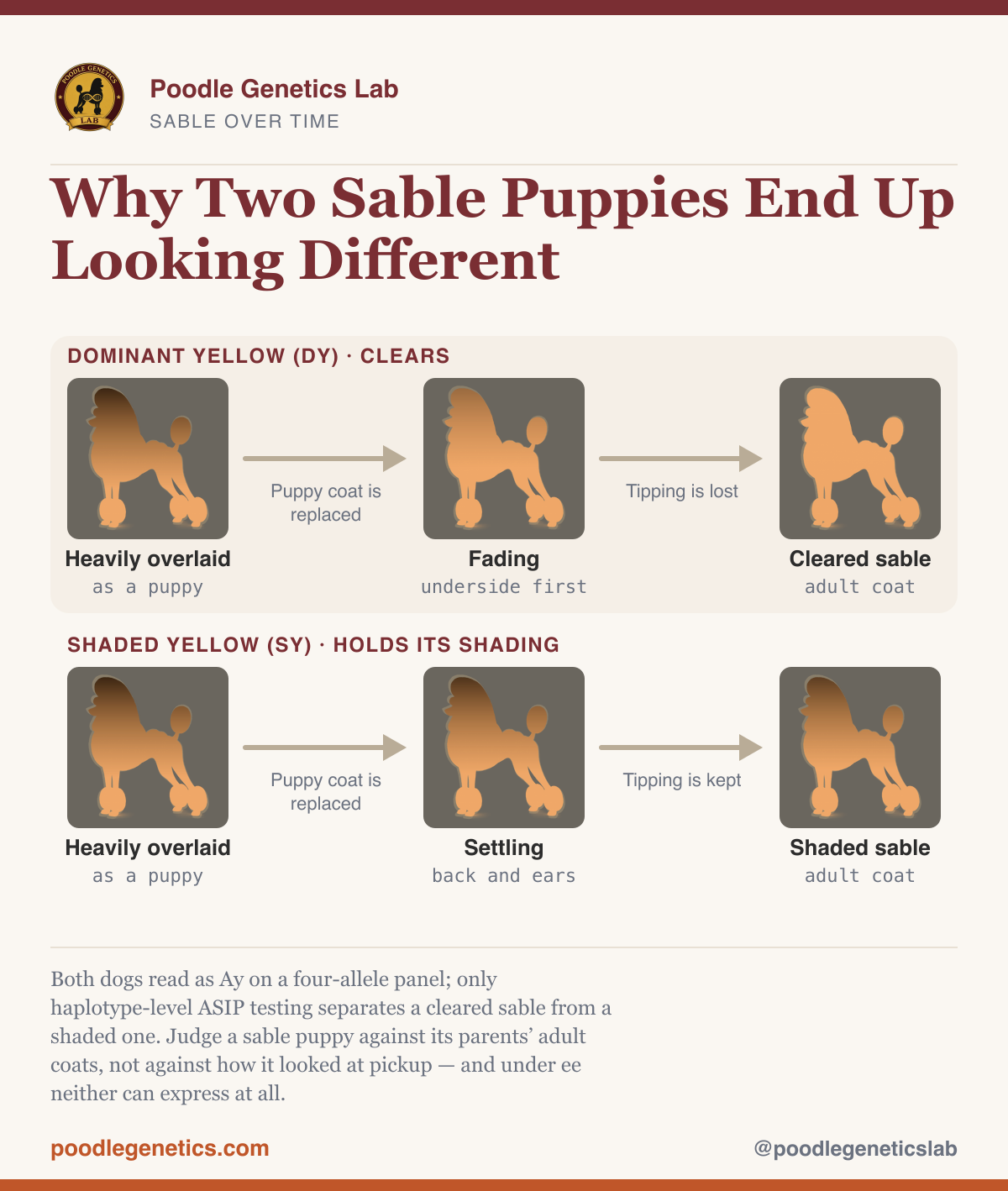
Phaeomelanin runs nearly the full length of each hair with little or no dark tipping. This is the coat most people picture when they hear "sable" or "gold" — warm and largely even.
Shaded Sable
Dominant Yellow, hair-cycle variant 2
The same base phaeomelanin color, but individual hairs keep a band of dark tipping, concentrated along the back, ears, and outer coat. The dog reads visibly darker and more overlaid, especially before grooming.
Two littermates can each be a clean Ay on their lab report and still fall on opposite sides of that split — one cleared, one shaded — because the legacy test resolves the ventral promoter region but not the hair cycle promoter region that decides this. That's not a testing error; it's a genuine limit of what the standard panel reports. Only haplotype-level ASIP testing distinguishes them directly, and the full explanation of why the legacy test stops short here lives in the haplotype article if you want to see the mechanism.
Axis Two: Phaeomelanin Intensity Is a Separate, Polygenic Layer
The cleared/shaded split explains how much dark overlay a sable dog carries. It says nothing about the color underneath it — and that base phaeomelanin shade runs on its own dial, controlled by the same polygenic intensity modifiers this site has documented in red and apricot poodles, where the same phaeomelanin pigment is the entire coat rather than just the base layer. Two sable littermates with identical A locus results can still differ in how deep, gold, or pale that underlying color reads, for reasons that have nothing to do with the A locus at all. No single test predicts that shade; it's recorded from the dog, not read off a panel. See why red poodles fade for the full treatment of that mechanism — it's the same intensity variable, just showing up under a layer of tipping instead of on its own.
Put the two axes together and the spread of real-world sable phenotypes makes sense: haplotype decides whether a dog clears or holds its shading, intensity decides how warm or pale the phaeomelanin underneath is, and the two are inherited independently. A shaded, deep-gold dog and a shaded, pale-cream dog can both be shaded sable at the A locus and look like entirely different colors.
What Changes as the Coat Matures
There's a third source of visible difference that has nothing to do with genotype at all: a sable coat is not finished the day a puppy is born. Sable puppies across coated breeds are routinely born carrying more visible dark overlay than they'll show as adults, and that early shading commonly fades from the underside and legs first as the puppy coat is replaced. A puppy that looks heavily overlaid at eight weeks may settle into a cleared-looking adult coat by the time it's fully grown; a puppy that looks nearly solid gold at birth is not necessarily going to stay that way either. This is a general feature of how sable coats develop, not a poodle-specific measured timeline this site can put a precise age on, and it's a separate process from the A locus doing anything different in that individual dog — the underlying haplotype hasn't changed, the coat is just catching up to it. Judge a sable puppy's final look against its parents' adult coats, not against how the puppy looked at pickup.
What to Actually Track If You're Breeding Sable
Given both axes are real and neither shows up cleanly on a standard panel, the practical checklist for a sable program looks like this:
- Photograph adult coats, not puppy coats, for every dog in the pedigree. Since shading is heaviest in puppyhood and intensity is only visible once the adult coat is in, the puppy photo on a pedigree page tells you less than the dog itself does at eighteen months.
- If clearing vs. shading matters to your program, order haplotype-level ASIP testing rather than relying on the standard panel. A legacy Ay result cannot make this call for you.
- Track phaeomelanin depth the same way you'd track red or apricot intensity — by eye, across a dog's close relatives, not from a genotype. It's the same polygenic trait wearing a different coat pattern.
- Confirm K and E locus status before you draw any conclusion from a solid- looking parent. A solid dog can carry a sable haplotype invisibly under KB, and a red or cream parent can carry it invisibly under ee.
If you're working from an actual lab report and want help reading exactly what it says (and doesn't say) about a dog's A locus status, the DNA Interpreter walks through each lab's real notation, including the legacy letters most panels still print, and translates it into plain language without guessing at anything the test didn't measure.
For the complete breakdown of every A locus haplotype, the legacy-to-modern translation table, and the dominance order that governs which pattern wins when a dog carries more than one, Volume I covers the full locus in depth alongside every other coat color gene in the breed.
This article is educational and is not veterinary advice. Discuss breeding and clinical decisions with your veterinarian.
Download the Phantom Breeding Matrix for a printable summary.
Built on identified genes and validated tests. The claims here are supported by the peer-reviewed literature listed below.
- Published
- August 27, 2026
- Last reviewed
- September 3, 2026
References
- Bannasch DL, Kaelin CB, Letko A, et al. (2021). Dog colour patterns explained by modular promoters of ancient canid origin. Nature Ecology & Evolution 5(10):1415–1423. doi:10.1038/s41559-021-01524-x
- Candille SI, Kaelin CB, Cattanach BM, et al. (2007). A β-defensin mutation causes black coat color in domestic dogs. Science 318(5855):1418–1423. doi:10.1126/science.1147880
Free Tool
Apply This Knowledge
Model any parent pair with our interactive genetics calculator.
