The Fundamental Question: What Makes Brown?
Every poodle breeder who has produced a brown puppy from two black parents has had the same moment of confusion. How is that possible? The answer lies entirely in the B locus, one of the most elegantly simple pieces of canine color genetics, once you understand the underlying biochemistry.
The B locus gene is TYRP1 (tyrosinase-related protein 1), located on canine chromosome 11. This enzyme is part of the eumelanin synthesis pathway. When TYRP1 is fully functional, the eumelanin the melanocyte produces is black. When both copies carry a loss-of-function variant, the same pathway produces brown eumelanin instead, a structurally altered form that is lighter in colour and has slightly different spectral absorption, which is why we see it as brown or liver rather than black.
B vs. b: Dominant and Recessive
The B locus has two alleles relevant to poodle breeders:
- B (dominant): Functional TYRP1. Black eumelanin is produced normally.
- b (recessive): Non-functional TYRP1. Brown eumelanin is produced instead.
The critical word here is recessive. The B allele fully compensates for one b allele. A dog with genotype Bb has functional TYRP1 from the B allele and is phenotypically black (or whatever eumelanin-based color they would otherwise be). The b allele has no phenotypic effect unless the dog is homozygous, bb.
This is why two black poodles can produce brown offspring: both parents are Bb, and each puppy has a 25% chance of inheriting b from both.
Most labs report a plain "b" allele, but several labs (including Wisdom Panel, LABOKLIN, and ANTAGENE) separately name specific TYRP1 mutations, ba, bd, bs, and others, each an independent loss-of-function change at the same gene. This is the same situation as the D locus's d1/d2/d3: any two of these in combination (for example bd/bs) still produce an ordinary brown dog, not a different or more severe result. If your lab report shows a named sub-variant instead of a plain "b," treat it as brown.
The Three B Locus Genotypes
BB, Homozygous Black
A BB dog has two functional TYRP1 copies. All eumelanin in the body is black. These dogs cannot produce brown offspring regardless of which partner they are bred to, because they have no b allele to contribute.
Bb, Black, Carrying Brown (Brown Carrier)
A Bb dog has one functional and one non-functional TYRP1 copy. Phenotypically, they are black in all eumelanin pigmentation. There is no reliable way to identify a brown carrier by looking at the dog, the black coat, black nose, and dark eyes are indistinguishable from a BB dog.
This is the "carrier" genotype responsible for most breeder surprises. In heavily-bred black poodle lines, particularly where brown poodles were introduced into the pedigree at some point in the past, the b allele can persist silently for many generations before two carriers are bred together and brown puppies appear.
bb, Brown
A bb dog cannot produce black eumelanin, only brown. The effect is visible in every eumelanin-pigmented structure in the body:
- Coat: Brown rather than black
- Nose leather: Brown/liver rather than black
- Eye rims and lips: Brown rather than black
- Paw pad pigment: Often brownish/pinkish rather than black
- Eye color: Typically lighter, amber, hazel, or green rather than dark brown/black
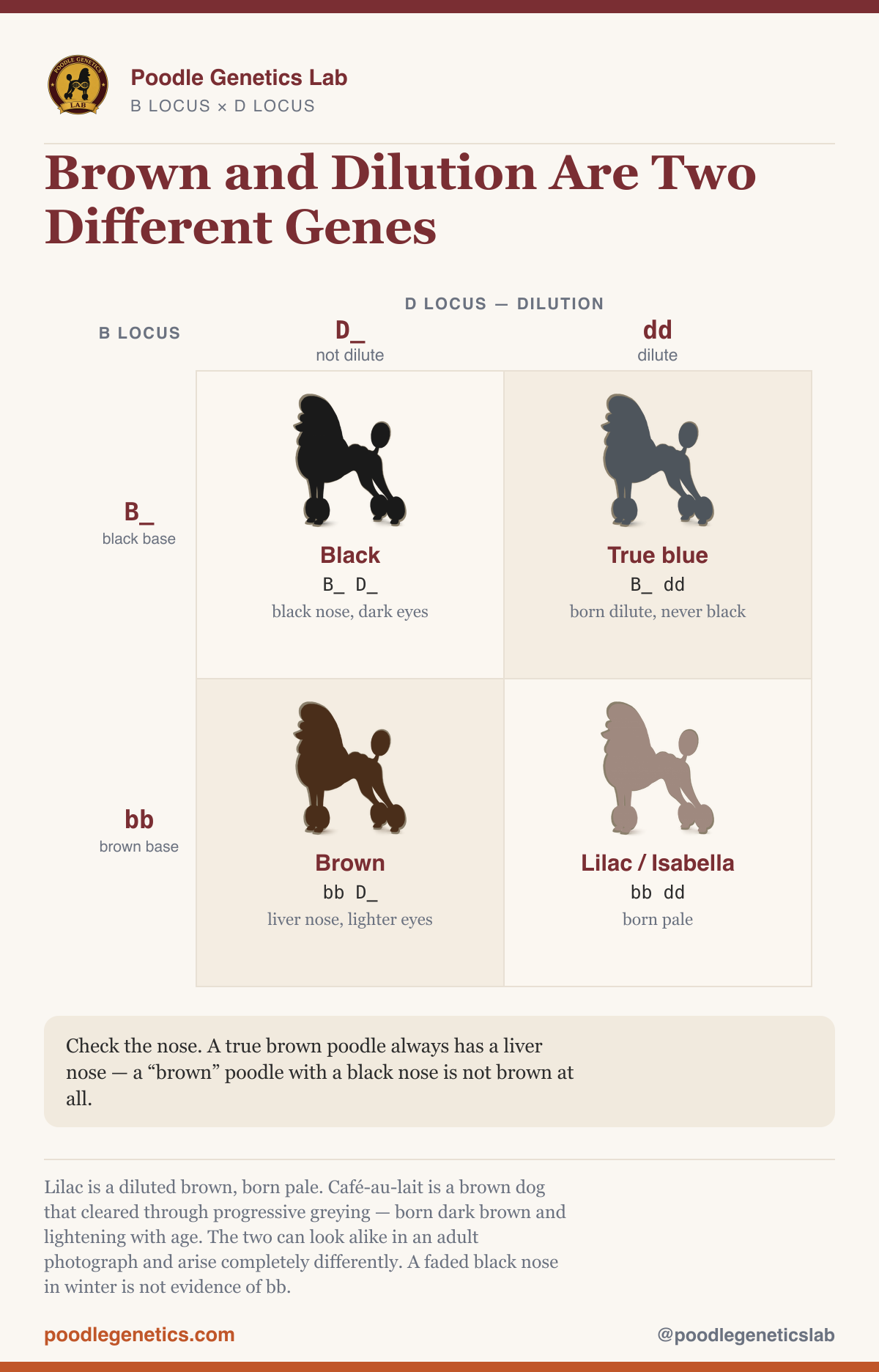
This last point is important: a true brown poodle should always have liver/brown nose pigment and lighter eye color. A poodle with a black nose cannot be a true bb brown, regardless of coat color.
B Locus and Related Colors
The B locus interacts with other loci to produce several poodle colors:
| B Genotype | Additional Loci | Resulting Color |
|---|---|---|
| BB or Bb | no dilution, no greying | Black (baseline eumelanin) |
| bb | no dilution, no greying | Brown |
| bb | dd (dilute) | Lilac / Isabella (born pale) |
| BB or Bb | dd (dilute) | True Blue (born dilute) |
| BB or Bb | greying, one copy | Blue (cleared) |
| BB or Bb | greying, two copies | Silver (cleared) |
| bb | greying, one copy | Café-au-Lait (cleared) |
| bb | greying, two copies | Silver Beige (cleared) |
| any | ee | Red/Apricot/Cream (B still sets nose and eye colour) |
The connection to dilution is important, and it is routinely got backwards. A lilac (isabella) poodle is a genetically diluted brown (bb + dd), born pale. Café-au-lait and silver beige are brown dogs that have cleared through progressive greying: born dark brown, lightening with age. They look alike in an adult photograph and arise differently. The nose and the birth coat separate them. Either way, B locus carrier status matters, because all four begin with a bb dog.
Nose Leather and Eye Color in Depth
The phenotypic difference between BB/Bb and bb dogs extends well beyond coat color, and understanding this is key for accurately evaluating your breeding stock.
Nose Leather
In a BB or Bb dog, melanocytes in the nose leather produce dense black eumelanin. The nose appears black or very dark grey. In a bb dog, those same melanocytes produce brown eumelanin, the nose will be liver-colored, ranging from dark brown to a somewhat pinkish-brown.
Importantly, nose color in poodles can fade seasonally (a phenomenon called "snow nose" or "winter nose") due to temperature-sensitive enzymes, and may also fade with age. A faded black nose does not indicate bb status, only DNA testing or confirmation of bb ancestry can determine that.
Eye Color
Black eumelanin in the iris creates dark brown to nearly black eyes. Brown eumelanin creates eyes that appear amber, hazel, or green-brown. The AKC breed standard requires "very dark" eyes for black poodles, which is why b allele carriers are sometimes selected against in show breeding programs, though a single b allele has no effect on eye color.
Why Two Black Parents Produce Brown Puppies
Let's work through the Mendelian probability:
When two Bb × Bb dogs are bred:
- BB: 25% probability, black, non-carrier
- Bb: 50% probability, black, carrier
- bb: 25% probability, brown
In a litter of eight puppies, you would expect two browns, but Mendelian ratios are probabilistic, not deterministic. You might get zero browns, you might get four. Over many litters the ratio approaches 1:4, but any individual litter can deviate substantially.
This is the concept of independent assortment: each puppy independently inherits one B allele from each parent. The puppies do not "know" that one of their siblings already got the b from dad, every conception is a fresh draw.
Strategies for Brown Breeding Programs
Reliably Producing Browns
To produce brown puppies with certainty, the most reliable approach is to breed bb × bb. Every puppy will be brown.
If you want to introduce new health genetics without sacrificing brown offspring, bb × Bb gives 50% brown puppies per litter, a reasonable yield.
Two Bb carriers bred together gives 25% browns, possible, but lower yield, and you produce 75% black puppies of varying carrier status.
Testing Your Black Dogs
If you have black dogs in your breeding program and wish to know their B locus status, all three major testing laboratories, UC Davis, Embark, and Wisdom Panel, offer B locus genotyping. Testing is done from a cheek swab and results typically arrive within 2–4 weeks.
Testing is especially valuable if:
- You have unknown pedigree dogs
- You are acquiring new breeding stock
- You want to avoid accidental brown production in a program focused on black dogs
- You are planning a brown breeding program and need to confirm carrier status
The Pale Brown Problem: Lilac vs Café-au-Lait
To reliably produce lilac (isabella) poodles you need both bb and dilution (dd), which means testing the B locus and the D locus (MLPH). Both are solved genes with validated tests, so a lilac programme is plannable.
Café-au-lait is a different animal. It is a greyed brown, not a dilute, and it cannot be produced on demand by dilution testing — progressive greying has no validated test at all. A café-au-lait programme is run by pedigree and observation, not by a panel.
AKC Color Standards and the B Locus
The AKC recognizes brown as a distinct colour in poodles, requiring:
- Coat: uniform dark brown
- Nose leather: liver-colored
- Eye rims: liver-colored
- Lips: liver-colored
- Eye color: dark amber
Show dogs presented as "brown" with a black nose are likely being misrepresented. Conversely, dogs presented as black with liver nose pigment may be browns fading from sun exposure or age.
For UKC and FCI standards, similar requirements apply. The biological marker, liver-colored nose and lighter eyes in bb dogs, is consistent across breed standards because it reflects the underlying biochemistry.
The B Locus Is Not About Health
Unlike some color genetics in other breeds, the B locus in poodles has no known direct health associations. Brown poodles are not inherently less healthy than black poodles due to their B locus genotype. Concerns sometimes raised in breeder communities about "brown health issues" typically relate to other factors: inbreeding coefficients in heavily-worked brown lines, or simple sample bias from smaller populations.
The TYRP1 enzyme primarily functions in pigmentation. While TYRP1 has been studied in other contexts, the recessive brown mutations found in dogs affect only the pigmentation pathway, they do not compromise immune function, longevity, or organ systems.
Quick Reference
| Genotype | Phenotype | Carrier? | Can Produce bb? |
|---|---|---|---|
| BB | Black | No | No (needs at least one Bb partner) |
| Bb | Black | Yes | Yes (25% with Bb partner, 50% with bb partner) |
| bb | Brown | n/a | Yes (100% with bb partner) |
The B locus is one of the cleanest examples of simple Mendelian recessive inheritance in poodle genetics. Once you understand that black always dominates over brown, and that brown requires two copies of the recessive allele, the breeding math becomes intuitive. For the complete inheritance tables across every color locus, see Volume I.
Download the E & B Locus Quick Reference for a printable summary.
Built on identified genes and validated tests. The claims here are supported by the peer-reviewed literature listed below.
- Published
- November 22, 2024
- Last reviewed
- September 8, 2026
References
- Schmutz SM, Berryere TG, Goldfinch AD (2002). TYRP1 and MC1R genotypes and their effects on coat color in dogs. Mammalian Genome 13(7):380–387. doi:10.1007/s00335-001-2147-2
Free Tool
Apply This Knowledge
Model any parent pair with our interactive genetics calculator.