A Note on Balance
The merle topic generates strong opinions in the poodle community. This article aims to present the genetics and health data accurately and without agenda. Responsible merle breeding, which means understanding the genetics thoroughly and never producing double merles, is a legitimate practice. Irresponsible merle breeding, which means ignoring the science or prioritizing aesthetics over health, causes real harm to dogs.
We will present what the science says, plainly and completely.
What Is Merle, Genetically?
Merle is caused by a variant at the M locus. The gene is PMEL (written PMEL17 or SILV in older sources); it is a separate gene from the poodle greying factor, whose gene has not been identified, so the two should not be conflated. The merle variant is a SINE insertion (Short Interspersed Nuclear Element) described by Langevin and colleagues (2018): a mobile genetic element that has inserted into the gene and disrupts its normal function. Crucially, the length of that insertion varies, producing an allelic series rather than a simple on/off allele, which is why merle is reported by testing labs as base-pair lengths.
The M allele exists as a spectrum of insertion lengths, and the class is the length, not the coat. Seven classes are recognised, and the boundaries between them are reporting conventions rather than biological walls:
| Class | Insert (bp) | One copy (het) | Two copies (hom) |
|---|---|---|---|
| m (non-merle) | — | No pattern | No pattern |
| Mc (cryptic) | 200–230 | No visible pattern | Usually none |
| Mc+ (cryptic) | 231–246 | Usually none; occasionally a faint, hard-to-see lightening of a small area (Langevin et al.) | May express faintly |
| Ma (atypical) | 247–254 | None (non-expressing) | Ma/Ma expresses weakly |
| Ma+ (atypical) | 255–264 | None (slight greying at most) | Marked; length-dependent |
| M (classic) | 265–268 | Classic merle pattern | Double merle |
| Mh (harlequin) | 269+ | Strong; can delete to white | Severe |
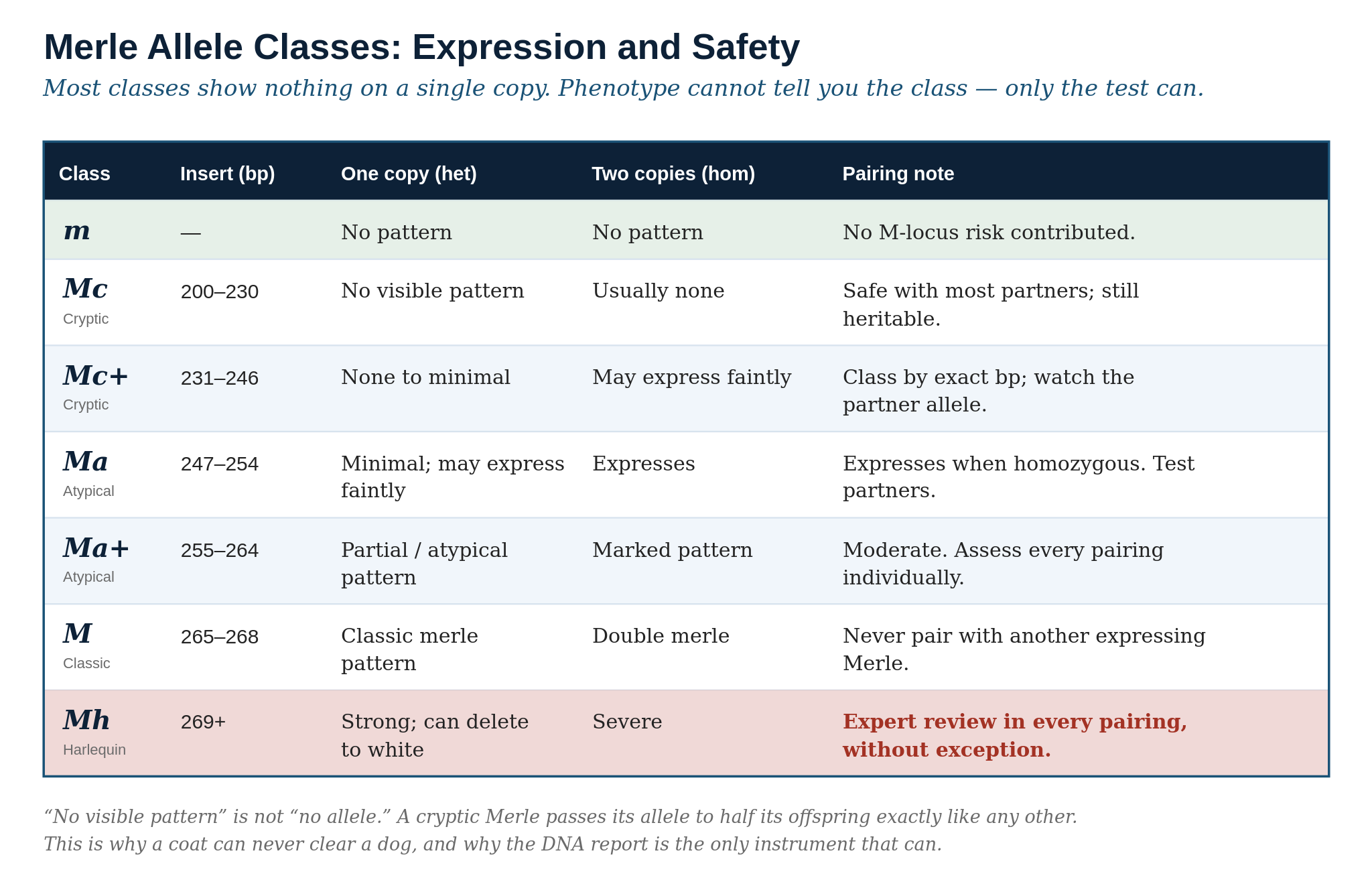
Expression and risk rise with length — a dose-response gradient, not a switch. Because the boundaries are binning of a continuous variable, a 254 bp and a 255 bp allele are neighbours, not opposites: classify from the reported base-pair value, and treat any result near a boundary as belonging to the more cautious class. For the complete risk matrix and pairing tables behind every one of those classes, see Volume II of the Poodle Genetics series.
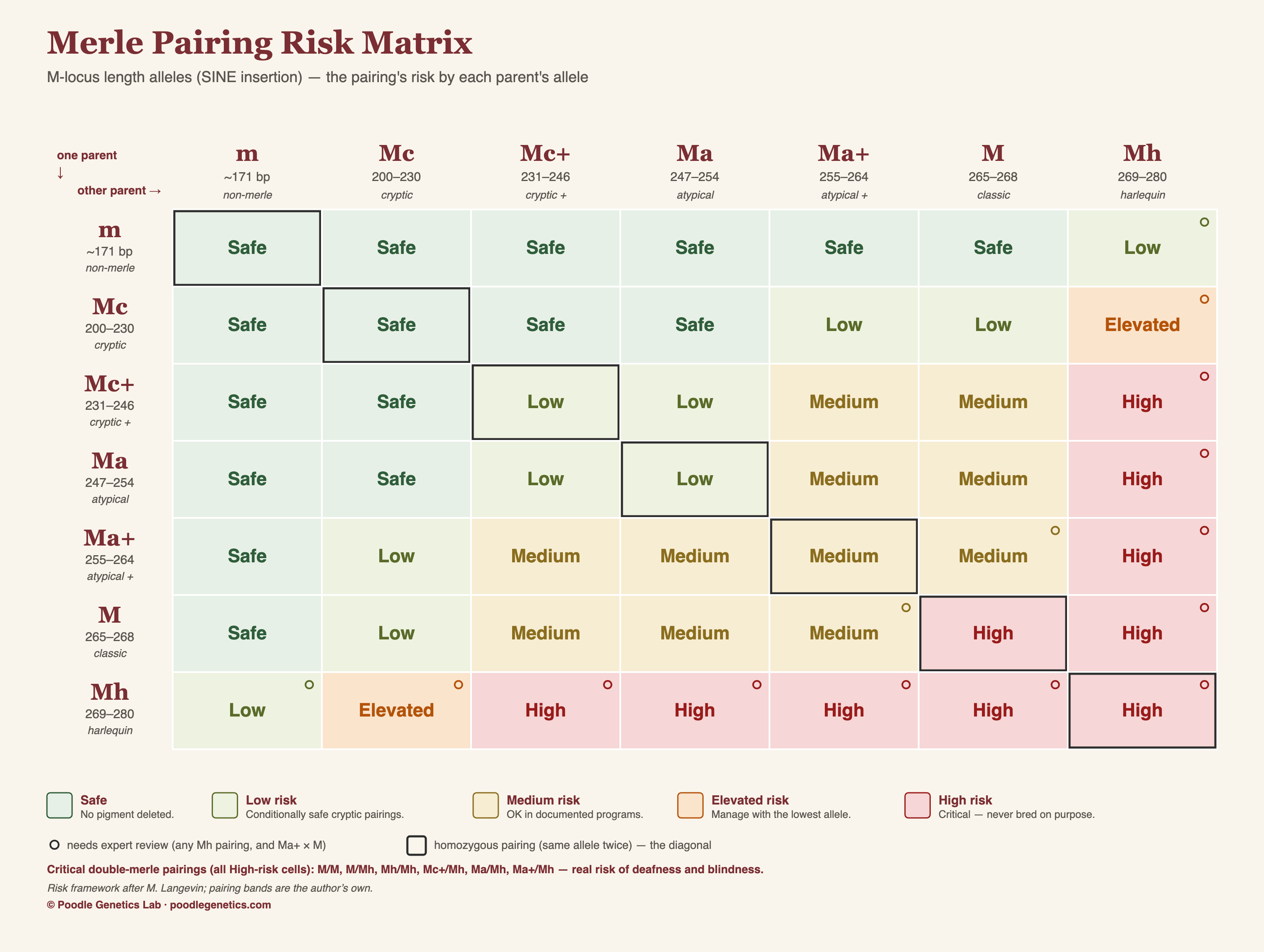
"No visible pattern" is not "no allele". A cryptic merle passes its allele to half its offspring exactly like any other merle. This is why a coat can never clear a dog, and why the DNA report is the only instrument that can.
The Merle Phenotype
A merle dog (Mm) shows a characteristic coat pattern: irregular, mottled patches of diluted color interspersed with areas of full eumelanin pigmentation. In black-based merle poodles, this appears as grey and black patches. On a brown-based merle, the patches are lighter brown/tan against full brown.
The pattern is random, no two merle dogs have the same exact pattern, because the SINE insertion affects PMEL expression in developing melanocytes in a stochastic (partly random) manner. Some merles have extensive dilution; others have minimal patterning that can be subtle enough to miss on casual inspection.
Merle also affects eye color. Merle dogs often have blue or blue-flecked eyes, or heterochromia (one blue, one brown eye). This occurs because the PMEL protein is involved in iris pigmentation as well as coat pigmentation.
Merle on Phaeomelanin Backgrounds
An important genetic point: merle does not visibly express on phaeomelanin-based coats (red, apricot, cream, ee dogs). An ee dog with the M allele will appear to be a normal-looking red or apricot dog because there is no eumelanin for the M allele to disrupt. However, the dog is genetically merle and can pass the M allele to offspring, where it will express if those offspring have eumelanin in their coats.
This is a critical safety concern: a "red merle" poodle may look like a solid red dog, but it is a merle. A dog with a merle allele is a merle — there is no silent "carrier" state for merle the way there is for a recessive gene, and no such thing as merle passing along invisibly as something a dog merely holds. The allele is simply not visible on that coat. If bred to another merle dog, the offspring statistics for double merle apply fully.
The Genetics of Merle Inheritance
The M allele is not simply dominant or recessive. It behaves closer to co-dominance: a single copy already produces the merle pattern, and a second copy produces a distinct, more severe phenotype (double merle) rather than being masked outright. What a merle dog looks like depends on the length of its insertion and on what is paired with it — which is why the allele table above has seven classes rather than two. The effects differ depending on how many copies are present:
- mm: Non-merle. Normal solid coat, no eye color alteration from M locus.
- Mm: Single merle (typical merle). Shows merle pattern in eumelanin-pigmented areas. Generally healthy, although some studies show modestly increased rates of hearing and vision defects even in single merles compared to mm dogs.
- MM: Double merle. Two copies of the M allele.
What Is a Double Merle?
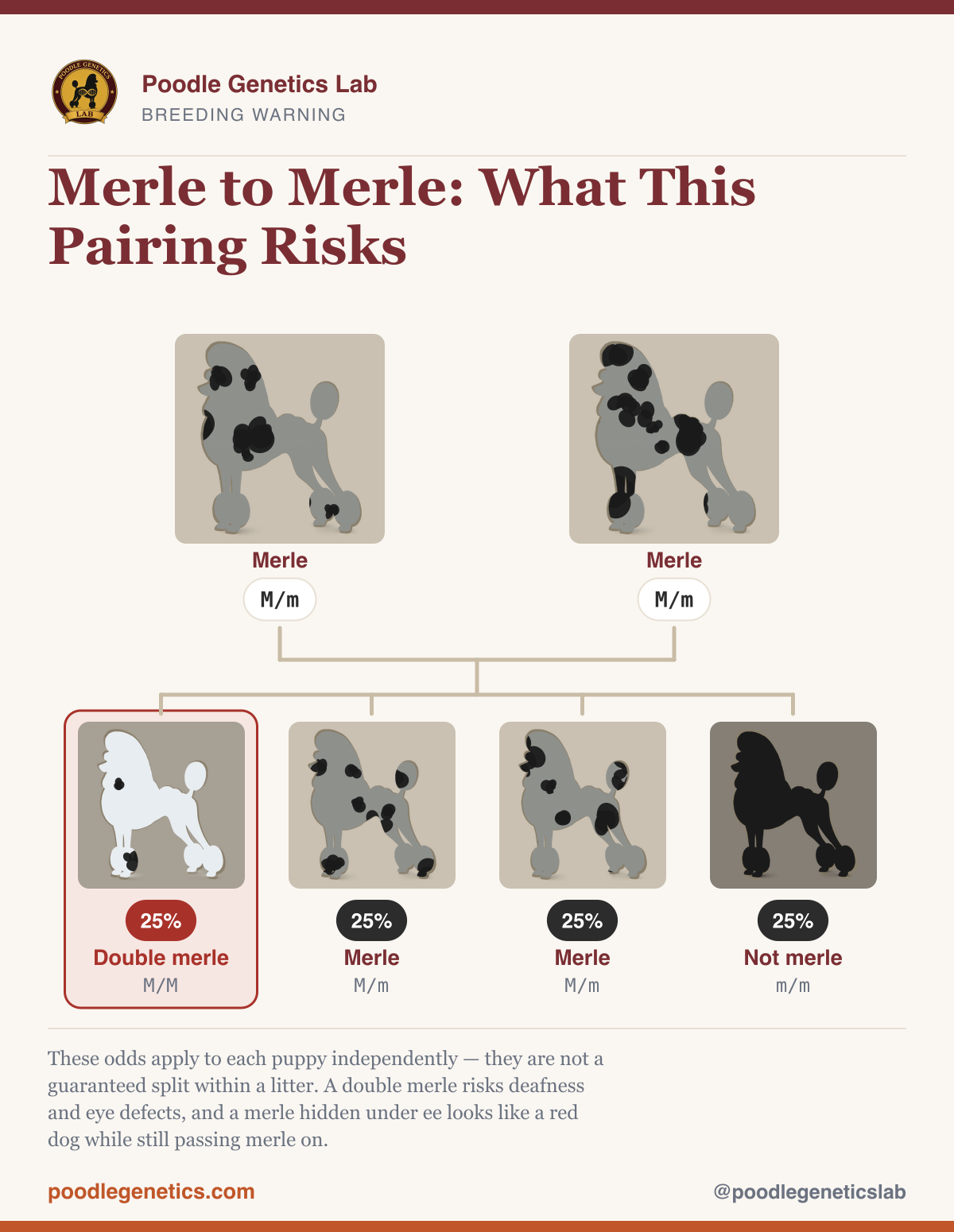
A double merle (MM) results from breeding a merle dog to another merle dog. Each puppy from a merle × merle pairing has:
- 25% chance of being mm (non-merle)
- 50% chance of being Mm (single merle)
- 25% chance of being MM (double merle)
Double merles often have predominantly white coats with reduced pigmentation. The extensive white coat results from the PMEL gene's role in melanocyte survival and migration, with two disrupted copies, many melanocytes fail to migrate and survive during embryonic development, leaving large areas without pigment-producing cells.
The sensory defects arise from the same developmental failure. Melanocytes are required for proper inner ear development (stria vascularis formation) and for aspects of retinal and eye development. Without them, the structures that enable hearing and vision do not form correctly.
What Statistics Say About Double Merle Outcomes
The health evidence on double merles comes from other merle-carrying breeds, not from poodles, and it is worth reading the numbers as they were actually measured:
- Hearing. The largest BAER-tested series (Strain et al. 2009, 153 merle dogs across multiple breeds) found some degree of hearing loss in 25% of double merles (10% deaf in one ear, 15% in both) versus 3.6% of single merles (2.7% unilateral, 0.9% bilateral), a statistically significant difference by genotype. That study did not include a non-merle comparison group, so a precise double-merle-versus-solid-dog ratio is not available from it; treat 25% as the best current estimate for double merles specifically, not as a multiple of a measured baseline.
- Eyes. Eye abnormalities including microphthalmia and coloboma are documented separately in double merles (Gelatt et al. 1981, Australian Shepherds), with severity tracking the amount of white in the coat.
- What the numbers do not say. Some double merles are otherwise healthy, since the defects are probabilistic rather than universal. The risk is substantial and cannot be screened prenatally, and no poodle-specific figures exist for either statistic; these are the best available evidence, not poodle-validated numbers.
The only way to avoid producing double merles is to never breed merle to merle.
Single Merle Health Considerations
Research suggests that even single merles (Mm) may have modestly elevated rates of auditory and ocular issues compared to mm dogs, particularly when merle patterning is extensive. The data here is less clear-cut than for double merles, and many single merle dogs are completely healthy throughout their lives.
Responsible breeders of merle poodles:
- BAER (Brainstem Auditory Evoked Response) test all merle offspring
- Have CAER (Companion Animal Eye Registry) exams performed on all merle breeding candidates
- Disclose merle status honestly to puppy buyers
Merle in Poodles: The Controversy
Is Merle a "Natural" Poodle Color?
This is the core of the community debate. Merle does not appear in the historical record of traditional poodle lines, and it is not among the colours the AKC standard describes. How it entered the breed is genuinely unknown, and honesty requires saying so. The leading hypothesis is introgression from a breed that has merle, such as the Australian Shepherd, followed by generations of backcrossing to poodles; a second is the deliberate crossbred trade; a third is that a short, cryptic insertion has been present in some lines longer than anyone noticed, invisible because it was too short to pattern a coat. Each is plausible. None is established for any particular pedigree. What can be measured today is a dog's insertion length; its ancestry several generations back is an argument, not a lab result.
This does not automatically make merle poodles invalid, all breeds have mixed ancestry at some point, but it does mean that the presence of merle in poodle lines is relatively recent and that pedigrees of merle poodles often cannot be traced to registered poodle-only ancestry for the relevant generation.
One point of frequent confusion should be separated cleanly: registration and the breed standard are different things. A merle poodle with two registered parents is itself registrable with the AKC, exactly as a parti poodle is. What merle is not is a standard colour, so it cannot be shown in conformation. "Not a standard colour" and "cannot be registered" are not the same claim, and the difference matters when a buyer is told a merle "can't be papered."
The Case Against Condemning All Merle Breeding
It is worth acknowledging the arguments made by those who breed merle poodles responsibly:
- The M allele itself is not inherently harmful in a single copy. An Mm dog with BAER-confirmed hearing and CAER-confirmed vision is a healthy dog.
- Aesthetic preferences are legitimate as long as health is not compromised.
- The health risk is entirely avoidable with proper breeding practice, never breed merle to merle.
- Genetic testing has advanced to the point where M allele identification is reliable and affordable.
The real objection to merle poodle breeding among experts is not the genetics itself but the misrepresentation, lack of testing, and irresponsible double merle production that has accompanied merle's popularization in poodles as a designer color. A breeder who DNA tests, never breeds merle × merle, BAER tests all merle offspring, and discloses everything honestly is doing something meaningfully different from a breeder who breeds for color without understanding what they are doing.
The Cryptic Merle Problem
One of the most serious risks in merle breeding involves cryptic merle (Mc) dogs, which are merle but show no merle pattern because the insertion is too short to disrupt pigmentation (or show only very subtle merle) because their SINE insertion is too short to fully disrupt pigmentation.
A cryptic merle Mc can be:
- Visually indistinguishable from a solid-colored dog
- Sold and bred without knowledge of their M-locus result
- Bred to a merle dog, producing double merle offspring, even though the cryptic parent appeared solid
This is why DNA testing is mandatory, not optional, for any responsible merle breeding program. Visual assessment of the coat cannot rule merle out. Only the test can.
What Responsible Merle Poodle Breeding Looks Like
If you choose to breed merle poodles, this is the minimum standard:
- DNA test every potential merle breeding dog for M locus status before breeding
- Never breed Mm × Mm (or any merle × merle combination, including Mc variants)
- BAER test all puppies from merle parents before placement
- CAER eye exams for all breeding-age merle dogs
- Full disclosure to buyers of merle genetics and associated health risks
- Screen pedigrees for unknown or suspicious color histories that might indicate hidden merle ancestry
- Maintain records of all M locus test results for your breeding program
Additionally, responsible breeders perform all standard poodle health testing (hips, elbows, eyes, heart) alongside these merle-specific tests.
Identifying Merle Offspring
From a merle × non-merle pairing:
- 50% of puppies will be Mm (merle)
- 50% of puppies will be mm (non-merle)
All puppies should be DNA tested regardless of apparent phenotype, to identify cryptic merles among the "solid" offspring — a cryptic merle is a merle, and passes its allele to half its own offspring.
From a merle × cryptic merle pairing: this is effectively a merle × merle situation and can produce double merles. This is why comprehensive M locus testing must capture cryptic alleles, not just classic M.
Color Interactions With Merle
Merle expression varies with the underlying base color:
The name follows the pigment the merle is patterning, which is set by B and D:
- Black-based merle (merle on B_ D_): the classic grey-and-black mottled coat, black nose
- Blue merle (merle on B_ dd): the true blue merle is the dilute merle — lighter and silvery, dilute from birth, slate nose
- Brown-based merle (merle on bb D_): brown and tan mottling, liver nose
- Lilac merle (merle on bb dd): dilute brown merle, the palest of the four
- Red/apricot merle (merle on ee): phenotypically invisible. The dog looks solid red or apricot and is still a merle
- Phantom merle (merle on a phantom base — A locus, kyky): merle shows in the eumelanin areas only; the tan points are unaffected. This requires kyky — a KB dog cannot be phantom at all, because dominant black masks the A locus
The interaction between merle and the ee genotype is particularly important from a safety standpoint. Breeding an "apricot" poodle without knowing its M locus status is a risk if it will be paired with any merle dog.
Summary: What Every Breeder Must Know
| Genotype | Phenotype | Key Risk |
|---|---|---|
| mm | No merle | None from M locus |
| Mm | Merle pattern | Low individual health risk; can produce double merle offspring if bred to any merle |
| MM | Double merle | ~25–30% rate of deafness; ~25% rate of eye defects |
| Mc (cryptic) | Appears solid | Can produce MM offspring, MUST be identified by DNA test |
The bottom line is straightforward: merle is manageable with knowledge and discipline; it is dangerous when combined with ignorance or carelessness. The science does not condemn merle poodle breeding categorically, but it condemns double merle production without qualification. DNA test. BAER test. Never breed merle to merle. Those three rules are not optional.
Download the Merle Health Risk Chart for a printable summary.
This article is educational and is not veterinary advice. Discuss breeding and clinical decisions with your veterinarian.
Built on identified genes and validated tests. The claims here are supported by the peer-reviewed literature listed below.
- Published
- December 10, 2024
- Last reviewed
- September 8, 2026
References
- Langevin M, Synková H, Jančušková T, Pekova S (2018). Merle phenotypes in dogs — SILV SINE insertions from Mc to Mh. PLoS ONE 13(9):e0198536. doi:10.1371/journal.pone.0198536
- Strain GM, Clark LA, Wahl JM, Turner AE, Murphy KE (2009). Prevalence of deafness in dogs heterozygous or homozygous for the merle allele. Journal of Veterinary Internal Medicine 23(2): 282–286. doi:10.1111/j.1939-1676.2008.0257.x
- Gelatt KN, Powell NG, Huston K (1981). Inheritance of microphthalmia with coloboma in the Australian shepherd dog. American Journal of Veterinary Research 42(10): 1686–1690. link
Free Tool
Apply This Knowledge
Model any parent pair with our interactive genetics calculator.


