Ask any breeder who has worked with red poodles for the story, and it is always the same story. A litter of deep, glowing mahogany puppies. Deposits taken on the promise of red. And then, somewhere between four months and the first birthday, the fire goes out of the coat and a rich red becomes an ordinary apricot. The disappointment is real, the buyers are unhappy, and the breeder is left explaining something they did not fully predict themselves.
This article is about why that happens, why it is so stubbornly hard to prevent, and what actually works. The short version is that red intensity is polygenic and there is no test for it, which means it behaves very differently from the loci breeders are used to controlling. Understanding that difference is the whole game.
First, What Red Actually Is
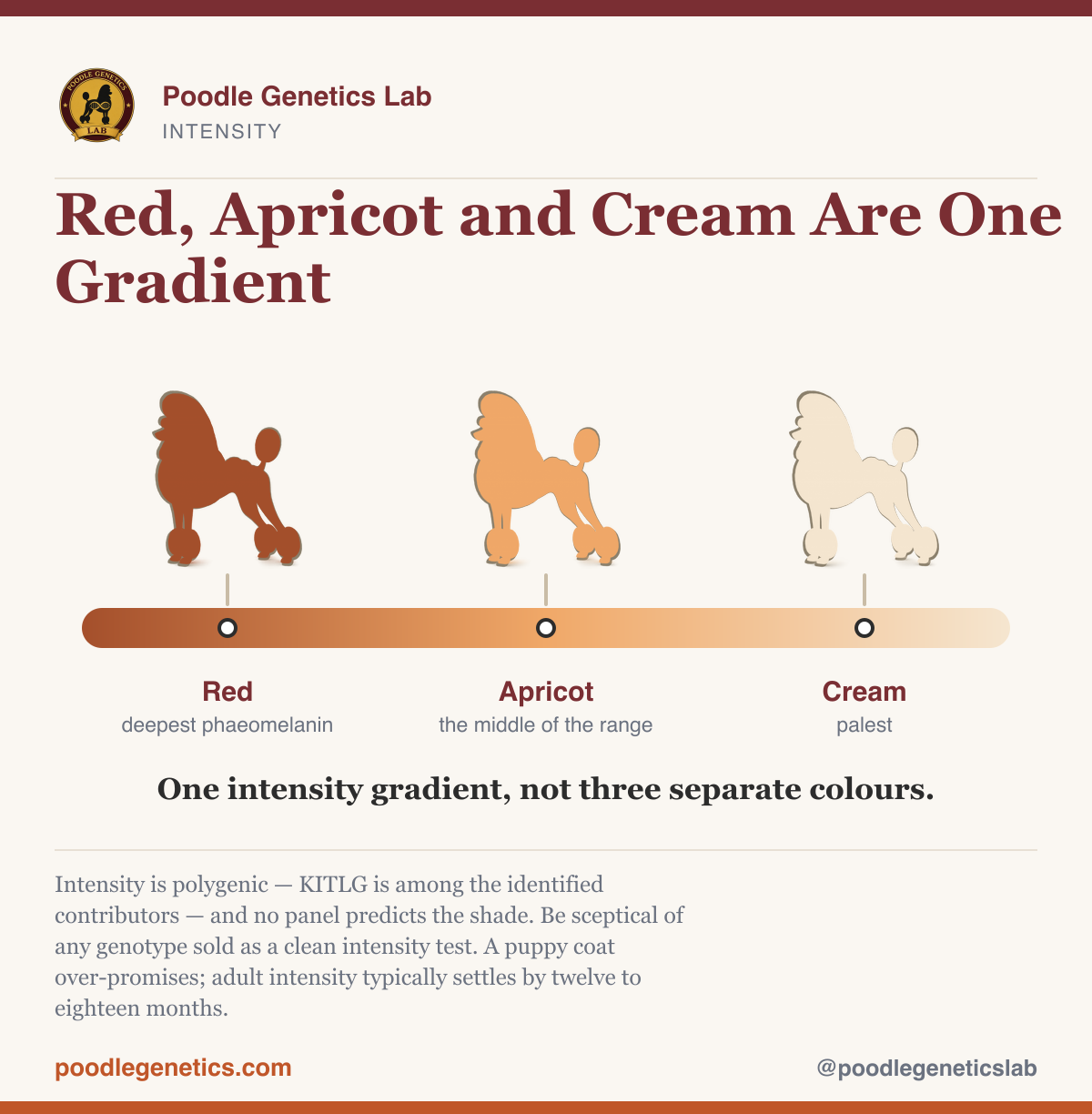
Every red, apricot, and cream poodle is the same thing at the E locus: e/e. Two copies of the recessive extension allele mean no eumelanin, the dark pigment, reaches the coat. What is left is phaeomelanin, the warm reddish-yellow pigment, and the entire visible range from deep red through apricot to pale cream is a matter of how intensely that phaeomelanin is expressed.
This is the first thing to internalise: red, apricot, and cream are not three different colours in the genetic sense. They are three points on a single intensity gradient, and a dog can move along that gradient as it matures. A "red" puppy and an "apricot" adult can be, and often are, the same dog at two different points on the same curve.
Why It Is So Hard to Predict: Polygenic Means No Single Switch
The loci breeders learn first, B for brown, D for dilution, E for extension, are mostly clean single-gene switches. One gene, a couple of alleles, a testable result, a predictable outcome. Intensity is not like that.
Intensity is polygenic. It is controlled by many genes of small effect, working together, and the known factors explain only part of the variation. In poodles specifically the identified contributors include KITLG and a variant linked to GPR22 (Batcher et al., 2022). There are others not yet identified. This is why:
-
No single test predicts the shade. There is no "red gene" to test for. A panel cannot tell you whether your ee puppy will hold deep red or clear to cream, because the outcome is the sum of many small contributions rather than one switch. Be sceptical of any product or genotype, "I/I", "i/i", offered as a clean intensity answer; it is ahead of the science.
-
The ratios do not behave cleanly. With a single-gene recessive you get tidy 1:4 Mendelian outcomes. With a polygenic trait you get a spread, a bell curve of intensities across a litter, and two deep-red parents can still throw a range from rich red to light apricot because each puppy inherits a different combination of the many small-effect variants.
-
Selection is slow. Because you are selecting on the combined effect of many genes rather than fixing one allele, progress toward consistently deep red takes generations of careful choice, not a single well-planned mating.
The Fade Itself: What Changes and When
Two distinct things get called "fading," and separating them prevents a great deal of confusion.
Intensity clearing (the usual culprit)
Most red-to-apricot fading is the intensity gradient expressing itself over time. The puppy coat often carries more apparent depth than the adult coat will, and as the adult coat comes in, the true intensity, set by that polygenic background, reveals itself. This is not damage and not greying; it is the dog arriving at its genetically determined adult intensity. It typically resolves by 12 to 18 months, after which the colour is relatively stable.
Progressive greying (a different mechanism entirely)
A minority of apparent "red fading" is actually progressive greying, and this matters because greying is a completely different factor. Greying acts on eumelanin, so a genuinely e/e dog with no coat eumelanin is not greying in the coat. But a dog you believe is a deep red might carry more going on than the coat shows, and lines that carry greying can produce complicated cases. The tell is the pattern and timing: pure intensity clearing is a smooth, overall lightening toward apricot or cream; greying tends to arrive differently. When in doubt, the pedigree, whether greying runs in the line, is more informative than the coat.
The practical point: do not assume every fade is the same mechanism. Most is intensity. Some is not.
What Actually Works
If intensity cannot be tested and does not follow clean ratios, is red breeding just luck? No. It is selection, and experienced red breeders stack the odds with a consistent set of practices.
Select on adults, not puppies. This is the single most important discipline. Because the puppy coat over-promises, the only honest evidence of a dog's intensity is its own adult coat, evaluated at 18 months or later. A breeding program built on adult colour will drift toward depth; one built on puppy colour will chase its own tail.
Look at the whole family, not the individual. Since intensity is the sum of many small-effect genes, a dog's siblings, parents, and produced offspring tell you more about what it will pass on than its own coat does. A moderately red dog from an intensely red family may be a better intensity producer than a flashier dog from a mixed one.
Breed depth to depth, consistently. With a polygenic trait, the reliable lever is to concentrate the small-effect variants by repeatedly selecting the deepest adults on both sides. There is no shortcut mating that fixes intensity in one generation; there is steady accumulation across several.
Record and photograph honestly, at a fixed age. Because the trait is subtle and shifts with maturity, a program benefits enormously from standardised records: photograph every dog at the same age, in the same light, and track how puppy colour predicted adult colour in your own lines. Over a few litters this becomes the most valuable intensity data you own, precisely because no lab can sell it to you.
Be honest with buyers about the puppy coat. The disappointment that damages a breeder's reputation is almost always the gap between a promise and an outcome. A buyer told "this deep red puppy will likely clear somewhat toward apricot as an adult, here are the parents at maturity" is a buyer who stays happy. Selling the puppy coat as the final colour is selling something you cannot guarantee.
The Honest Bottom Line
Red intensity is the clearest example in the whole of poodle colour of a trait that is real, visible, heritable, and untestable. It does not yield to a panel, it does not follow clean ratios, and it shifts as the dog matures. That combination makes it the most frustrating trait in the breed to work with, and also the one where genuine skill, patient selection on adult colour across whole families, still separates the serious breeder from the lucky one.
Anyone who tells you they can test a puppy and guarantee its adult red is either mistaken about the science or selling something. The truth is less convenient and more useful: watch the adults, know the families, breed depth to depth, and tell your buyers what a puppy coat can and cannot promise.
The Poodle Color Genetics Calculator models the loci that do follow clean inheritance, and flags intensity as a polygenic trait it cannot reduce to a single predicted shade. For the full treatment of phaeomelanin intensity and the poodle-specific research, see Poodle Color Genetics, 2nd Edition. Download the Red Intensity & Fading Reference for a printable summary of the two fade mechanisms and what actually works.
Credible evidence supports what is described here, but the mechanism, the population studied, or its application to Poodles still has limits. The literature below is real and cited in full; where it stops short, the article says so rather than rounding up.
- Published
- July 16, 2026
- Last reviewed
- September 5, 2026
References
- Weich K, Affolter V, York D, et al. (2020). Pigment intensity in dogs is associated with a copy number variant upstream of KITLG. Genes 11(1):75. doi:10.3390/genes11010075
- Honkanen L, Loechel R, Davison S, Donner J, Anderson H (2024). Canine coat color E locus updates: identification of a new MC1R variant causing ‘sable’ coat color in English Cocker Spaniels and a proposed update to the E locus dominance hierarchy. Animal Genetics 55(2):291–295. doi:10.1111/age.13398
- Batcher K, Varney S, Affolter VK, Friedenberg SG, Bannasch D (2022). An SNN retrocopy insertion upstream of GPR22 is associated with dark red coat color in Poodles. G3: Genes|Genomes|Genetics 12(11):jkac227. doi:10.1093/g3journal/jkac227
Free Tool
Apply This Knowledge
Model any parent pair with our interactive genetics calculator.