Which Lab Should You Actually Use?
That question gets asked before a single result exists, and it deserves an answer that isn't just a brand recommendation. The honest version of the question is narrower: which loci does each lab actually report for a poodle, because that's what determines whether the swab you buy can answer the question you're breeding for.
This is a coverage comparison, not a how-to-read-your-results guide. If you already have a report in hand and want help interpreting what the letters mean, see how to read a poodle DNA color panel instead. This article is about what to buy before you have a report at all.
Locus Coverage by Lab
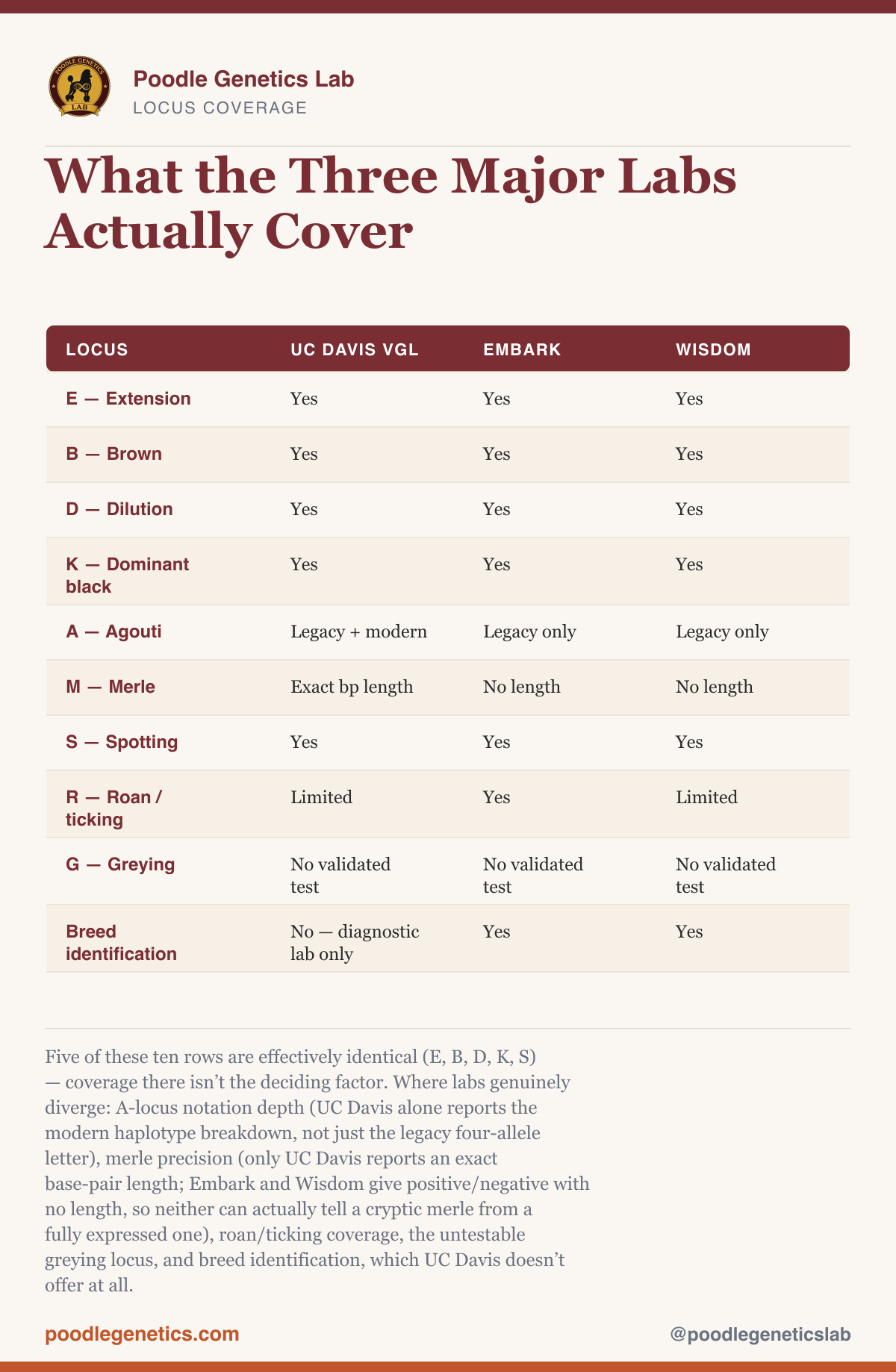
The table below reflects the same lab-comparison data this site maintains on its Resources page, locus by locus, across the three major providers most poodle breeders compare: UC Davis Veterinary Genetics Laboratory, Embark, and Wisdom Panel.
| Locus | UC Davis VGL | Embark | Wisdom Panel |
|---|---|---|---|
| E (Extension) | Yes | Yes | Yes |
| B (Brown) | Yes | Yes | Yes |
| D (Dilution) | Yes | Yes | Yes |
| K (Dominant Black) | Yes | Yes | Yes |
| A (Agouti) | Yes — legacy + modern haplotypes | Yes — legacy notation only | Yes — legacy notation only |
| M (Merle) | Yes — exact base-pair length | Yes — positive/negative only, no length | Yes — positive/negative only, no length |
| S (Spotting) | Yes | Yes | Yes |
| G (Greying) | No validated test | No validated test | No validated test |
| R (Roan/Ticking) | Limited | Yes | Limited |
| Breed identification | No — single-locus diagnostic lab, not an ancestry product | Yes | Yes |
A few things worth reading directly off that table rather than assuming:
- E, B, D, K, and S are a wash. All three labs report these the same way. If that's all you need, coverage isn't the deciding factor, other things (price, health add-ons, turnaround, report format) are.
- A locus depth is not a wash. UC Davis VGL reports both the legacy four-allele notation and the modern haplotype breakdown (DY, SY, AG, BS, BB1–BB3); Embark and Wisdom Panel report legacy notation only. The legacy at allele in particular covers two different modern haplotypes that behave differently in a phantom breeding program, so the modern breakdown is real added information, not just a different label for the same result.
- Merle is reported by all three, but not with the same precision. UC Davis VGL reports the exact base-pair length of the insertion. Embark and Wisdom Panel report merle as positive or negative only, with no length, which means neither can actually distinguish a cryptic, barely-expressing merle from a fully expressed one. That distinction is exactly what matters for double-merle risk, more on that below.
- Breed identification is not a UC Davis product. Embark and Wisdom Panel are consumer ancestry/breed-mix tests as much as they are color and health panels; UC Davis VGL is a single-locus diagnostic lab and doesn't offer breed identification at all. If ancestry is part of why you're testing, that rules UC Davis out on its own.
- No lab tests for greying. This isn't a gap one provider has closed and the others haven't. Of the labs we surveyed for this comparison, none currently offers a validated DNA test for progressive greying, and the causative gene has not been identified in the published literature. Any product marketed as testing "the greying gene" is selling something the current science can't deliver.
- Roan/ticking coverage is uneven. Embark reports it; UC Davis VGL and Wisdom Panel offer only limited coverage. If roan or ticking specifically matters to your program, that's the one row where the lab you pick changes what you can learn.
Choosing a Lab Based on What You Actually Want
If you want color prediction
The core color loci (E, B, D, K, A, S, M) are covered everywhere, so lab choice comes down to secondary factors: whether you also want roan/ticking coverage (Embark), whether you want an à la carte single-locus test from an academic lab (UC Davis VGL), or a broader consumer panel with its own breeder tools (Wisdom Panel). None of the three will tell you a puppy's exact red shade or how much white a parti will carry, that's polygenic and modifier-driven, and no panel from any lab measures it directly.
If you want health screening
Health screening is a different product from color testing, and coverage varies by lab and by panel tier in ways this comparison, focused on the color loci, doesn't capture. What's consistent across labs: a health panel tells you carrier and at-risk status for the specific conditions it screens, nothing more and nothing less. Once you have results, run them through the DNA Interpreter's health tool to see what a given result actually means for a pairing, rather than reading a single line in isolation.
If you want both
Most breeders end up wanting a combined color-plus-health panel in a single swab rather than separate tests from separate labs. Whichever lab you land on, the coverage table above tells you what its color panel can and can't answer; pair that against the health panel's own condition list before you buy.
If you're deciding which provider to actually order from, the fuller breakdown, including pricing, turnaround, and which lab this site links to as an affiliate, is on the DNA testing page.
The Notation Problem: Why the Same Locus Looks Different on Different Reports
Coverage is only half the story. Even when two labs both report the A locus or the M locus, they don't necessarily report it the same way, and this is where PGL's coverage comparison turns into something more useful than a checklist.
A locus notation. Some labs still report the legacy four-allele system (Ay, aw, at, a). Others report the modern haplotype system (DY, SY, AG, BS, BB1–BB3). The legacy at allele in particular covers two different modern haplotypes, black saddle and black back, that behave differently in a phantom breeding program. A report that only gives you the legacy letter is telling you less than it looks like it's telling you.
Merle notation. This is the one that causes the most expensive mistakes. A merle-positive result reported as a base-pair length is a usable breeding number. A merle-positive result reported as a plain yes/no, with no length, is not, it can't distinguish a cryptic, barely-expressing merle from a fully expressed one, and that distinction is exactly what matters for double-merle risk.
Health notation. Different labs use different shorthand for the same carrier/at-risk status, and some report a raw genotype where others report a category label.
None of this means a lab is wrong, it means labs don't share a single notation standard, and a breeder comparing a UC Davis result against an Embark result (or fielding one of each from two different puppy buyers) is translating between two dialects, not reading one language. This is exactly the problem the DNA Interpreter was built to solve: you enter your lab's exact reported notation, legacy or modern A-locus, base-pair merle length or a simple positive, and it tells you what that specific notation means rather than forcing you to guess whether your lab's "at" means the same thing as someone else's.
The Bottom Line
For the standard color panel, the three major labs cover the same core loci, so coverage alone won't pick a lab for you. Where they genuinely diverge is roan/ticking coverage, and in how precisely they report merle and A-locus results, precision that determines whether a result is directly usable for a breeding decision or needs a second look. None of the three tests for greying, and none of them ever will until the causative gene is identified. Buy for the loci you actually need reported, then read whatever comes back against the lab's own notation, not a notation from a different report.
Download the Poodle Health Panel Worksheet for a printable summary.
This article is educational and is not veterinary advice. Discuss breeding and testing decisions with your veterinarian.
Built on identified genes and validated tests. The claims here are supported by the peer-reviewed literature listed below.
- Published
- August 27, 2026
- Last reviewed
- September 8, 2026
References
- Bannasch DL, Kaelin CB, Letko A, et al. (2021). Dog colour patterns explained by modular promoters of ancient canid origin. Nature Ecology & Evolution 5(10):1415–1423. doi:10.1038/s41559-021-01524-x
- Langevin M, Synková H, Jančušková T, Pekova S (2018). Merle phenotypes in dogs — SILV SINE insertions from Mc to Mh. PLoS ONE 13(9):e0198536. doi:10.1371/journal.pone.0198536
Free Tool
Apply This Knowledge
Model any parent pair with our interactive genetics calculator.