The Question Before the Question
Most poodle DNA testing advice starts one step too late. It assumes you already know you want a color panel, or a health panel, or both, and it walks you through which lab reports which locus, or how to read the letters once a report lands in your inbox. Useful, but it skips the questions a genuine first-timer is actually stuck on: what should I even order, for which dog, what will it cost, and by when?
This is that earlier step. If you already have results and need help reading them, see how to read a color panel or how to read a health panel. If you know you want color and/or health and just need to pick a provider, see the lab-by-lab coverage comparison. If you're past ordering and into building an actual testing program for a breeding dog, CHIC requirements, screening ages, and all, see the first health-testing panel checklist. This article is for the decision that comes before any of those: what to buy, what it costs, and when to order it.
Color, Health, or Both?
Color only makes sense if you're simply curious what a dog carries, or you're choosing a pet-quality puppy and want to know its coat possibilities. It won't tell you anything about the dog's health status.
Health only makes sense for almost nobody in practice, because health panels are typically sold alongside color testing in the same swab at little or no extra cost. There's rarely a reason to skip color if you're already paying for a kit and a lab fee.
Both is the right default for anyone actually planning to breed, not just own, a poodle. A health result changes what pairings are safe. A color result changes what a pairing can produce. Neither substitutes for the other, and a breeder who orders only one is going to be back at the lab within a year buying the other.
One Dog, or Both Sides of a Pairing?
This is the distinction first-time breeders miss most often. Testing your own dog tells you what your own dog carries. It does not, by itself, tell you anything about a pairing, because a pairing's risk depends on both parents.
If you're a pet owner or simply curious, one dog is the whole answer. If you're evaluating a specific breeding, both dogs need results before you commit to the pairing, not after. A carrier x carrier combination, or a merle x merle combination, is a completely different decision than a carrier x clear one, and you can't tell which you're looking at from one dog's report alone. This also means the budget question below is almost always a two-dog question, not a one-dog question, and first-time breeders routinely price out only their own dog's test before realizing the mate's needs one too.
What a First Panel Actually Costs
Nobody plans a first purchase around a locus table. They plan it around a number, and the poodle DNA testing world has two genuinely different pricing models sitting side by side, which is exactly why cost planning gets skipped or guessed at.
Tier one: the bundled consumer panel. Embark and Wisdom Panel both sell a single combined color-plus-health kit for one flat price. As of this writing, Embark's Breed + Health kit lists around $199, with the company frequently running promotions that bring it closer to $150–160; its breed-ID-only tier, without health, runs roughly $109–129 and is the wrong buy for anyone actually breeding. Wisdom Panel's Premium kit, which bundles breed, health, and traits, lists around $159. Embark also sells a breeder-specific kit line with per-kit discounts for anyone testing more than one dog, worth checking if you're planning to test an entire breeding program rather than a single pairing.
Tier two: the academic à la carte lab. UC Davis VGL prices differently, by the test, not by the dog. Its all-breed Basic Coat Color Panel runs around $100 per animal, with each additional single-locus color test added at roughly $15–16. Health conditions are priced and ordered as separate, individual tests rather than bundled into one health product, so a UC Davis order for full color plus a handful of relevant health variants is typically assembled test-by-test rather than bought as one SKU; check the current listing before ordering, since VGL updates individual test prices independently of each other. Turnaround is also different here: VGL's coat color panels run a minimum of about 15 business days, longer than the 2–3 weeks Wisdom Panel and Embark typically quote.
What this means for your actual budget. A single combined kit from Embark or Wisdom Panel is the simplest way to price a first panel: one number, one shipment, one report, in the rough $150–200 per dog range depending on current promotions. Building an equivalent picture from UC Davis costs less per individual test but adds up across several line items and takes longer to land in your inbox, an academic-lab tradeoff, not a discount. Either way, double the number if you're pricing a specific pairing rather than one dog. The lab comparison covers what each provider's price actually gets you, locus by locus; the DNA testing page has current pricing and links for whichever provider you land on.
Building a Real Timeline
"At your own pace" and "before this specific litter" are two different clocks, and confusing them is how breeders end up rushing a decision they didn't need to rush, or discovering too late that a result changes their plans with no runway left to act on it.
At your own pace applies if you're building general knowledge about a dog you own, or planning a breeding program months or years out. There's no deadline. Order when convenient, and use the time to actually read the results rather than skim them.
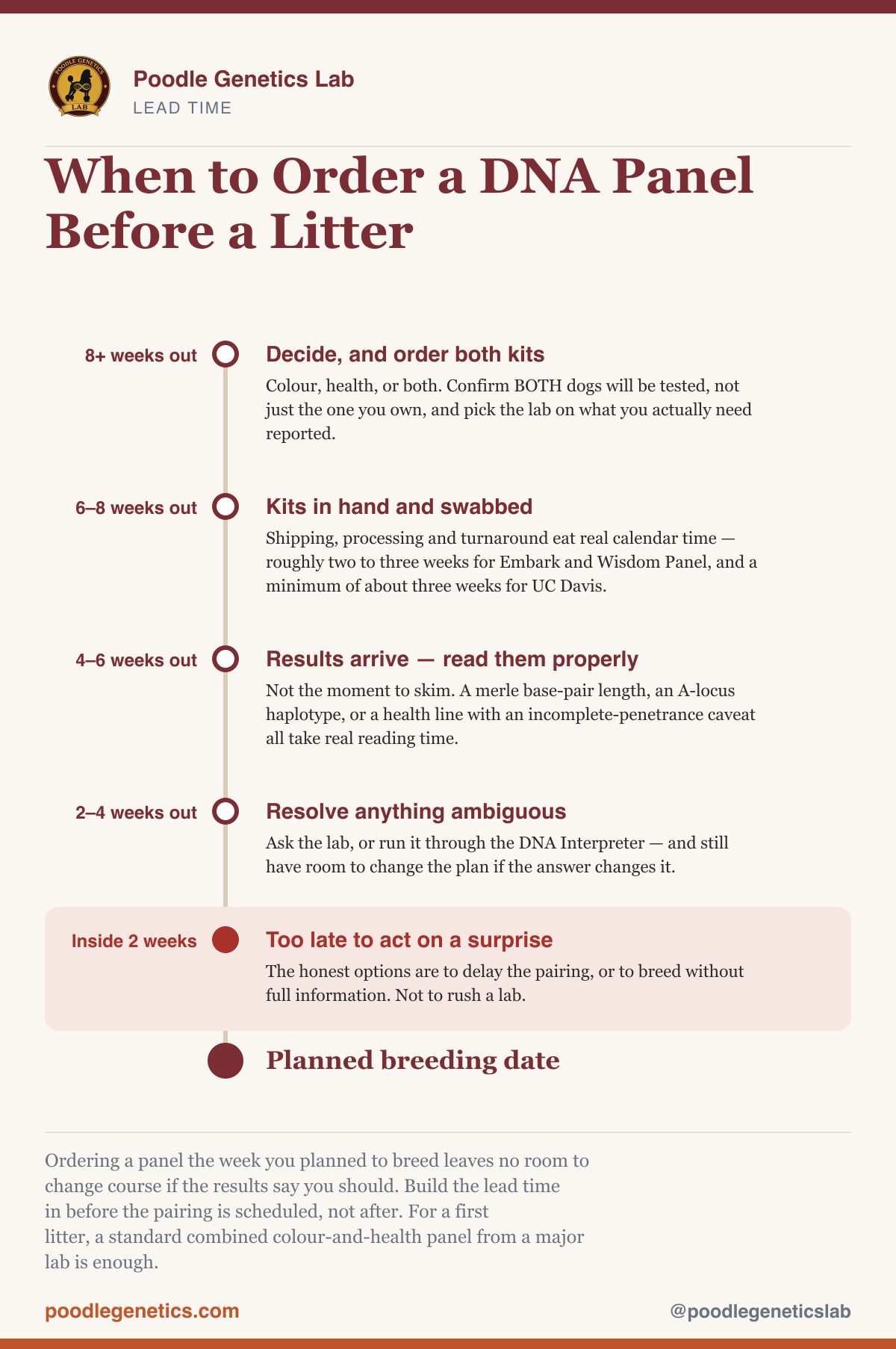
Before this specific litter applies if you already have a pairing in mind and a date, or a season, attached to it. Here, lead time is not a formality, it's the difference between a result you can act on and one you can only regret. Work backward from the planned breeding date:
- 8+ weeks out: decide color, health, or both, and confirm both dogs will be tested, not just the one you own. Order both kits now. This is also the point to pick a lab based on what you actually need reported (see the lab comparison if roan, ticking, or a specific health variant matters to the pairing).
- 6–8 weeks out: kits should be in hand and swabbed. Shipping to the lab, processing, and standard turnaround (roughly 2–3 weeks for Embark and Wisdom Panel, closer to a minimum of 3 weeks for UC Davis panels) eats real calendar time even before anything unexpected happens.
- 4–6 weeks out: results should be arriving. This is not the moment to skim them. A merle base-pair length, an A-locus haplotype, or a health line with an incomplete-penetrance caveat all take real reading time, covered in how to read a color panel and how to read a health panel.
- 2–4 weeks out: if anything in the results is ambiguous, an unclear merle length, a notation you can't translate, a health line your lab interprets differently than you expected, this is your window to run it through the DNA Interpreter or ask the lab directly, and still have time to change the plan if the answer changes it.
- Inside 2 weeks: too late to meaningfully act on a surprising result. If you're here without results in hand, the honest options are to delay the pairing or to breed without full information, not to rush a lab.
Ordering a panel the week you planned to breed leaves no room to change course if the results say you should. Build the lead time in before the pairing is scheduled, not after.
The Pre-Order Checklist
Four decisions, in order, before you place an order:
- Scope: color only, health only, or both? (Almost always both, if you're breeding, not just owning.)
- Subjects: one dog, or both sides of a specific pairing? (Both, the moment a real litter is under consideration.)
- Budget tier: one bundled kit per dog (~$150–200, simplest, fastest), or an à la carte academic panel (cheaper per test, slower, assembled line by line)? Multiply by the number of dogs being tested.
- Timeline: at your own pace, or working backward from a specific breeding date? If the latter, has the full 8-week window above been built into the plan, not just the swab-and-ship part of it?
If every box above is checked before you open a lab's order page, the actual purchase, which provider, which panel tier, is a five-minute decision instead of the thing that stalls a first-time breeder for a month.
What a First Panel Should Cover
For a first-time breeder, a standard combined color-and-health panel from one of the major labs is enough. It's not necessary to chase an à la carte single-locus test unless you already have a specific reason to, such as resolving a haplotype ambiguity the standard panel left open. Coverage of the core color loci is essentially interchangeable across the major providers; the lab comparison breaks down where they actually diverge, mainly roan/ticking coverage and how precisely merle and A-locus results are reported.
What Happens After the Swab
Once results arrive, the job shifts from ordering to reading. A color report is read locus by locus, with several places a first-timer commonly gets misled, covered in how to read a color panel. A health report is read line by line, since not every result means what its label suggests, covered in how to read a health panel. If your results come from a lab whose notation you're unsure how to translate, legacy or modern A-locus letters, a base-pair merle length instead of a plain positive, run them through the DNA Interpreter, which takes your lab's exact reported notation and tells you what it means without asking you to guess. And once the DNA is in hand and read, it's only one input into a broader testing program, physical screenings, CHIC minimums, population diversity, which the health-testing checklist walks through next.
The Bottom Line
Before you compare labs or learn to read a report, settle four things: color, health, or both (almost always both, if you're breeding); one dog or both sides of a pairing (both, if a specific litter is the goal); which pricing tier actually fits, a single bundled kit around $150–200 per dog or a slower, cheaper-per-test academic panel; and whether you're working at your own pace or against a litter's timeline, which decides how much of that eight-week runway to build in before you're locked into a breeding date. Get those four decisions right first, and the lab comparison and the reading guides will actually be useful when you get to them, instead of answering questions you weren't ready to ask yet.
This article is educational and is not veterinary advice. Prices and lab turnaround times change; confirm current pricing directly with each provider before budgeting a specific figure. Discuss breeding and testing decisions with your veterinarian.
Download the Poodle Health Panel Worksheet for a printable summary.
Built on settled, deterministic reasoning or a directly observable fact rather than a specific cited study, so no References section appears below.
- Published
- September 4, 2026
- Last reviewed
- September 8, 2026
Free Tool
Apply This Knowledge
Model any parent pair with our interactive genetics calculator.