The Short Answer
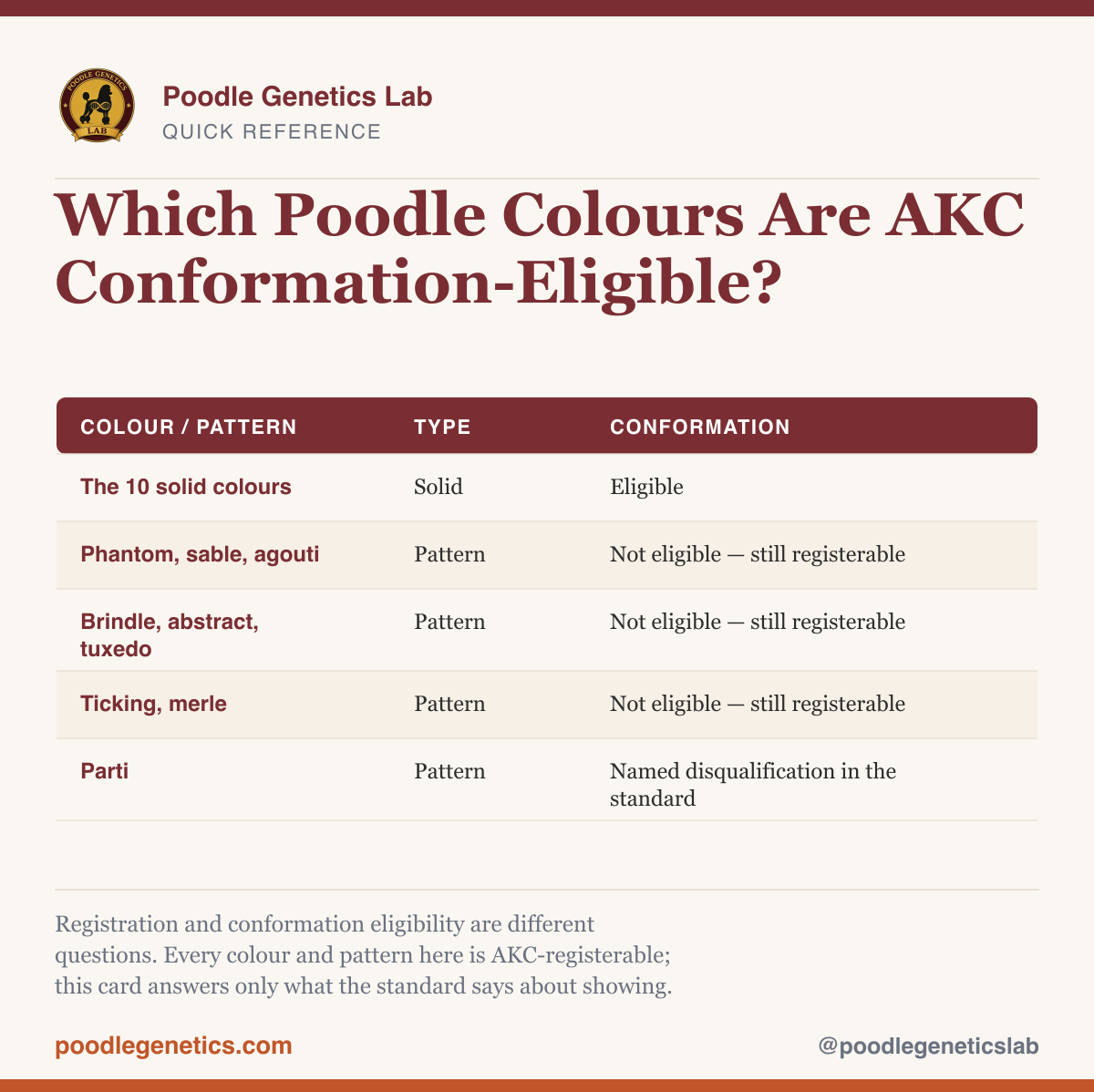
The AKC Poodle breed standard requires a solid color. Every one of the 10 recognized solid colors is eligible for conformation. Every pattern or marking, phantom through merle, is not, because none of them is a solid color, and one of them (parti) is a named disqualification in the standard's own text. All of it, solid or patterned, is AKC-registerable. Registration and conformation eligibility are different questions, and this page is about the second one.
| Color / Pattern | Type | AKC Conformation Status |
|---|---|---|
| Black | Solid | Eligible |
| White | Solid | Eligible |
| Cream | Solid | Eligible |
| Apricot | Solid | Eligible |
| Red | Solid | Eligible |
| Brown | Solid | Eligible |
| Café-au-lait | Solid | Eligible |
| Blue | Solid | Eligible |
| Silver | Solid | Eligible |
| Silver Beige | Solid | Eligible |
| Phantom | Pattern | Not eligible for conformation — AKC-registerable |
| Sable | Pattern | Not eligible for conformation — AKC-registerable |
| Agouti | Pattern | Not eligible for conformation — AKC-registerable |
| Brindle | Pattern | Not eligible for conformation — AKC-registerable |
| Abstract | Pattern | Not eligible for conformation — AKC-registerable |
| True Tuxedo | Pattern | Not eligible for conformation — AKC-registerable |
| Ticking | Pattern | Not eligible for conformation — AKC-registerable |
| Merle | Pattern | Not eligible for conformation — AKC-registerable |
| Parti | Pattern | Disqualified by name in the standard — AKC-registerable |
A note on "Gray": the standard uses both "gray" and "silver" as separate words. In current genetics and registration usage, and in this table, they refer to the same dilute phenotype, so "gray" isn't given its own row. If a breeder's paperwork uses "gray," it's the same eligible solid color as "Silver" above.
For the genetics behind every one of these names, see the complete colors and patterns guide. This page only answers one question: what does the AKC standard itself say about showing.
What "Eligible" Actually Means
Eligibility and registration are not the same gate, and conflating them is where most confusion starts.
Registration is about parentage, not color. A poodle with two AKC-registered parents is registerable regardless of what it looks like, phantom, parti, merle, or otherwise. Most breed registries, the AKC included, work this way: they record a color, they don't require a particular one.
Conformation eligibility is narrower. It's about whether a dog can be judged and placed in the breed-standard ring against other Poodles. The official AKC Poodle standard is explicit on this point:
"The coat is an even and solid color at the skin... Parti-colored dogs shall be disqualified."
That's the entire basis for the table above. Solid color, in any of the shades the standard permits, meets the requirement. Anything with two or more colors, or a distinct pattern rather than a uniform shade, doesn't, and parti specifically is called out by name as a disqualification rather than left to fall out of the general solid-color rule.
Registerable-but-not-eligible is not a penalty on the dog. It's a scope limit on one specific event type. A phantom, parti, or merle poodle can still earn AKC titles in obedience, rally, agility, scent work, and every other performance and companion event, on the same footing as a solid-colored littermate. Only the conformation ring, where dogs are judged against the written breed standard itself, draws the line at solid color.
A Note on the Standard's Exact Wording
The official written standard (approved 1984, unchanged since) names its solid colors as: black, white, cream, apricot, brown, café-au-lait, blue, gray, and silver, and it explicitly allows "varying shades of the same color" within the blue/gray/silver/brown/café-au-lait/apricot/cream range. Red and silver beige don't appear as separate words in that 1984 text, but the AKC's registration color-code list, applied when the standard's shade allowance is read against the ee (red/apricot/cream) and greying (blue/silver, café-au-lait/silver beige) mechanisms, treats them as recognized solid shades within it, which is why they're listed as eligible above alongside the colors the standard names outright. Judges are evaluating "even, solid color," not the specific word on the registration form.
One more thing worth being precise about, since claims about it circulate: no AKC rule found for this article establishes a separate multi-color or parti conformation division for Poodles under the current written standard. If that changes, this page will be updated. As of publication, the disqualification quoted above is the operative rule.
Why This Matters for Buyers and Breeders
If a conformation career, or a puppy destined for one, is the goal, color isn't a cosmetic detail, it's a hard gate before the dog ever gets judged on structure. A buyer told a parti or phantom puppy is "show quality" should ask what kind of showing is meant; the honest answer is performance and companion events, not the breed ring. None of this bears on the dog's structure, temperament, or health, which is a separate evaluation covered by the standard's other sections, including the anatomical landmarks the standard is written around.
For breeders, the practical upshot is the same one this site's genetics coverage keeps returning to: a solid-looking parent isn't a guarantee of a solid-looking litter. Phantom and abstract in particular can hide invisibly behind a dominant black or a single-copy S-locus carrier. If conformation eligibility matters to a specific breeding decision, test for the pattern genes rather than judging by the parents' coats, and use the color genetics calculator to see what a specific pairing can actually produce.
Download the Full Loci Reference Card for a printable summary.
This article is educational and is not veterinary advice. Discuss breeding and clinical decisions with your veterinarian.
Built on settled, deterministic reasoning or a directly observable fact rather than a specific cited study, so no References section appears below.
- Published
- August 27, 2026
- Last reviewed
- September 8, 2026
Free Tool
Apply This Knowledge
Model any parent pair with our interactive genetics calculator.