The Short Answer
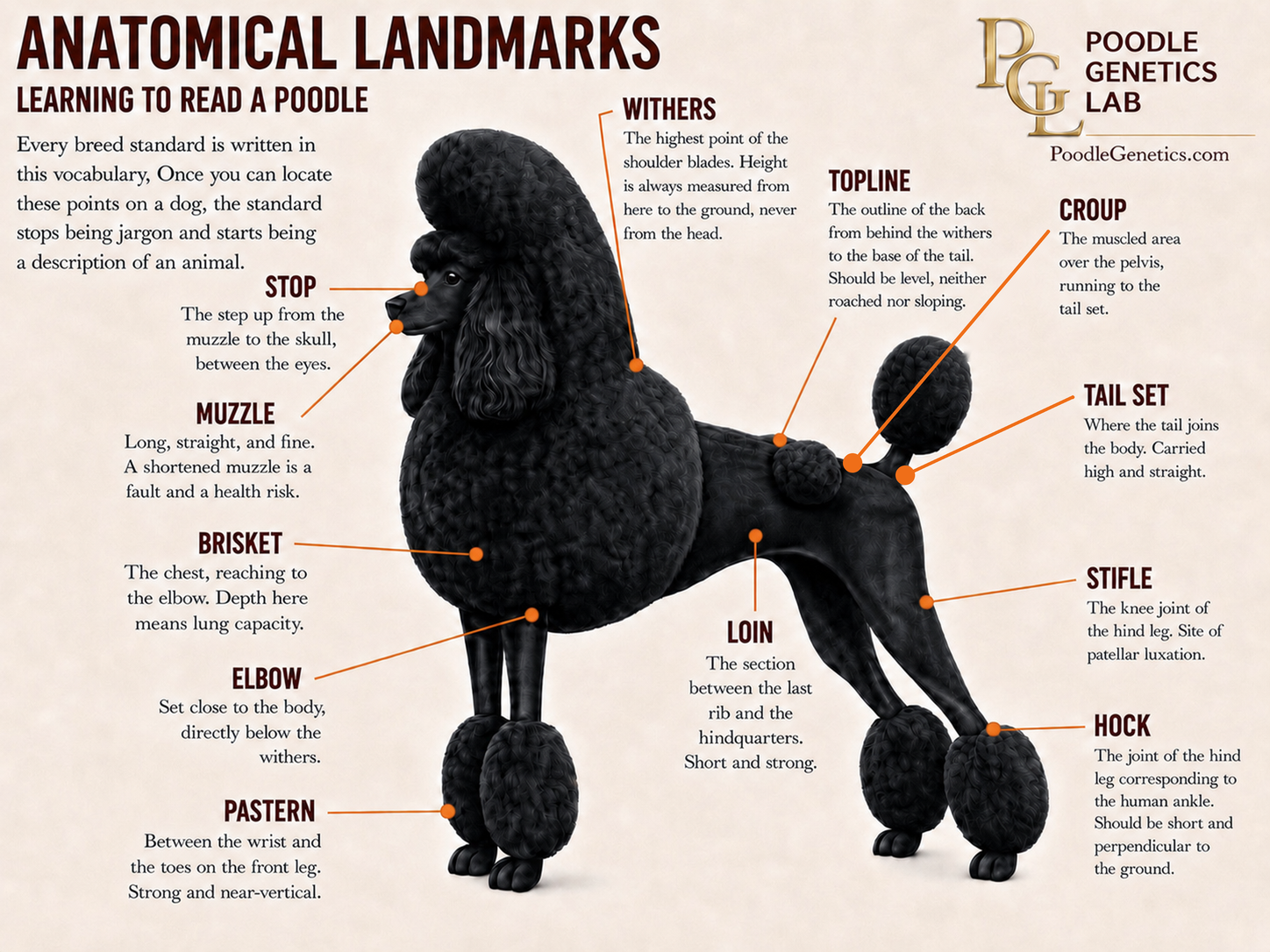
Every breed standard, the Poodle's included, is written in a specific vocabulary: withers, topline, croup, stifle, and a dozen other terms that name exact points on a dog's body. Learn to find these points and the standard stops being jargon — it becomes a description of an actual animal you can check against, point by point. This is the map: 12 landmarks, what each one is, and why the standard cares about it.
The descriptions below track the language of the AKC's official Poodle breed standard directly wherever the standard uses a term itself — "well bent" stifle, "perpendicular" hock, "slight but definite" stop are all its own words. A handful of landmarks here (withers, croup, brisket, pastern) are the general conformation vocabulary judges and breeders use for the same points, since the written standard itself doesn't always spell out those exact words.
Head
Stop
Head
The step up from the muzzle to the skull, between the eyes. The standard's own words call for a "slight but definite" stop — present and visible, but not the abrupt right angle of a brachycephalic breed.
Muzzle
Head
Long, straight, and fine, roughly matching the length of the skull. A shortened or snipey muzzle is a structural fault, not just a cosmetic one: general canine anatomy ties muzzle length to bite alignment and airway space, though Poodles are not a brachycephalic breed and this is not a documented Poodle-specific health concern.
The head is where most newcomers start reading a dog, and it's the least useful place to stop. A refined head over a poorly built body is still a poorly built dog.
Front Assembly
Withers
Front
The highest point of the shoulder blades, where they meet at the top of the back. Height is always measured from here to the ground — never from the head, and never from the topline further back.
Brisket
Front
The chest floor, reaching down to the elbow. Depth here is a traditional proxy conformation judges use for lung capacity: a shallow brisket on paper is read as a signal of a shallow-chested dog, though the relationship is judged by eye rather than measured.
Elbow
Front
Set close to the body, directly below the withers. Elbows that stand out from the ribcage (or tuck in under it) throw off everything below them, down through the pastern.
Pastern
Front
Between the wrist and the toes on the front leg — the front-leg equivalent of a human's palm. The standard calls for it simply to be "strong"; by general conformation convention a well-set pastern also sits close to vertical, and a soft, overly sloping one is read as a weight-bearing fault, not just a look.
Why the Withers Anchor Everything
Every height measurement in the standard is taken from the withers, and for good reason: it's the one point on a standing dog's topline that doesn't shift with head position or how the dog is stacked. A dog "measured from the head" isn't being measured by the standard at all — that number means nothing.
Topline and Body
Topline
Body
The outline of the back from the highest point of the shoulder blade to the base of the tail. The standard calls for level — neither roached (arched upward) nor sloping downward toward the rear — with one small, standard-named exception: a slight hollow just behind the shoulders is allowed and isn't counted against the dog.
Loin
Body
The short section between the last rib and the hindquarters. Short and strong is the goal; an overlong loin reads as weak through the middle, even on a dog with a good front and rear.
Rear Assembly
Croup
Rear
The muscled area over the pelvis, running from the end of the loin to the tail set. Its angle sets the tail carriage and a good part of the rear's driving power.
Tail Set
Rear
Where the tail joins the body, at the end of the croup. Carried high and straight is the standard's call — a low tail set usually traces back to croup angle, not the tail itself.
Stifle
Rear
The knee joint of the hind leg, anatomically the same joint as a human knee. Patellar luxation is a well-documented health concern in small and toy breeds generally, including the Toy and Miniature Poodle, which is why "well-bent stifle" shows up throughout structural health conversation about the breed.
Hock
Rear
The hind-leg joint corresponding to the human ankle, between the stifle and the foot. Short and close to perpendicular to the ground; a long or angled hock ("sickle hock") costs the dog drive on the move.
Common Questions
Do these terms apply the same way across all three poodle varieties? Yes — Toy, Miniature, and Standard share one structural standard. Size varies; the landmarks and their proportions to each other don't.
Is a moderate stop a fault? No. The standard's own phrase is "slight but definite" — present and visible, not absent or exaggerated. That phrasing is doing real work: a completely flat topskull and an overly abrupt, right-angled one are both departures from it.
Why does loin length matter if the dog can still move fine? A short loin transmits power from the rear to the front efficiently; an overlong one flexes more than it should under drive, which shows up as inefficiency (and, over years, as more wear) rather than as an obvious fault at a glance.
The Bottom Line
Twelve landmarks, four regions, one vocabulary that every judge, breeder, and structural health conversation in this breed is written in. Once you can point to withers, topline, croup, and stifle on an actual dog, the standard stops being a paragraph to memorize and becomes something you can check, point by point, against the dog in front of you. For the structural genetics behind why points like the stifle and hock matter so much, see Volume III.
Download the Anatomy & Conformation Quick Reference for a printable, laminate-ready summary of all twelve landmarks.
This article is educational and is not veterinary advice. Discuss structural or health concerns about a specific dog with your veterinarian.
Built on settled, deterministic reasoning or a directly observable fact rather than a specific cited study, so no References section appears below.
- Published
- August 19, 2026
- Last reviewed
- September 5, 2026
Free Tool
Apply This Knowledge
Model any parent pair with our interactive genetics calculator.