Cavapoo breeders and puppy buyers run into the same surprise often enough that it deserves a straight answer: a litter produces a puppy in a color that doesn't look like the Cavalier parent and doesn't look like the "expected" Poodle colors either. A genuinely parti-patterned puppy. A blue or silver coat. A red noticeably more intense, or less, than either parent. None of this is random, and none of it requires an undisclosed outcross to explain. It's what happens when a breed with a narrow color range is crossed with one carrying a much wider set of options underneath its visible coat.
This article covers how the standard coat-color loci play out in a Cavapoo cross, focused on what the Poodle parent's genotype can contribute. That's the sourced, well-documented half of this cross, and the half breeders most often underestimate. For the broader picture of how doodle coat genetics trace back to the Poodle side generally, read The Poodle Half of Your Doodle first.
The Cavalier side, briefly
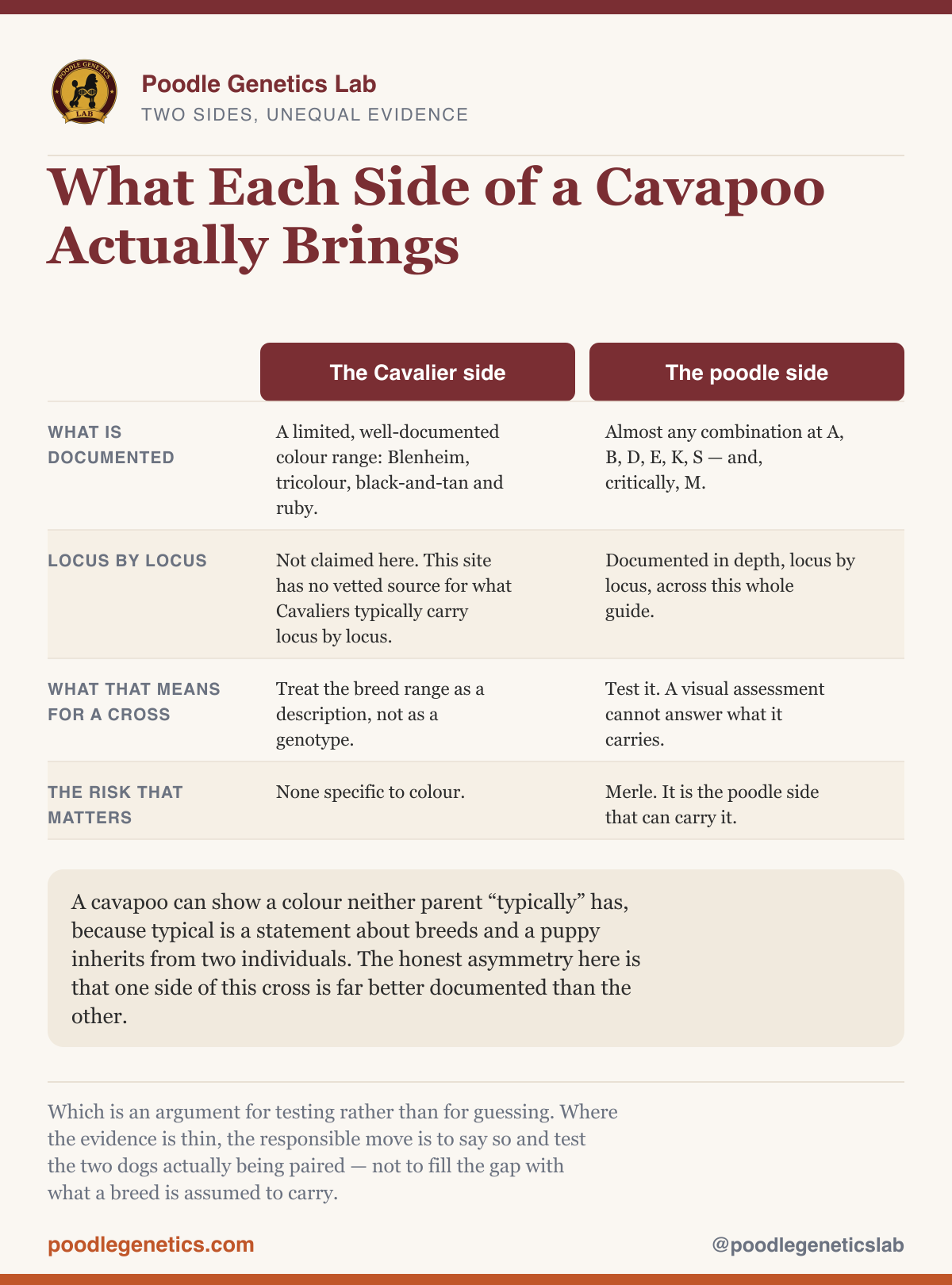
Cavalier King Charles Spaniels have a limited, well-documented color range: Blenheim (chestnut and white), tricolor, black-and-tan, and ruby (solid red). These are the breed's recognized standard colors, largely a function of the S (spotting) locus and the E (extension) locus expressing within that breed's typical range. That's as far as this article goes on the Cavalier side. This site doesn't have vetted sources for specific allele or genotype claims about what Cavaliers typically carry locus by locus, so the accurate statement stops at the breed-standard level: four recognized colors, governed in general terms by those two loci.
What matters for a Cavapoo litter is that the Cavalier parent's visible phenotype only tells you what's showing. It doesn't tell you what's hiding, and on the Poodle side, a great deal can be hiding.
What the Poodle side can actually carry
Poodles carry variation across all six standard coat-color loci, and general canine genetics describes how each one works.
A locus (agouti) controls the base pattern of eumelanin (black/brown) versus phaeomelanin (red/yellow) across the coat, including solid black, sable, and tan-point patterns. B locus determines whether black pigment expresses as true black or as brown/liver; a dog that is bb produces brown wherever black would otherwise show. D locus is true dilution: dd is born diluted, turning black to blue and brown to lilac, present at birth rather than developing over time. E locus governs whether eumelanin can be produced at all; ee is red or apricot regardless of the other loci, since the red pathway overrides the rest. K locus determines whether a dominant solid black pattern masks the agouti pattern underneath, or lets it show. S locus governs spotting, including the parti pattern that produces large, well-defined white patches with color.
Any of these can be present in a Poodle in a form the coat doesn't show, because several are recessive or otherwise maskable. A solid black Poodle can still carry Bb, Dd, or an S-locus parti allele without any of it being visible.
Why a Cavapoo can show a color neither parent "typically" has
This is the real value in understanding the cross: the Cavalier's narrow color range doesn't limit what a Cavapoo can inherit, because inheritance runs through genotype, not through the parent's visible phenotype. If the Poodle parent carries a recessive or masked allele at any of these loci, that allele is real and heritable whether or not the Poodle's own coat shows it. Pair it with whatever the Cavalier parent contributes at the same locus, and the puppy can land somewhere neither breed's typical range covers.
Dilution and progressive clearing are not the same mechanism
Blue or silver-looking Cavapoo puppies are the clearest example of this, and where the most confusion happens, because two different mechanisms can produce a similar-looking result.
True dilution is the D locus described above. A puppy that is dd is born diluted, and the color is present from birth and stable.
Progressive clearing is a separate, distinct gene, unrelated to D-locus dilution, that causes a coat to lighten or fade gradually over the dog's first one to two years rather than being diluted at birth. A puppy that starts out looking like a standard dark color can clear toward blue, silver, or a lighter shade of its original color as it matures. This site is careful to keep it terminologically separate from dilution, since the two are caused by different genes and shouldn't be described interchangeably.
Either mechanism, from the Poodle parent, can put a Cavapoo puppy in a color category neither breed's typical range includes on its own.
Parti coloring is real, testable, and comes from the S locus
Genuine parti coloring, large, well-defined white patches combined with color rather than the small white markings sometimes seen in Cavaliers, is driven by the S locus. Research on the MITF-M promoter repeat has linked variation at this region to the spotting phenotype in dogs, including the parti pattern documented in Poodles (Baranowska Körberg et al., 2014). If the Poodle parent carries a parti-pattern allele, a Cavapoo puppy can present true parti coloring even though neither parent's visible coat necessarily predicted it. It's a testable, S-locus-driven trait, not a random outcome, and it follows normal Mendelian inheritance once the parent genotypes are known.
Red and apricot intensity is observed, not predicted from genotype alone
E-locus genotype determines whether a dog can produce eumelanin at all, but the actual shade within the red/apricot spectrum is influenced by additional factors that current genetic testing doesn't fully resolve (Bannasch et al., 2021). A Cavapoo can turn out with a shade of red or apricot noticeably more intense or more muted than either parent's, and that variation is a real, recorded outcome, not a testing gap. It's another category where the honest answer is to look at the puppy in front of you rather than predict the exact shade from a genotype report.
What this means for a real pairing
None of this is a case for guessing. It's a case for testing both parents and modeling the specific pairing rather than treating either breed's typical color range as a ceiling on what's possible. A Cavapoo litter's color outcomes are the product of two real genotypes combining, and the Poodle side is where most of the range comes from, both visible and carried quietly underneath. The dominant-black and dilute-eumelanin framework from early canine coat-color genetics (Drögemüller et al., 2007) is part of what makes these predictions possible once real genotypes are known.
The Coat Color Calculator is built for exactly this: enter both parents' known or tested genotypes and see the actual range of outcomes for a specific pairing, rather than relying on either breed's typical color list as a guide.
Download the Doodle Coat Genetics Reference for a printable summary of which side of a doodle cross typically carries which trait.
Credible evidence supports what is described here, but the mechanism, the population studied, or its application to Poodles still has limits. The literature below is real and cited in full; where it stops short, the article says so rather than rounding up.
- Published
- October 20, 2026
- Last reviewed
- August 25, 2026
References
- Bannasch DL, Kaelin CB, Letko A, et al. (2021). Dog colour patterns explained by modular promoters of ancient canid origin. Nature Ecology & Evolution 5(10):1415–1423. doi:10.1038/s41559-021-01524-x
- Baranowska Körberg I, Sundström E, Meadows JRS, et al. (2014). A simple repeat polymorphism in the MITF-M promoter is a key regulator of white spotting in dogs. PLoS ONE 9(8):e104363. doi:10.1371/journal.pone.0104363
- Drögemüller C, Philipp U, Haase B, Günzel-Apel A-R, Leeb T (2007). A noncoding melanophilin gene (MLPH) SNP at the splice donor of exon 1 represents a candidate causal mutation for coat color dilution in dogs. Journal of Heredity 98(5):468–473. doi:10.1093/jhered/esm021
Free Tool
Apply This Knowledge
Model any parent pair with our interactive genetics calculator.