If you breed or own a Goldendoodle, Cavapoo, Bernedoodle, Labradoodle, or Sheepadoodle, half of that dog's genome is Poodle. Not "Poodle-influenced." Not "partly Poodle." Half, in the same literal sense a human child is half each parent: one full set of chromosomes from the Poodle side, one full set from the other breed.
That matters more than it sounds like it should, because most of what determines a doodle's coat color, and all of what determines its merle risk, comes from genes this site has documented for Poodles for years. The loci don't change species. A Poodle's B locus and a Goldendoodle's B locus are the same gene, inherited the same way, tested the same way. What changes in a cross is which alleles are actually in play, and that's set by what each parent breed typically carries.
This is the first article in a cluster built around that one fact: the Poodle side of a doodle's pedigree is not a mystery, because it's the same genetics this site already covers. We're not claiming expertise on the other half. A Golden Retriever's or Bernese Mountain Dog's own genetics are their own breed's specialty, and we won't pretend otherwise here. What we can do, credibly, is tell you exactly what the Poodle parent is contributing, and where that contribution creates real risk that deserves the same caution it gets in a purebred Poodle.
What actually crosses over
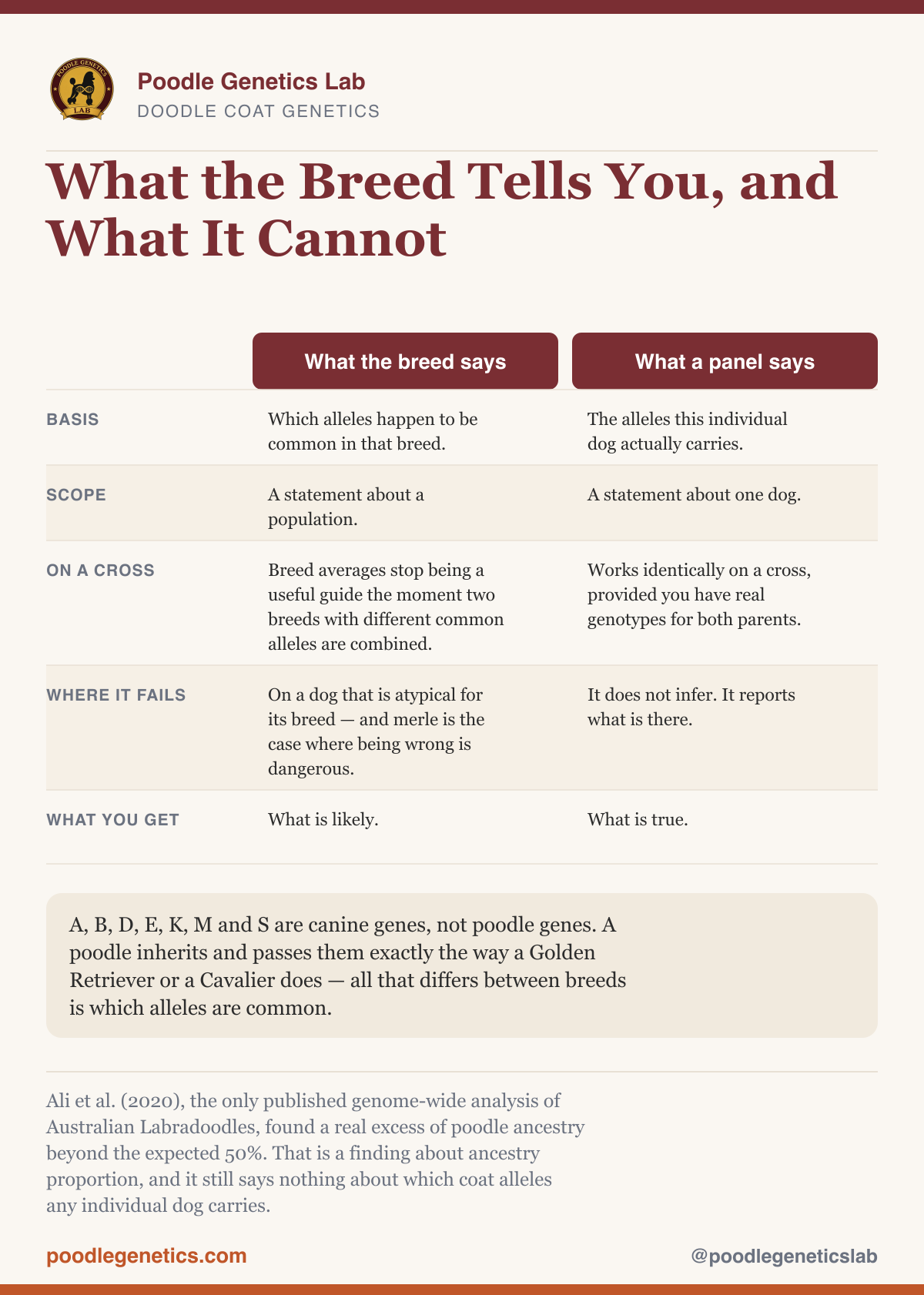
Coat color in dogs is governed by a small, well-mapped set of loci: A (agouti), B (brown), D (dilution), E (extension/red), K (dominant black), M (merle), and S (spotting/parti), among others. None of these are Poodle-only genes. They're canine genes, present across breeds, and a Poodle inherits and passes them exactly the way a Golden Retriever, a Bernese Mountain Dog, or a Cavalier King Charles Spaniel does.
What differs breed to breed is which alleles are common. A Golden Retriever is overwhelmingly ee (red/cream) at the E locus, because that's what the breed has been selected for. A Poodle can carry almost any combination at A, B, D, E, K, S, and, critically for this cluster, M. When you cross the two, the puppy's actual coat color depends on which specific alleles each individual parent carries, not on breed averages. This is exactly the same math the Coat Color Calculator already runs for purebred Poodle pairings. It works the same way for a doodle cross, provided you have real genotypes for both parents, not assumptions based on what "usually happens" in that breed.
The genome study most relevant here is Ali et al. (2020), the only published genome-wide analysis of Australian Labradoodles. It found the breed carries a real and substantial excess of Poodle ancestry beyond the expected 50%, consistent with generations of breeding back toward Poodle type. That's a genuine finding about ancestry proportion. It says nothing about which specific coat alleles any individual dog carries, which is the point worth sitting with: pedigree tells you what's likely, not what's true for this dog. A DNA panel tells you what's true.
Where the Poodle side creates real risk: merle
This is the part of the cluster that matters most, and it's why we're writing it at all rather than leaving doodle coat-color content to breed-specific sites.
Merle is caused by a variant at the M locus (gene: PMEL), and it behaves identically regardless of which breed carries it. The full mechanics are covered in depth here. Briefly: merle is not a simple on/off allele. It's an insertion whose length determines how much it expresses, classified into seven length bands from non-expressing cryptic merle through classic merle to harlequin-range. The class is the length, not the coat. A dog can be genuinely merle and show no visible pattern at all.
Every doodle breed that has any merle ancestry anywhere in its lines (and, given how often merle is bred deliberately for its striking coat pattern, that includes a meaningful share of Goldendoodles, Bernedoodles, Cavapoos, and Sheepadoodles on the market) inherits that same double-merle risk the moment a merle Poodle is bred to a merle dog of the other breed, or to another merle doodle. The math doesn't care which breed contributed the second merle allele. Two merle parents, of any breed or cross, produce a litter that is 25% double merle by simple Punnett-square arithmetic.
If you're breeding a doodle and either parent's pedigree includes any merle ancestry on the Poodle side, that dog needs a real M-locus DNA test before it's paired with anything, not a visual assessment, and not an assumption based on what the puppy looks like. This is the exact same rule this site has stated for purebred Poodles since the day it launched. Crossing to another breed does not create an exception to it.
What this cluster covers, and what it doesn't
Over the next several weeks we're publishing articles that apply this same Poodle-side lens to the specific breeds and questions doodle breeders search for most: merle Goldendoodles, whether two Cavapoos can produce a merle puppy, Bernedoodle and Labradoodle coat color, Sheepadoodle merle risk, Goldendoodle red and apricot shade intensity, and what actually changes genetically across F1, F1b, and multigenerational breeding.
Each of those articles stays inside one boundary: what the Poodle parent contributes, tested and documented the same way this site already documents it for purebred Poodles. We are not going to tell you what a Golden Retriever's or a Bernese Mountain Dog's own genome does beyond what's already established, peer-reviewed science. That's not this site's expertise, and claiming otherwise would be exactly the kind of overreach we criticize when other sources do it.
What we can tell you, with the same rigor applied to every Poodle article on this site, is the half of the equation we actually know.
Download the Doodle Coat Genetics Reference for a printable summary of which parent breed typically contributes which trait, and where a standard coat panel can miss it.
Run your own dog's genotype through the Coat Color Calculator →
Built on identified genes and validated tests. The claims here are supported by the peer-reviewed literature listed below.
- Published
- September 8, 2026
- Last reviewed
- September 8, 2026
References
- Langevin M, Synková H, Jančušková T, Pekova S (2018). Merle phenotypes in dogs — SILV SINE insertions from Mc to Mh. PLoS ONE 13(9):e0198536. doi:10.1371/journal.pone.0198536
- Ali MB, Evans JM, Parker HG, et al. (2020). Genetic analysis of the modern Australian labradoodle dog breed reveals an excess of the poodle genome. PLOS Genetics 16(9): e1008956. doi:10.1371/journal.pgen.1008956
Free Tool
Apply This Knowledge
Model any parent pair with our interactive genetics calculator.