Animal Genetics is one of the more commonly used labs among Poodle and Doodle breeders working to a budget, largely on the strength of its bundled Complete Panel — a single order covering most of the coat-color loci a breeder actually needs, priced around $120 rather than paying per-locus. Reading the report correctly means understanding two things: what's actually in the panel, and how the lab writes a result.
What the Complete Panel covers
Animal Genetics' dog coat-color testing spans the loci most relevant to Poodle and Doodle breeding programs: A (agouti), B (brown), D (dilution), E (extension), K (dominant black), S (spotting/parti), M (merle), plus harlequin and cocoa/albinism screening where relevant. Poodles are listed among the breeds the panel supports, and Animal Genetics also markets Doodle-hybrid-specific panel bundles — worth knowing if you're testing a mixed litter rather than a purebred one.
Genotype codes, not category words
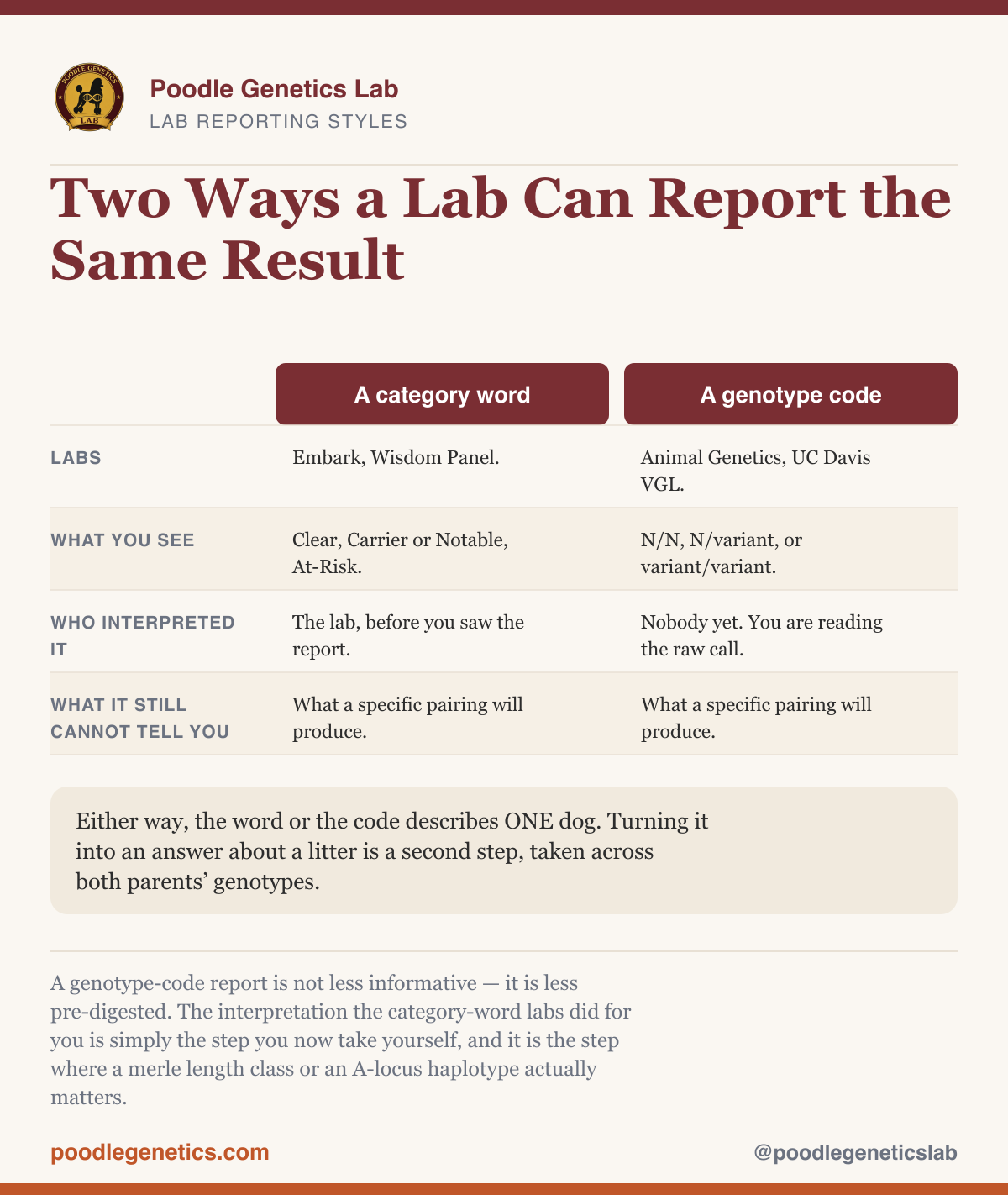
Like UC Davis VGL, Animal Genetics reports results as genotypes rather than translating them into a Clear/Carrier/At-Risk-style label. Expect a result formatted around the pattern N/N — N/[code] — [code]/[code]: two normal alleles, one normal and one variant, or two copies of the variant. This is the same underlying system the UC Davis VGL guide walks through in more detail — if you've read that one, the pattern here is identical, just from a different lab.
The practical consequence is the same too: a genotype code by itself doesn't tell you what a specific pairing will produce. It tells you what one dog carries. Converting that into a real answer about a litter takes a second step, whether that's mental math across two parents' genotypes or a calculator that does it for you.
A real caution on the merle result specifically
This is important enough to say plainly, not bury in a footnote: breeders have reported Animal Genetics merle results coming back "non-merle" on dogs that were visibly, unmistakably merle. This is breeder-reported experience shared within the community, not an independent lab-accuracy study PGL has conducted or reviewed — we're stating it as anecdotal because that's what it is, not because it isn't worth taking seriously.
It's worth taking seriously specifically because merle status is a double-merle-risk question, not just a coat-color question. A false "clear" merle result that gets trusted at face value, then used to justify a pairing that turns out to be merle × merle, is exactly the kind of mistake this site exists to help breeders avoid. If a dog is visually consistent with merle and an Animal Genetics result says otherwise, don't treat that result as the final word. Confirm independently — a second test from a different lab, or a visual/pedigree-based assessment — before using a "non-merle" result from this lab as the basis for a pairing decision. The merle guide covers what visual and pedigree-based merle assessment actually involves.
Two places Animal Genetics is genuinely strong
It isn't all caution. Animal Genetics has the fastest turnaround of the five labs in this cluster — a real, practical advantage if you're testing a puppy on a deadline. And like UC Davis, it lets you order individual loci rather than a fixed bundle, useful for the same puppy-testing scenario where you only need one or two specific answers, not a full panel run on every pup.
One honest gap
Animal Genetics' exact result-page wording and layout weren't independently confirmed for this article — the lab's public pages describe the test menu and pricing clearly, but not a sample report. What's described above (the loci covered, and the genotype-code notation style) reflects what's confirmed; the specific visual layout of your own report may include additional formatting not described here.
How Animal Genetics compares to the other labs breeders use
| Lab | Breed ID | Merle Base Pair Test | Order by locus | Turnaround | Notable |
|---|---|---|---|---|---|
| Embark | Yes, generally accurate | Not offered | No — bundled panels only | Standard | Only lab in this cluster with a Red Intensity marker (0–10) |
| UC Davis VGL | Not offered | Yes — the only lab here with base-pair-length testing | Yes | Standard | The precise assay for merle length class |
| Wisdom Panel | Yes | Not offered | No | Standard | Improved over time, but see that guide's note on breeder-reported reliability |
| Animal Genetics | Not offered | Not offered (see the caution above on general merle screening) | Yes | Fastest of the five | |
| Orivet / Paw Print Genetics | Not independently confirmed | Not independently confirmed | Not independently confirmed | Not independently confirmed | Report format not independently confirmed for this cluster |
Turn a genotype into an offspring answer
Decode your Animal Genetics result in the DNA Report Interpreter →
Model a pairing across every locus in the Coat Color Calculator →
Enter both parents' genotypes as your report actually states them, and the calculator does the cross for you — no need to hold a nine-locus punnett square in your head.
Download the Poodle Health Panel Worksheet for a printable summary.
Credible evidence supports what is described here, but it rests on general, uncited scientific principle rather than a specific study, and the article says so rather than rounding up.
- Published
- October 23, 2026
- Last reviewed
- August 25, 2026
Free Tool
Apply This Knowledge
Model any parent pair with our interactive genetics calculator.