Order a coat-color or health panel from UC Davis Veterinary Genetics Laboratory and you will not see the words "Clear," "Carrier," or "At-Risk" anywhere on it. UC Davis reports a genotype, not a category label — and that one difference is why breeders who learned to read an Embark or Wisdom Panel report first often stall completely the first time a UC Davis report lands in their inbox.
What "genotype-code" actually means
Most consumer labs translate a dog's DNA into a plain-English judgment for you: Clear, Carrier, At-Risk. UC Davis VGL doesn't do that translation. It reports the genotype directly, using the lab's wild-type/mutant notation for that specific test — something like N/N, N/[code], or [code]/[code], where N is the normal allele and the code is the lab's own short name for the variant being tested.
This isn't a formatting quirk. It's a different philosophy of what a diagnostic lab's job is: report the measurement, not the interpretation. UC Davis VGL is an ANAB-accredited academic laboratory that has run canine genetic testing since 1974 and holds ISAG membership — its reports are written for a reader who's expected to know what a genotype implies, not one who needs it pre-translated. That's a reasonable design choice for a lab whose customer base includes researchers and veterinarians as well as breeders. It's also exactly why a genotype-code report feels harder to a first-time reader: nothing on the page tells you, in words, what N/[code] actually means for your breeding decision. You have to already know, or go look it up.
Reading N/N — N/[code] — [code]/[code]
The pattern is consistent across every UC Davis test that uses this system:
- N/N — two copies of the normal allele. Zero copies of the variant.
- N/[code] — one copy of the normal allele, one copy of the variant. One copy of the mutant allele.
- [code]/[code] — two copies of the variant. Two copies of the mutant allele.
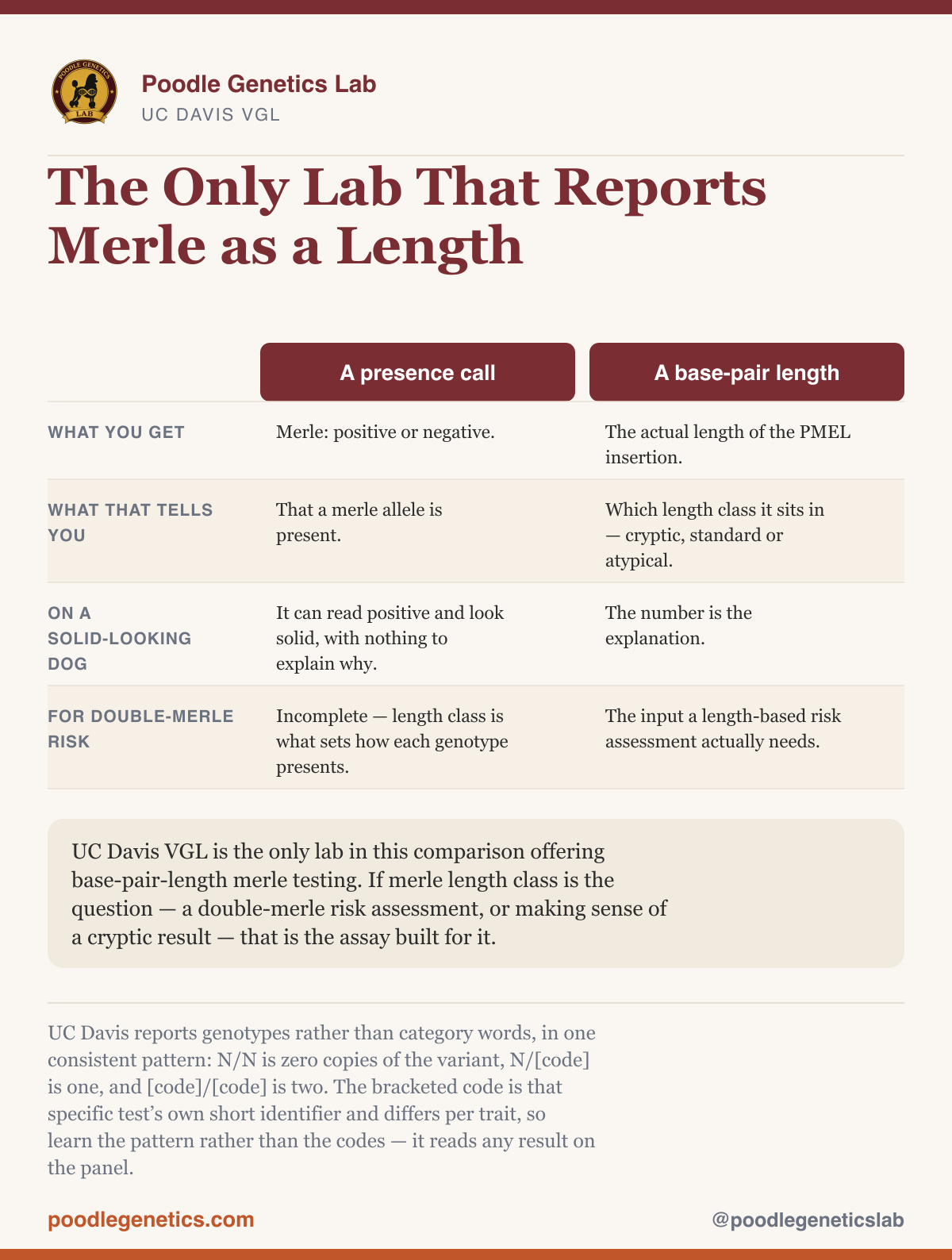
The bracketed [code] is the lab's own short identifier for that specific
test — it's different for every trait, and UC Davis doesn't publish one
universal decoder page listing every code across their full test catalog.
What stays constant is the pattern: how many copies of N versus how many
copies of the variant. Once you know that, you can read any UC Davis result
correctly even without memorizing every individual code.
What UC Davis actually tests
UC Davis VGL's dog coat-color panel screens the standard color loci, and their canine genetic diversity test explicitly does not include breed identification — it's a diversity/heterozygosity panel, a different product from a consumer breed-mix test. Poodle varieties are enrolled in their programs. The lab is a standing member of ISAG (International Society for Animal Genetics) and has held ANAB accreditation since November 2020.
Two things that make UC Davis worth the extra reading
UC Davis is the only lab in this cluster that offers base-pair-length merle testing — not just a presence/absence merle call, but the actual length class of the PMEL insertion, which is what tells you whether a merle dog sits in a cryptic, standard, or atypical length range. If merle length class specifically is what you need — for a double-merle risk assessment, or to understand a "cryptic merle" result — this is the lab built for that question. None of the other four labs in this cluster offer this assay.
UC Davis also lets you order individual loci rather than a fixed bundle — useful for puppy testing, where you may only need to confirm one or two specific loci rather than pay for a full panel on every pup in a litter.
One honest gap
UC Davis VGL's actual report layout — the full page, section by section — is delivered through their MyVGL customer portal, which requires a login. No public sample report exists to review independently, so this article describes the lab's confirmed notation system, not a line-by-line walkthrough of the page itself. If your own report includes sections not described here, that's expected — this article covers what's verifiable, not everything.
How UC Davis compares to the other labs breeders use
| Lab | Breed ID | Merle Base Pair Test | Order by locus | Turnaround | Notable |
|---|---|---|---|---|---|
| Embark | Yes, generally accurate | Not offered | No — bundled panels only | Standard | Only lab in this cluster with a Red Intensity marker (0–10) |
| UC Davis VGL | Not offered | Yes — the only lab here with base-pair-length testing | Yes | Standard | The precise assay for merle length class |
| Wisdom Panel | Yes | Not offered | No | Standard | Improved over time, but see that guide's note on breeder-reported reliability |
| Animal Genetics | Not offered | Not offered (see that guide's note on merle-screening accuracy) | Yes | Fastest of the five | |
| Orivet / Paw Print Genetics | Not independently confirmed | Not independently confirmed | Not independently confirmed | Not independently confirmed | Report format not independently confirmed for this cluster |
Turning a genotype into an answer
A genotype code by itself doesn't tell you what a pairing will produce. That's exactly the gap the interpreter and calculator close — enter what your report actually says, and get a real answer instead of trying to hold the pattern in your head across two parents at once.
Decode your UC Davis result in the DNA Report Interpreter →
Model a pairing in the Coat Color Calculator →
Download the Poodle Health Panel Worksheet for a printable summary.
Credible evidence supports what is described here, but it rests on general, uncited scientific principle rather than a specific study, and the article says so rather than rounding up.
- Published
- September 25, 2026
- Last reviewed
- August 25, 2026
Free Tool
Apply This Knowledge
Model any parent pair with our interactive genetics calculator.