A phantom Bernedoodle puppy — black with crisp copper eyebrows, chest, and leg markings — sells the moment its photo goes up. Buyers call it rare. Breeders price it accordingly. And nearly everyone involved misattributes where it comes from.
The tan points come from the poodle. Not partly, not "influenced by" — the pattern is poodle A-locus genetics, at/at, expressed in a crossbred dog. The Bernese Mountain Dog side, famous for its own rust markings, contributes essentially nothing to the mechanism, for reasons this article will make precise. If you breed or buy phantom doodles, this is the genetics you are actually trading in.
The short answer
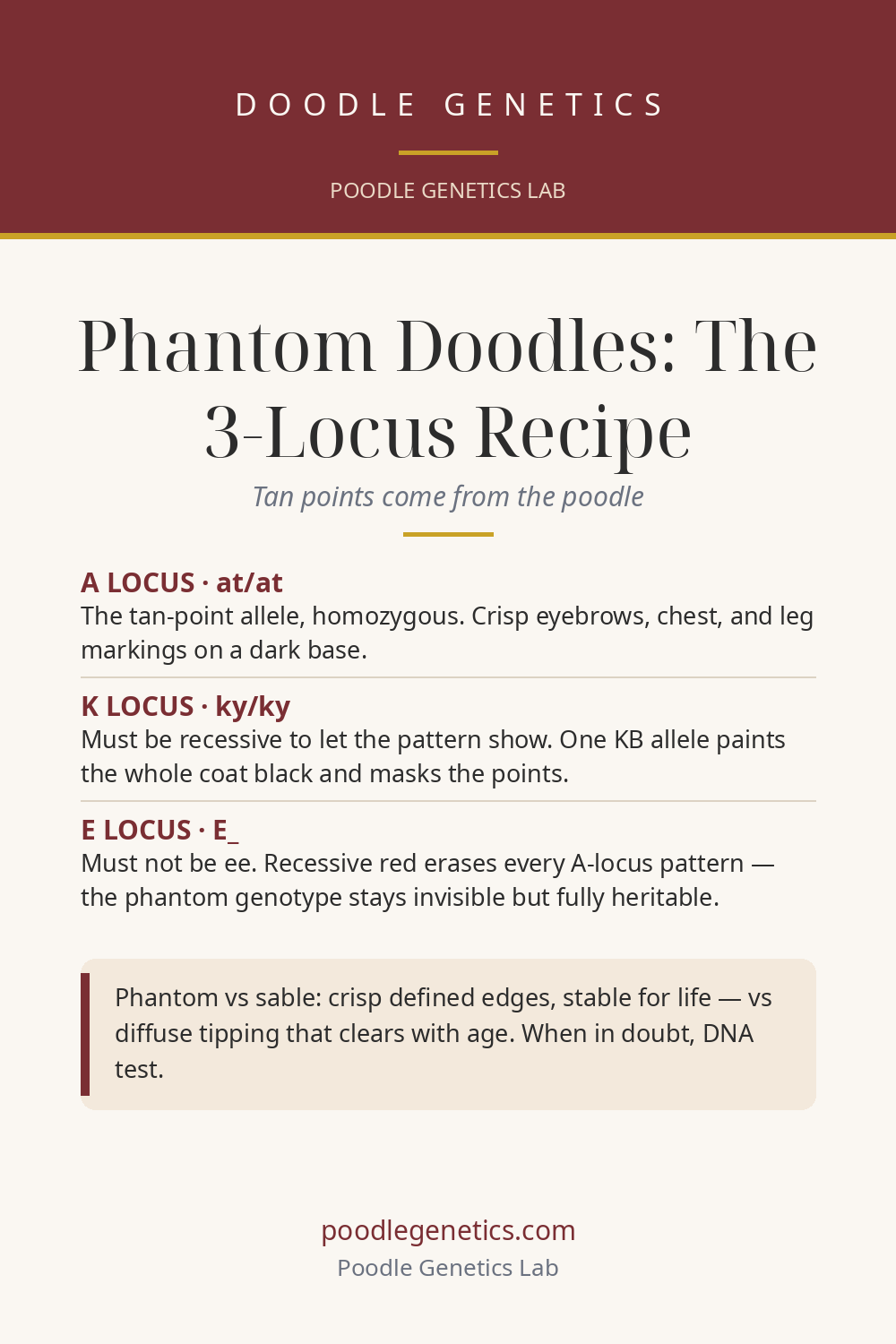
The phantom pattern is produced by a specific genotype at the A (agouti) locus: at/at, the tan-point allele, homozygous. On its own that isn't enough — two other loci have veto power:
- The K locus must be ky/ky (recessive, non-black). A dominant black allele (KB) paints the whole coat black and masks the tan points entirely.
- The E locus must not be ee. Recessive red/yellow masks all A-locus patterns — an at/at, ky/ky, ee dog looks solid cream, and its phantom genotype is invisible.
So a visible phantom doodle is at/at, ky/ky, E_. Three loci, all three cooperating. Miss any one and the pattern vanishes — while the genotype underneath stays exactly as heritable as ever, which is where the surprises come from.
For the complete poodle-side treatment, see phantom poodles: the A locus and tan points.
Why the Bernese doesn't get the credit
This confuses people because Bernese Mountain Dogs famously have tan points. Surely the Bernese side contributes the pattern in a Bernedoodle?
No — and the reason is instructive. The Bernese's own markings come from the Bernese's own at/at genotype, but in a Bernedoodle cross, what matters is what each individual parent carries, not what their breed is known for. A Bernese parent bred to a poodle passes one A-locus allele; if that allele is at, the puppy still needs at from the poodle side to be at/at. More importantly, the poodle is the side where tan-point genetics are actively selected and documented — phantom is an established, bred-for poodle pattern with known inheritance, while in most doodle crosses the poodle is simply the only parent anyone has actually genotype-tested.
The deeper point, and the one this site's doodle cluster keeps returning to: the loci are the same across breeds (the poodle half of your doodle). Phantom in a doodle isn't a new phenomenon requiring a new explanation. It is the poodle's at allele, doing exactly what at does, in a dog that happens to be half something else.
The ee eraser: phantom genotypes hiding in cream dogs
Here is the genuinely underappreciated part, and the most practical reason to DNA-test rather than eyeball.
Golden Retrievers are overwhelmingly ee — recessive red, the genotype that produces their cream-to-gold coat. And ee is epistatic to the entire A locus: it switches off black pigment production, which means every A-locus pattern — phantom, sable, agouti — becomes invisible. An at/at Goldendoodle that is also ee looks like a perfectly ordinary cream doodle. The phantom genotype is there, fully heritable, completely hidden.
This creates two classic surprises:
- Two cream Goldendoodles produce a phantom puppy. Both parents carried hidden at alleles masked by ee; the puppy inherited at/at and inherited E from... wait — it needs E_ to show. Right: the puppy got at/at from both parents and at least one E allele (possible if either parent was Ee rather than ee). The phantom appears "out of nowhere." It was never nowhere — it was in the pedigrees, masked.
- A phantom bred to a cream produces all cream puppies. The phantom parent is at/at, E_; the cream parent is ee. Every puppy is Ee or ee... those that are ee are cream regardless of their A locus. Breeders who expected "phantom x cream = half phantom" learn about epistasis the expensive way.
If you are breeding phantom doodles deliberately, the rule is simple: test the E locus on both parents, not just the A locus. A phantom program built on untested cream dogs is built on invisible genotypes.
Phantom vs. sable vs. tricolor: stop mixing these up
Doodle marketing uses these three terms almost interchangeably. They are three different genetic situations:
- Phantom (at/at): sharply defined tan points on a dark base — eyebrows, muzzle sides, chest, legs, under the tail. The boundary between dark and tan is crisp. Present from birth, stable for life (modulo graying).
- Sable (Ay): each hair is banded, dark tip over red base, producing an overall shaded or grizzled look — the famous "burnt toast" puppy that clears to cream. Diffuse, not crisp. Changes dramatically with age. (Covered in depth in our sable doodles guide.)
- Tricolor: not a locus genotype at all in this context — it describes a phantom-patterned dog plus white markings from the S locus. Three visible colors, two pattern systems.
A puppy cannot be "phantom sable." The A locus holds two alleles; Ay/at is possible as a genotype, but the expressed pattern follows the dominance hierarchy, and what you see is one pattern, not a blend. Sellers who list both are describing vibes, not genetics.
What to actually check before a pairing
- A locus on both parents. at/at × at/at gives all at/at. at/at × at/a gives half carriers. Know which you're doing.
- K locus. One KB allele anywhere in the sire or dam and the tan points vanish in half or all of the puppies. Phantom programs need ky/ky on both sides.
- E locus — the one everyone skips. Especially with cream/apricot/red dogs in the pedigree. ee masks everything; test it.
- Don't trust puppy photos for pattern diagnosis. Sable puppies can show darker markings that read as "phantom" at eight weeks and clear by six months. If the pattern matters to your program, the DNA panel is the diagnosis, not the photo.
The bottom line
Phantom doodles are poodle tan-point genetics — at/at, ky/ky, E_ — expressed in a cross. The pattern is well understood, deliberately producible, and completely invisible whenever ee or KB gets in the way, which is why DNA testing beats eyeballing by a mile. Price the puppies however you like; just know which three loci you're actually selling.
Built on identified genes and validated tests. The claims here are supported by the peer-reviewed literature listed below.
- Published
- October 16, 2026
- Last reviewed
- October 16, 2026
References
- Bannasch DL, Kaelin CB, Letko A, et al. (2021). Dog colour patterns explained by modular promoters of ancient canid origin. Nature Ecology & Evolution 5(10):1415–1423. doi:10.1038/s41559-021-01524-x
- Candille SI, Kaelin CB, Cattanach BM, et al. (2007). A β-defensin mutation causes black coat color in domestic dogs. Science 318(5855):1418–1423. doi:10.1126/science.1147880
Free Tool
Apply This Knowledge
Model any parent pair with our interactive genetics calculator.
Share this summary
Take the key points with you
A one-page visual summary of this article — handy for saving to Pinterest or passing along to a fellow breeder.