At eight weeks old, the puppy was a rich, dark, burnt-toast brown. The breeder called it sable, and it was gorgeous. At fourteen months, the same dog is cream — light, even, unremarkable cream — and the owner is somewhere between disappointed and suspicious. Did the breeder misrepresent the puppy? Is this even the same color genetics?
It is. What you watched is the Ay allele doing the one thing Ay does: arriving dark and leaving light. Sable is the most dramatic puppy-to-adult transformation in the doodle world, and it is also the most predictable — if anyone had explained the mechanism before the puppy went home.
The short answer
Sable is caused by the Ay allele at the A (agouti) locus — the top of the A-series dominance hierarchy. Ay produces hairs that are banded: dark (eumelanin) at the tip, red/cream (phaeomelanin) at the base. On a young puppy, the dark tips dominate and the dog looks dark brown or "burnt toast." As the coat matures, the proportion shifts — new growth carries less dark tipping — and the dog clears to cream or light apricot.
This is not fading in the progressive-graying sense (though a sable dog can also carry graying — more on that below). It is the Ay pattern expressing across a changing coat. The genotype never changes; the phenotype does, on a schedule.
And the poodle connection, since this is a poodle genetics site: sable is a classic poodle pattern — the apricot and red poodles that "clear" to lighter shades are overwhelmingly Ay at work. In a Goldendoodle, the Ay allele essentially always arrives via the poodle parent. Golden Retrievers are ee, and while ee dogs can carry Ay invisibly (more on that too), the expressed sable pattern in the cross traces to poodle ancestry.
What "burnt toast" actually looks like, month by month
Breeders use food metaphors because the progression is that consistent:
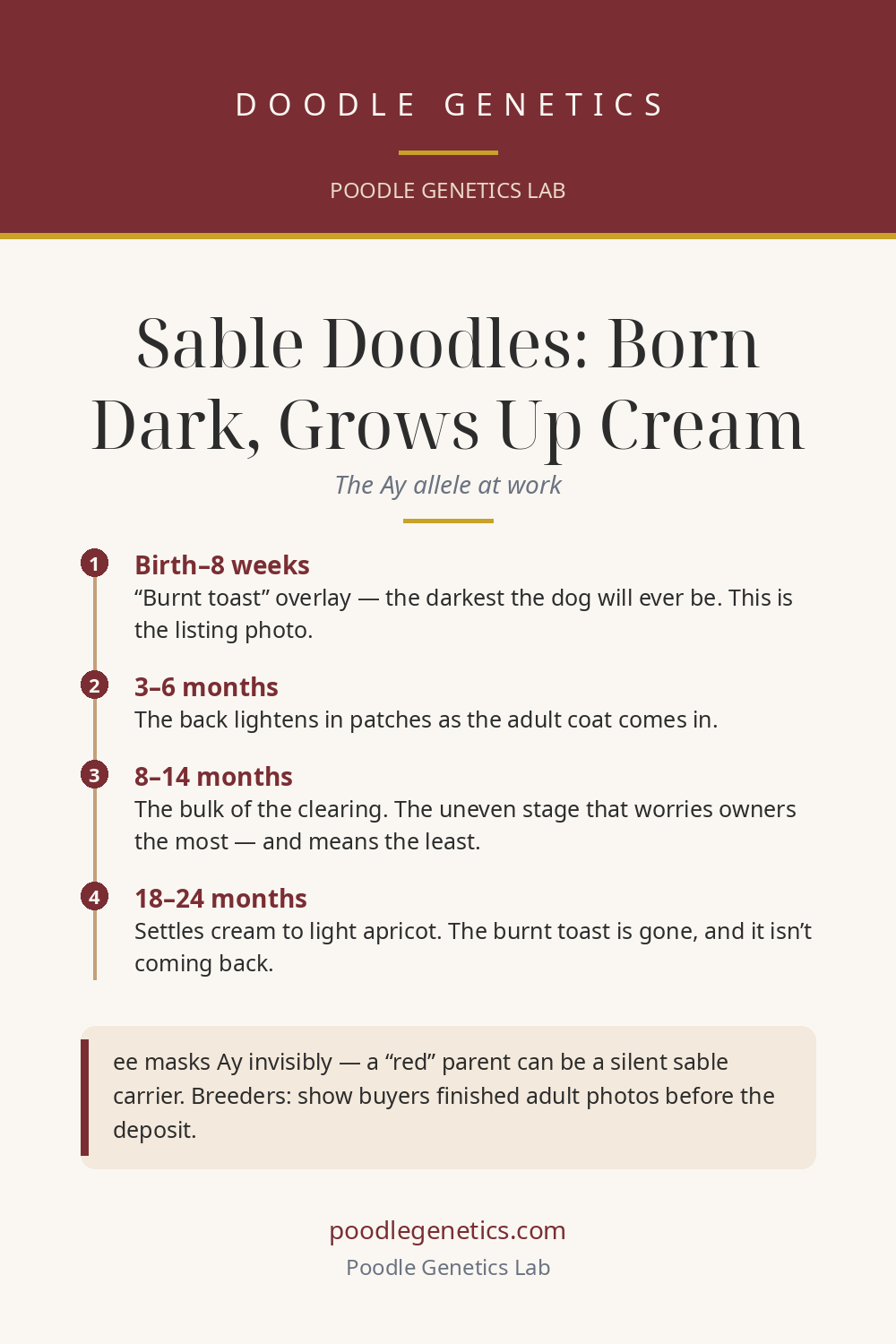
- Birth–8 weeks: dark brown to nearly black overlay, especially along the back, ears, and tail. The red/cream base is visible on the legs and face. This is the puppy in the listing photo — the darkest it will ever be.
- 3–6 months: the back begins to lighten in patches as adult coat comes in. Owners often describe it as the dog "losing" its color. It isn't lost; it's the banded hairs cycling out.
- 8–14 months: the bulk of the clearing. The dog passes through an uneven intermediate stage — darker saddle, lighter legs — that worries owners the most and means the least.
- 18–24 months: the adult pattern stabilizes, typically cream to light apricot with perhaps a slightly darker shading along the back. The burnt toast is gone, and it isn't coming back.
Two littermates with identical Ay genotypes can finish at visibly different shades. Same allele, different modifiers — the modifiers being the part nobody's panel reads.
The ee complication: sable you can't see
Here's the wrinkle that makes sable the most mislabeled pattern in doodles. The Golden Retriever's ee genotype — recessive red — masks the A locus the same way it masks phantom (see phantom doodles). An Ay, ee dog looks solid red/cream. The Ay allele is present, heritable, and invisible.
Practical consequences:
- A "red" Goldendoodle parent can be a silent Ay carrier. Breed it to a poodle carrying Ay, and sable puppies appear from two parents neither of which looked sable. Not a pedigree scandal — Mendelian masking.
- You cannot visually distinguish Ay/ee red from plain ee red. They look identical. Only a DNA panel separates them, and for breeding decisions the distinction matters: one of those "red" dogs will produce sable-patterned puppies when bred to the right partner.
- This is why sable sometimes "skips" a generation. It didn't skip anything. It was masked by ee in the intermediate generation and re-expressed when a puppy inherited E_ alongside Ay.
Sable vs. phantom: the identification problem
More doodle arguments start here than anywhere else in coat genetics. A dark-marked puppy gets labeled phantom by the breeder, sable by the buyer, and tricolor by someone's aunt. The genetics is unambiguous even when the photos aren't:
- Phantom (at/at): crisp boundaries. Tan eyebrows, tan cheeks, tan chest, tan legs — each marking sharply edged against the dark base. Present at birth, stable for life.
- Sable (Ay): diffuse. Dark tipping scattered through the coat, darkest on top, fading into the base color with no sharp edge. Born dark, clears dramatically.
The confusion peaks at 6–10 weeks, when a sable puppy's heavy dark overlay can look like a dark base with lighter markings — the photographic negative of a phantom. Then the sable clears and the phantom doesn't, and the argument resolves itself about a year too late to matter commercially.
If the pattern determines price in your program — and for phantom it often does — don't adjudicate from photos. A $100 panel reading Ay vs. at is cheaper than one mislabeled litter.
Graying on top of sable: the double fade
One more layer, because poodles love layers: a sable dog can also carry progressive graying. The two mechanisms stack — Ay clears the dark tipping while graying silvers whatever dark pigment remains. The result is a dog that lightens faster and further than either trait alone would produce, sometimes finishing near-white.
This is worth knowing rather than worrying about. Neither trait is a health issue. But a breeder describing expected adult color for sable puppies out of a silver poodle parent should understand they're describing two lightening processes, not one — and set buyer expectations accordingly. (For graying on its own, see why Goldendoodles fade.)
What breeders should actually do
- Show adult photos. Not the sire and dam as young adults — adult sables from previous litters, at two-plus years. One photo of a finished cream adult next to its burnt-toast puppy photo does more expectation-setting than any paragraph.
- Say the word "clear" out loud, before the deposit. "Sable puppies clear to cream" should be in the listing, not discovered at month nine.
- Test Ay when the pattern matters. Especially with red/cream dogs in the pedigree, where ee masking makes visual identification worthless.
- Don't sell sable as rare. Ay is one of the most common A-locus alleles in the dog world. The pattern is beautiful and the transformation is striking, but rarity pricing for a dominant, widespread allele is marketing, not genetics.
The bottom line
The burnt-toast puppy that grows up cream is not a mystery, a defect, or a misrepresentation — it is the Ay allele expressing exactly as Ay expresses: dark tips first, clearing after. It comes from the poodle parent, it can hide behind ee for a generation, and it is visually distinct from phantom if you know what crisp versus diffuse looks like. Tell buyers before the deposit, show them finished adults, and the most dramatic color change in doodledom becomes a feature instead of a complaint.
For the poodle-side deep dive — why two sable littermates with identical genotypes can look nothing alike — see sable poodle color genetics.
Built on identified genes and validated tests. The claims here are supported by the peer-reviewed literature listed below.
- Published
- October 16, 2026
- Last reviewed
- October 16, 2026
References
- Candille SI, Kaelin CB, Cattanach BM, et al. (2007). A β-defensin mutation causes black coat color in domestic dogs. Science 318(5855):1418–1423. doi:10.1126/science.1147880
Free Tool
Apply This Knowledge
Model any parent pair with our interactive genetics calculator.
Share this summary
Take the key points with you
A one-page visual summary of this article — handy for saving to Pinterest or passing along to a fellow breeder.