An F1 Goldendoodle costs one price. An F1B costs more, and the justification is always the coat: curlier, more hypoallergenic, less shedding. Buyers pay the premium. Breeders repeat the claims. And remarkably little of the sales pitch maps onto what the genetics actually says.
Two real, well-mapped loci explain nearly everything predictable about doodle coat type: furnishings (RSPO2) and curl (KRT71). A third thing everyone talks about — shedding — is not a single locus at all, which is exactly why the promises made about it keep outrunning the evidence. This article separates the three.
The short answer
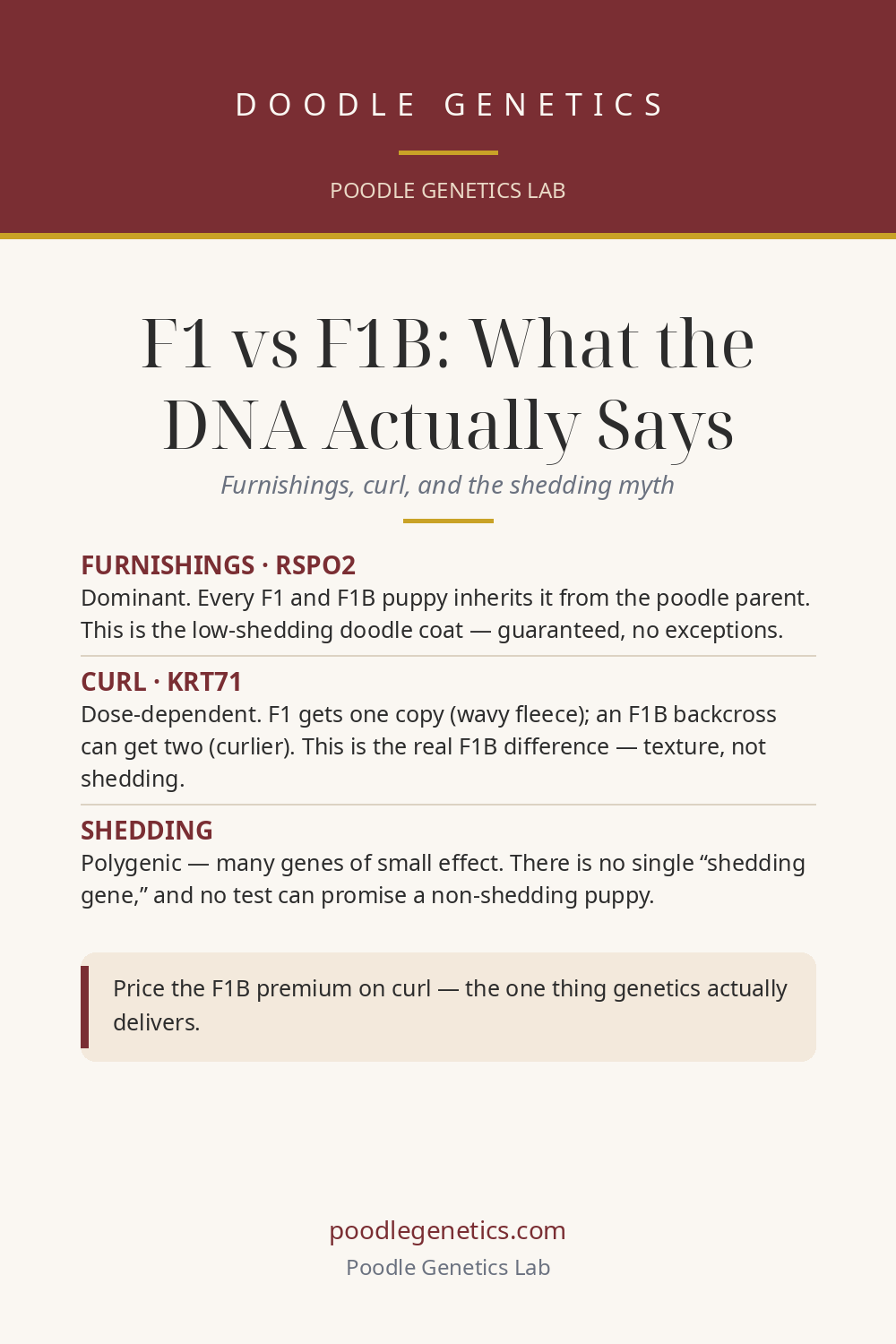
Furnishings determines whether the dog has the wavy, mustached, low-shedding doodle coat at all. It is dominant, poodles are homozygous for it, and every F1 and F1B puppy with a genuine poodle parent inherits it. This is the reliable prediction.
Curl determines how tight that furnished coat curls. Poodles carry curl variants; Golden Retrievers do not. An F1 gets one copy (wavy); an F1B backcross can get two (curlier). This is the real, predictable F1-vs-F1B difference — texture, not shedding.
Shedding is polygenic — controlled by many genes of small effect, not one switch. No coat panel on the market tests "the shedding gene," because there isn't one. Anyone guaranteeing a non-shedding puppy from a DNA result is selling certainty the science doesn't offer.
Furnishings: the one result you can bank on
The furnishings locus (RSPO2) controls the difference between a flat, shedding coat and the furnished coat — the beard, eyebrows, and wavy hair that defines the doodle look. The furnished allele (F) is dominant over the unfurnished allele (f). Poodles are essentially all FF. Golden Retrievers, Labradors, and most other gundog breeds are ff.
Do the cross and the math is trivially clean:
- F1 (poodle × golden): every puppy is Ff — furnished, no exceptions.
- F1B (F1 × poodle): puppies are FF or Ff — still furnished, every one.
This is why the coat-panel article on this site calls furnishings the genuinely reliable result: it is Mendelian, dominant, and the poodle parent guarantees it. An "improper coat" (ff) result in a supposed F1 or F1B doesn't mean the genetics is mysterious — it means at least one parent wasn't what the pedigree says. That is a pedigree problem, and it is worth treating as one.
For the full treatment of which coat-panel results are load-bearing and which are marketing, see what a doodle coat panel can and cannot tell you.
Curl: where F1 and F1B actually differ
Curl is governed substantially by variants in KRT71, a keratin gene. Poodles carry the curly variants; Golden Retrievers carry the straight-coat versions. Unlike furnishings, curl behaves more like a dosage trait in crosses: one copy gives you wave, two copies give you curl.
- F1: one curl allele from the poodle parent, one straight allele from the golden. Result: the classic wavy fleece coat. Soft, loose waves, the look most people picture when they picture a Goldendoodle.
- F1B: the F1 parent (one curl allele) bred back to a poodle (two curl alleles). Roughly half the puppies get two curl alleles and develop the tighter, more poodle-like curly coat; the other half resemble the F1.
So the F1B premium buys you, on average, a curlier coat — not a less-shedding one. That is a real difference, and for buyers who specifically want the tight curly look, it is worth paying for. It is simply not the difference the marketing usually names.
Shedding: the promise no locus can keep
Here is the uncomfortable part. The number one reason buyers pay the F1B premium — "won't shed" — is the trait least supported by single-gene testing. Shedding in dogs is polygenic: many loci of small effect, plus coat growth-cycle biology that no commercial panel assays. The studies that mapped furnishings, curl, and length (notably Cadieu et al. 2009) found exactly three large-effect loci for coat type — and shedding propensity wasn't one of them.
What this means in practice:
- A furnished doodle (F1 or F1B) will shed minimally compared to a Golden Retriever. That much is real, and it is the furnishings locus doing the work.
- No test result — not furnishings, not curl, not any "shedding score" — can guarantee an individual puppy won't shed. Variation within a litter is normal.
- Marketing that ties shedding guarantees to F1B status specifically is borrowing credibility from the real furnishings genetics and spending it on a claim the genetics doesn't make.
Breeders who want to be honest about this have a simple, accurate pitch available: "every puppy is furnished, which is what makes the coat low-shedding; the F1B cross gives you a curlier coat on average." Everything true, nothing oversold.
What about F2 and multigen? Where improper coats actually come from
Everything above assumed a poodle parent in the immediate cross — and that assumption is doing load-bearing work. Breed an F1 to an F1 (an F2 cross), and the furnishings math changes completely: Ff × Ff produces roughly a quarter ff puppies. Those puppies have improper coats — flat, shedding, nothing like the doodle look — from two parents that both looked perfectly furnished.
This is the actual source of most "my doodle sheds" stories, and it has nothing to do with F1 vs F1B. It is F2-and-beyond genetics: once both parents are crosses rather than a pure poodle, the guaranteed furnishings of the first generation no longer apply. Multigen breeders who test and select only furnished (F_) breeding stock avoid it; those who don't, produce it at textbook ratios.
If you're buying: ask whether the parents are F1/F1B (poodle parent = furnishings guaranteed) or multigen (ask for the furnishings test results). If you're breeding multigen: test every breeding dog for RSPO2 and don't place ff puppies as low-shedding. The locus is dominant, the test is cheap, and there is no excuse for surprise improper coats two generations in.
What to actually check before a pairing
- Test the poodle parent for furnishings anyway. It will come back FF, and now you have it on paper for every buyer who asks. Cheap credibility.
- Don't promise shedding outcomes from panel results. Promise furnishings (you can, it's Mendelian) and describe curl expectations honestly.
- Look at the actual dogs, not just the genotypes. An F1B bred for three generations of tight curl will out-curl an F1B from wavy parents regardless of what any single locus says. Phenotype still matters.
- Remember the poodle half. As the poodle half of your doodle explains, every one of these alleles arrives via the poodle parent. The quality of your cross's coat genetics is downstream of the quality of your poodle's.
The bottom line
F1 vs F1B is not a shedding story — it is a texture story written by two loci. Furnishings (RSPO2) is the reliable, dominant, guaranteed-in-every-puppy foundation. Curl (KRT71) is the dose-dependent difference that makes F1Bs curlier on average. Shedding is polygenic and unpromisable. Price the premium on what's real — the curl — and you'll never have to explain to a buyer why their expensive "non-shedding" F1B leaves hair on the couch.
Built on identified genes and validated tests. The claims here are supported by the peer-reviewed literature listed below.
- Published
- October 16, 2026
- Last reviewed
- October 16, 2026
References
- Cadieu E, Neff MW, Quignon P, et al. (2009). Coat Variation in the Domestic Dog Is Governed by Variants in Three Genes. Science 326(5949): 150–153. doi:10.1126/science.1177808
- Hayward JJ, Castelhano MG, Oliveira KC, et al. (2016). Complex disease and phenotype mapping in the domestic dog. Nature Communications 7: 10460. doi:10.1038/ncomms10460
Free Tool
Apply This Knowledge
Model any parent pair with our interactive genetics calculator.
Share this summary
Take the key points with you
A one-page visual summary of this article — handy for saving to Pinterest or passing along to a fellow breeder.