Your Goldendoodle was jet black at eight weeks. At six months there is silver threading through the muzzle. At a year, the whole dog is going pewter, and you are wondering whether something is wrong — or whether the breeder misled you.
Nothing is wrong, and the answer is genetics. Specifically, poodle genetics. What you are watching is progressive graying, sometimes called clearing, and it comes from the poodle half of your dog's pedigree the way merle does: the Golden Retriever side has essentially nothing to do with it.
The short answer
Poodles carry a heritable trait that causes dark coats to lighten progressively as the dog matures. A puppy born black can finish silver; a puppy born dark brown can finish café-au-lait. The lightening is gradual — months to a few years — and it is directional: coats lighten with age, never darken back. If your Goldendoodle is fading, it inherited this trait from its poodle parent, and it was always going to happen. The only variable was how far it goes, and that was never fully predictable.
This is worth stating plainly because it is the single most common coat-color surprise in doodle ownership, and it is almost never disclosed up front. Not out of malice, in most cases — out of a gap in knowledge that this article is meant to close.
What progressive graying actually is
Every hair on a dog grows, rests, and is replaced. In a progressively graying dog, each new generation of hair carries slightly less pigment than the last. The effect starts where the coat is shortest and the new growth most visible — typically the muzzle and face — and spreads across the body over the first year or two. Guard hairs, the longer outer hairs, tend to hold color longest, which is why a fading dog often looks darker along the back than on the legs and face for a while.
The underlying genetics are described in the poodle literature as the G locus, and the honest caveat belongs right here: of all the major coat-color loci, progressive graying is the one whose molecular basis is least nailed down. The inheritance pattern behaves as though a single copy is enough to produce the effect — breed a graying poodle to a non-graying one and graying puppies appear — but the precise variant and its full behavior are still being worked out. This site's own graying gene guide covers the poodle-side detail, including which base colors it acts on.
What is solid: it is heritable, it comes from the poodle side in a doodle cross, it affects dark eumelanin pigment (blacks, browns, and their dilutes), and it does not reverse.
Why this is a poodle trait wearing a doodle's coat
Golden Retrievers do not progressively gray. Their breed genetics simply don't include this trait — a Golden is born its shade and stays it, modulo sun bleaching. So when a Goldendoodle fades, there is exactly one candidate source: the poodle parent.
This is the same bridge logic as the rest of this site's doodle cluster. As the poodle half of your doodle explains, the loci don't change between breeds — what changes is which alleles each parent breed typically carries. Progressive graying is common enough in poodles (it is how the silver and blue poodle colors are produced) that any poodle used in a cross should be considered a possible carrier until its own adult coat and pedigree say otherwise.
Clearing is not the same as fading (and the words get mixed up)
Doodle conversations use "fading" and "clearing" interchangeably, but they describe different things, and the distinction matters for expectations:
- Progressive graying is the inherited, directional lightening described above. It has a genetic basis, it follows a timeline, and it is the main event in a black-to-silver transformation.
- Fading in the casual sense also gets used for sun bleaching (red and apricot coats lighten with sun exposure and can darken again with regrowth), for the normal softening of red pigment with age, and for poor coat condition. None of these are the G locus at work.
If your red Goldendoodle went from deep red to light apricot over two summers, that is mostly sun and the nature of red pigment, not progressive graying — though a poodle parent can contribute to red fading too through separate mechanisms covered in our clearing guide. The dramatic black-to-silver transformation, though, is graying, full stop.
What to actually expect: the timeline
Nobody can give you the endpoint, but the shape of the curve is consistent:
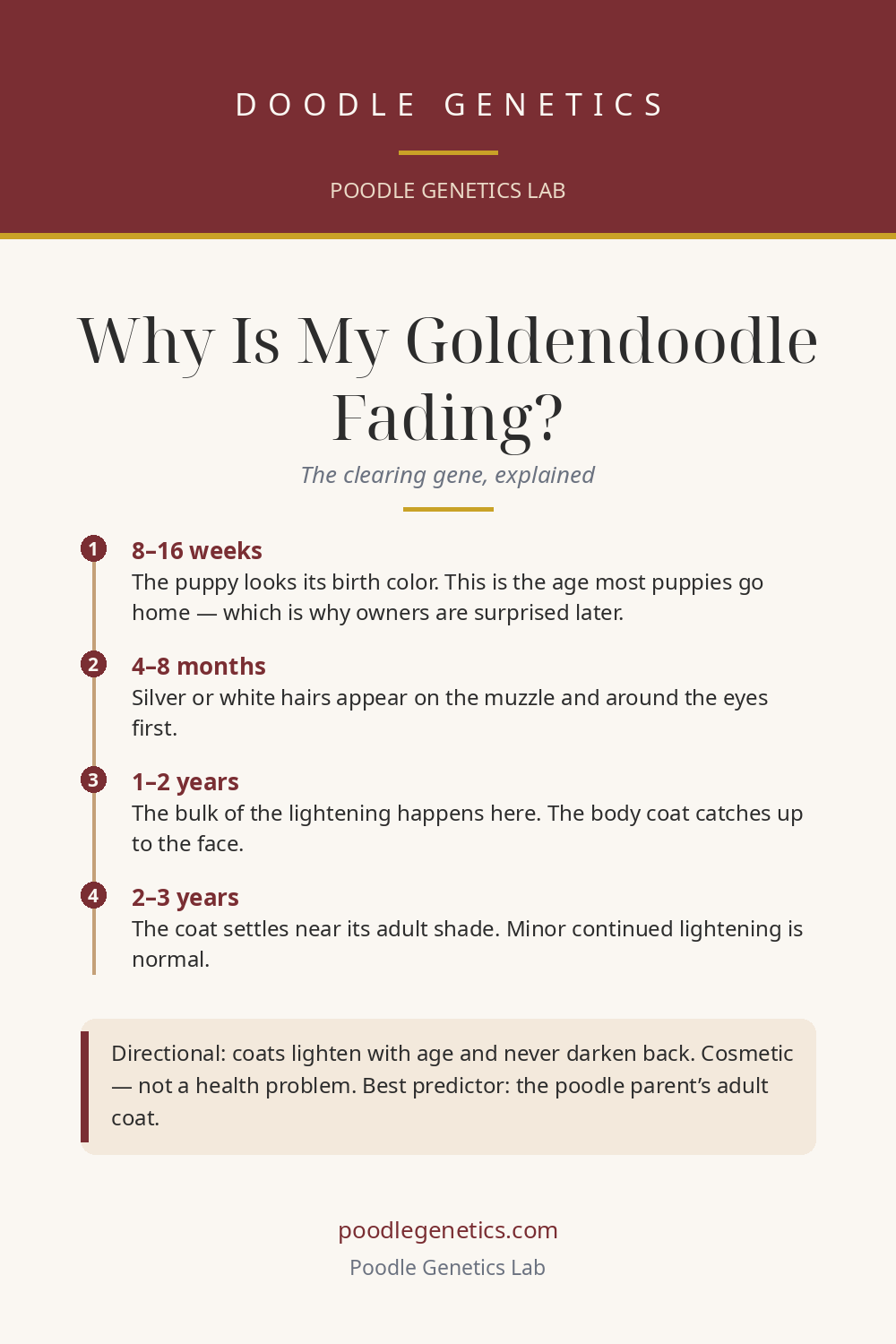
- 8–16 weeks: the puppy looks its birth color. No visible graying yet. This is the age most puppies go home, which is exactly why buyers are surprised later.
- 4–8 months: silver or white hairs appear on the muzzle and around the eyes. On a black puppy this reads as a distinguished gray face; on a dark brown puppy it reads as dustiness.
- 1–2 years: the bulk of the lightening happens here. The body coat catches up to the face. This is when most owners first search "why is my goldendoodle fading."
- 2–3 years: the coat settles near its adult shade. Minor continued lightening is normal after this, but the big moves are done.
Two puppies from the same litter can finish at visibly different shades. That is normal variation, not evidence that something went wrong with one of them.
What breeders should disclose (and what buyers should ask)
If you breed doodles with a poodle that grays — which includes any silver, blue, or café-au-lait poodle, and many blacks and browns — the honest move is to tell puppy buyers that fading is possible and show them what it looks like. Adult photos of the poodle parent at multiple ages are worth more than any promise. Even better: photos of adult dogs from the poodle's previous litters.
If you are buying: ask for the poodle parent's puppy photos, not just current ones. A black puppy photo of a now-silver adult poodle tells you everything. And be wary of any breeder who guarantees a black puppy will stay black while breeding to a silver poodle — that guarantee contradicts the genetics.
The bottom line
Your fading Goldendoodle is expressing poodle genetics exactly as poodle genetics behaves. The trait is heritable, directional, cosmetic, and — once you know to look for it — entirely predictable in the ways that matter: check the poodle parent's adult coat, check its relatives, and set expectations before the puppy goes home. Everything else is just watching silver arrive on schedule.
For the full poodle-side picture, including which base colors graying acts on and how breeders track it across generations, see the graying gene guide and clearing, fading, and holding color. And for the general principle — every one of these surprises traces back to the poodle half — start with the poodle half of your doodle.
Built on identified genes and validated tests. The claims here are supported by the peer-reviewed literature listed below.
- Published
- October 16, 2026
- Last reviewed
- October 16, 2026
References
- Drögemüller C, Philipp U, Haase B, Günzel-Apel A-R, Leeb T (2007). A noncoding melanophilin gene (MLPH) SNP at the splice donor of exon 1 represents a candidate causal mutation for coat color dilution in dogs. Journal of Heredity 98(5):468–473. doi:10.1093/jhered/esm021
Free Tool
Apply This Knowledge
Model any parent pair with our interactive genetics calculator.
Share this summary
Take the key points with you
A one-page visual summary of this article — handy for saving to Pinterest or passing along to a fellow breeder.