A black puppy that turns silver. A deep red puppy that settles into apricot. A black puppy that is still, unmistakably, the same black at eight years old. New breeders often assume these are three versions of the same thing, "coats change over time", and try to explain all of them with one rule. They aren't the same thing. They are three separate, genetically distinct processes, and mixing them up is one of the most common ways a breeder misreads what a puppy's adult coat is going to do.
This article lays the three side by side: clearing, fading, and holding. What drives each one, which colors it touches, how fast it moves, and, just as important, which of the three can actually be predicted before it happens.
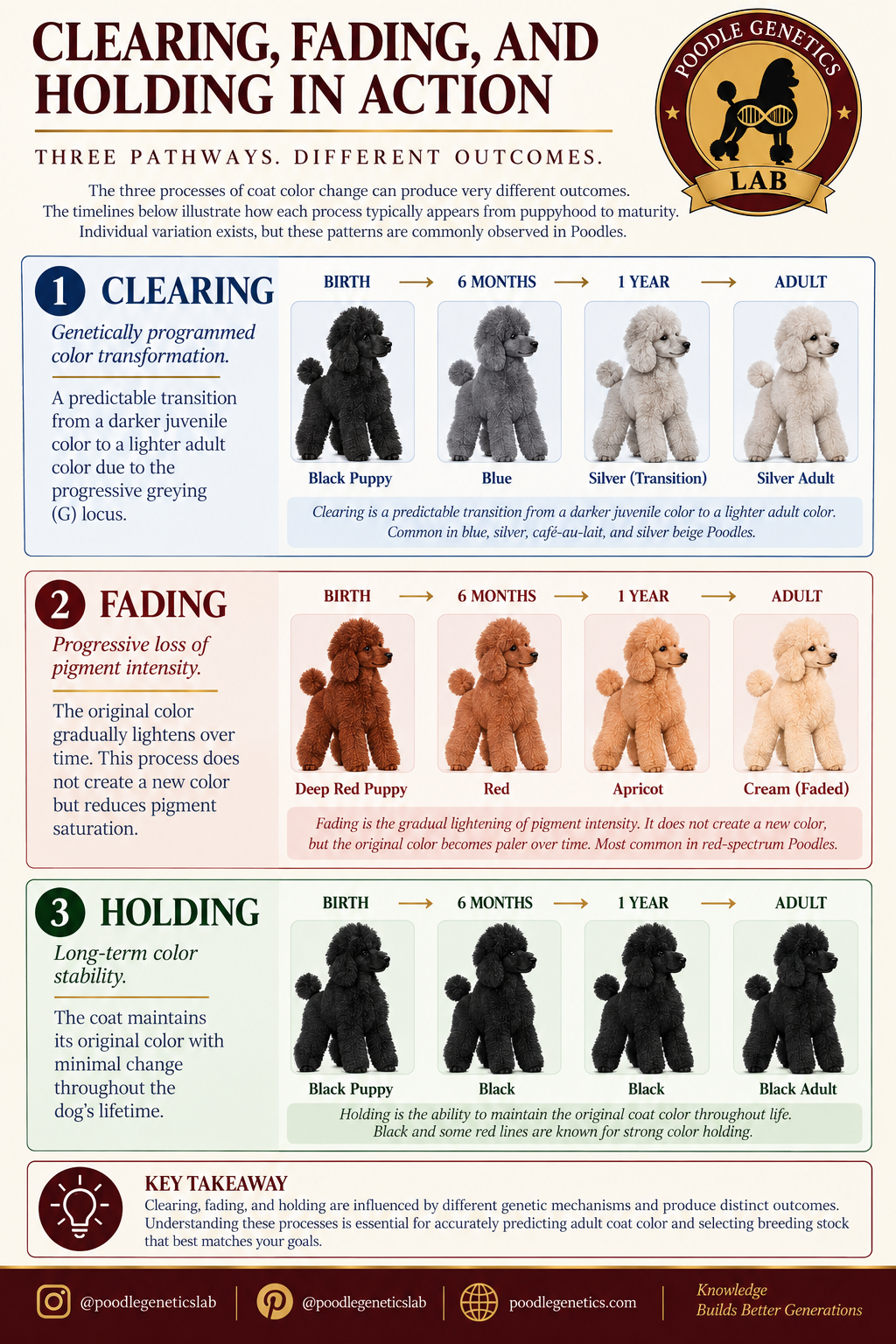
The Short Answer
- Clearing is the G (greying) locus at work: a single dominant factor that reduces eumelanin in new hair growth. It only touches black- and brown-based coats, it follows a predictable dominant/recessive pattern, and its endpoint is set by dosage, one copy clears to blue or café-au-lait, two copies clear further to silver or silver beige.
- Fading is the loss of pigment intensity in phaeomelanin, the red/apricot/cream pigment. It is polygenic, has no DNA test, and does not follow clean ratios the way clearing does. A deep red puppy settling into apricot by its first birthday is fading, not clearing.
- Holding is not a mechanism at all, it is the absence of either one. A dog that holds its color simply doesn't carry the factors that drive clearing or fading, and its adult coat looks like its puppy coat.
They are easy to confuse because all three show up as "the puppy coat wasn't the final coat." But they come from different genetic machinery, run on different timelines, and call for different advice to a buyer.
1. Clearing: A Predictable Transition, Locus by Locus
Clearing is the most genetically well-defined of the three. It is driven by the G locus, a single dominant gene that reduces eumelanin, the dark pigment, in every new hair that grows in after birth (Drögemuller et al., 2007). It does not bleach the hair already on the dog; it changes what color the next coat grows in as.
Because the mechanism is a single dominant gene, clearing behaves the way breeders expect genetics to behave: it is inherited in clean ratios, dosage sets the outcome, and a dog's own G status can be read reliably once it has finished developing its adult coat.
| G Genotype | Black base | Brown base |
|---|---|---|
| gg (no clearing) | Black, holds | Brown, holds |
| Gg (one copy) | Clears to Blue | Clears to Café-au-Lait |
| GG (two copies) | Clears to Silver | Clears to Silver Beige |
A clearing puppy is born looking like its birth color (full black or full brown) and begins lightening at the face and paws first, typically by 6-8 weeks, because those areas cycle through hair growth fastest. From there, the timeline depends entirely on dosage: a GG dog is usually fully cleared to silver by 12-18 months, while a Gg dog settles into blue or café-au-lait more slowly, often over two to three years.
2. Fading: Pigment Loss With No Test and No Clean Ratio
Fading looks similar on the surface, a coat that is lighter at maturity than it was as a puppy, but the mechanism underneath it has almost nothing in common with clearing. Fading happens in phaeomelanin, the red/apricot/cream pigment, in dogs that are ee at the E locus. Where clearing is one dominant gene with a clean inheritance pattern, intensity is polygenic: many genes of small effect acting together, with known contributors including KITLG and a variant linked to GPR22 (Batcher et al., 2022), plus others not yet identified.
That difference in mechanism produces a completely different practical picture:
- There is no test that predicts the shade. A panel can tell you a dog is ee, but nothing currently on the market can tell you whether that dog will hold deep red or fade to cream.
- Litters don't sort into clean ratios. Two deep red parents can throw a spread of intensities across one litter, a bell curve rather than a Mendelian split.
- The timeline is less predictable. Most fading happens somewhere between four months and the first birthday, but because it's the sum of many small effects rather than one dominant switch, there's no dosage chart to read it off of the way there is for G.
For the full treatment of why intensity resists prediction and what actually works for breeders selecting on it, see Why Red Poodles Fade.
3. Holding: What It Looks Like When Nothing Changes
Holding isn't a third mechanism competing with the first two, it's what you see when neither one is present. A dog that is gg at the G locus and carries strong, stable intensity modifiers simply keeps the coat it was born with. Black and some red lines are known for particularly strong color holding, a black gg dog looks essentially the same at eight weeks and at eight years, and a well-selected deep red line can hold much closer to its puppy depth than an average one.
Holding is the default outcome, not a special trait to breed toward on its own. It's simply what's left once a line has been bred away from both clearing (by selecting gg parents) and significant fading (by selecting for depth across whole families, generation after generation, since intensity has no single switch to select on directly).
Telling the Three Apart in a Pedigree
| Clearing | Fading | Holding | |
|---|---|---|---|
| Pigment affected | Eumelanin (black/brown) | Phaeomelanin (red/apricot/cream) | N/A -- neither process active |
| Genetic basis | Single dominant gene (G locus) | Polygenic, many small-effect genes | Absence of G and significant intensity loss |
| DNA test available | No | No | N/A |
| Inheritance pattern | Clean, dosage-dependent | Spread/bell curve across a litter | Follows from parents' own clearing/intensity status |
| Typical colors | Black→Blue/Silver, Brown→Café-au-Lait/Silver Beige | Red→Apricot→Cream | Black, and some strong red lines |
| How to predict it | Read the mature dog and its pedigree | Evaluate adult dogs across the whole family, never puppies | Look for a line with no documented clearing or fading at maturity |
The practical takeaway for a breeding plan is the same across all three: a puppy's coat is not its final coat, and the only reliable evidence for any of these three outcomes is a mature adult, not a litter photo. What differs is how confidently that outcome can be predicted ahead of time. Clearing is the one you can actually model, dosage in, dosage out. Fading is the one you can only shape through patient, whole-family selection with no shortcut. Holding is what you get when a line has been kept clear of both for long enough that nobody has to watch for it anymore.
Summary
- Clearing is the G locus: one dominant gene, clean dosage-based inheritance, affects only black- and brown-based coats, no DNA test, read from the mature dog.
- Fading is intensity loss in phaeomelanin: polygenic, no clean ratios, no DNA test, affects only red/apricot/cream coats.
- Holding is the absence of both, not a separate mechanism, the default outcome in a line bred clear of clearing and faded intensity.
- None of the three can be read reliably off a puppy coat. All three require evaluating the mature adult, and ideally its whole family, before drawing conclusions for a breeding plan.
This article is educational and is not veterinary advice. Discuss breeding and clinical decisions with your veterinarian.
Credible evidence supports what is described here, but the mechanism, the population studied, or its application to Poodles still has limits. The literature below is real and cited in full; where it stops short, the article says so rather than rounding up.
- Published
- October 1, 2026
- Last reviewed
- October 1, 2026
References
- Drögemüller C, Philipp U, Haase B, Günzel-Apel A-R, Leeb T (2007). A noncoding melanophilin gene (MLPH) SNP at the splice donor of exon 1 represents a candidate causal mutation for coat color dilution in dogs. Journal of Heredity 98(5):468–473. doi:10.1093/jhered/esm021
- Batcher K, Varney S, Affolter VK, Friedenberg SG, Bannasch D (2022). An SNN retrocopy insertion upstream of GPR22 is associated with dark red coat color in Poodles. G3: Genes|Genomes|Genetics 12(11):jkac227. doi:10.1093/g3journal/jkac227
Free Tool
Apply This Knowledge
Model any parent pair with our interactive genetics calculator.