The Short Answer
Silver beige and café-au-lait are the same event at two different doses. Both start as a brown-based puppy (bb at the B locus) born dark, and both lighten over time because of the G (greying) locus. The only thing that separates them is how many copies of G the dog carries:
- One copy (Gg) clears partway and stops at café-au-lait.
- Two copies (GG) clears further and faster, landing at silver beige.
There's no third mechanism, no separate gene, and no test that reads the dosage directly — it's read from the dog and its pedigree, the same way blue is told apart from silver on a black base. What follows is the identification comparison in full, the timeline each color actually follows week by week, how to model a specific pairing before you commit to it, and an honest look at what can and can't be said about which color is rarer.
Side by Side
| Café-au-Lait | Silver Beige | |
|---|---|---|
| Base genotype | bb, Gg | bb, GG |
| Born | Dark brown | Dark brown |
| First visible clearing | Muzzle and paws, often not obvious until several months in | Muzzle and paws by 6–8 weeks |
| Clearing window | Roughly 1–3 years to settle | Largely cleared by 12–18 months |
| Adult coat | Warm tan-brown, "coffee with a little cream" — no silver cast | Paler beige with a distinct silver/pewter undertone |
| Nose leather | Liver/brown | Liver/brown |
| Eye rims & pads | Liver/brown | Liver/brown |
| Eye color | Amber/hazel | Amber/hazel |
| Most often mistaken for | A silver beige that hasn't finished clearing yet, or a brown puppy that simply hasn't started to fade | A lilac (isabella) because of the word "silver" — but lilac is dilute and born pale, not cleared |
Notice what doesn't distinguish them: nose, eye rims, pads, and eye color are all set by the bb base, not by G-locus dosage, so they read identically on both colors. That rules out the identification trick that works for telling a true bb brown apart from a cleared black (liver nose vs. black nose) — here, both sides of the comparison already have the liver nose. The only reliable tells are clearing speed and finished color, and even those overlap while a dog is mid-clearing.
The last row of the table is worth dwelling on, because it's the mix-up that actually happens in the field. "Silver beige" sounds like it should mean "silver plus dilute," and buyers hearing the name for the first time sometimes assume it's the same mechanism as a true blue or a lilac. It isn't. Silver beige is a clearing color — it starts dark and lightens — while lilac is a dilution color, born pale on day one and never dark at any point. A puppy's birth coat settles the question immediately: if it was ever genuinely dark brown as a young pup, dilution is off the table and you're looking at the greying route.
Watching the Clearing Happen: A Stage-by-Stage Timeline
Because neither color can be confirmed by a DNA panel, the coat itself is the only instrument available, and it helps to know what it should be doing at each stage rather than checking in only at "birth" and "adult."
Birth to 6 weeks. Both colors are indistinguishable at this point: a solid, dark brown puppy, liver nose, liver pads, no visible lightening yet. There is nothing on a very young puppy that tells a Gg from a GG pup, and there is nothing that rules out a non-clearing brown either. This is the stage where guessing is most tempting and least reliable.
6–8 weeks. This is the first real signal, and it belongs almost entirely to silver beige. GG dogs clear fastest, and the face and paws — the areas with the quickest hair-replacement cycle — start showing lighter growth here. A café-au-lait puppy (Gg) usually shows nothing yet; a single copy of G is a slower process, and its face-and-paw lightening can lag well behind a silver beige littermate's.
3–12 months. Silver beige puppies are visibly transitioning through this window, with the silvery undertone becoming apparent as the puppy coat sheds out. Café-au-lait puppies may just be starting to show their first hints of lightening around now, sometimes later — the 1–3 year window is wide, and slow starters are normal, not a sign anything is wrong.
12–18 months. Most silver beige dogs have essentially finished clearing and settled into their adult pewter-beige. Café-au-lait dogs are typically still mid-transition, showing a warmer, more uneven tan-brown that hasn't fully evened out.
18 months–3 years. Café-au-lait finishes here. The adult coat settles into a consistent warm tan-brown with no silver cast. Any dog still visibly changing color past the three-year mark is unusual for either route and worth a second look at whether something other than G-locus clearing is going on (seasonal nose/coat fading, sun bleaching, or simply a slow example of normal clearing).
Reading this timeline against a specific dog is still an inference, not a measurement — there's no lab step that converts "clears fast" into a confirmed GG. But it's the same kind of inference breeders already make for blue vs. silver on the black base, and it's the best tool available for either color.
Predicting Which One a Pairing Produces
Because G-locus dosage isn't testable, you can't pull a lab report and know in advance whether a litter will throw café-au-lait, silver beige, or plain non-clearing brown. What you can do is read the parents' own finished coats — since a dog that has fully cleared has told you what it is — and run the cross.
Assuming both parents are confirmed bb (testable at the B locus), here's what each pairing of observed adult coats produces:
| Parent A (observed) | Parent B (observed) | Puppy outcomes |
|---|---|---|
| Silver beige (GG) | Silver beige (GG) | 100% silver beige |
| Silver beige (GG) | Café-au-lait (Gg) | 50% silver beige, 50% café-au-lait |
| Silver beige (GG) | Non-clearing brown (gg) | 100% café-au-lait |
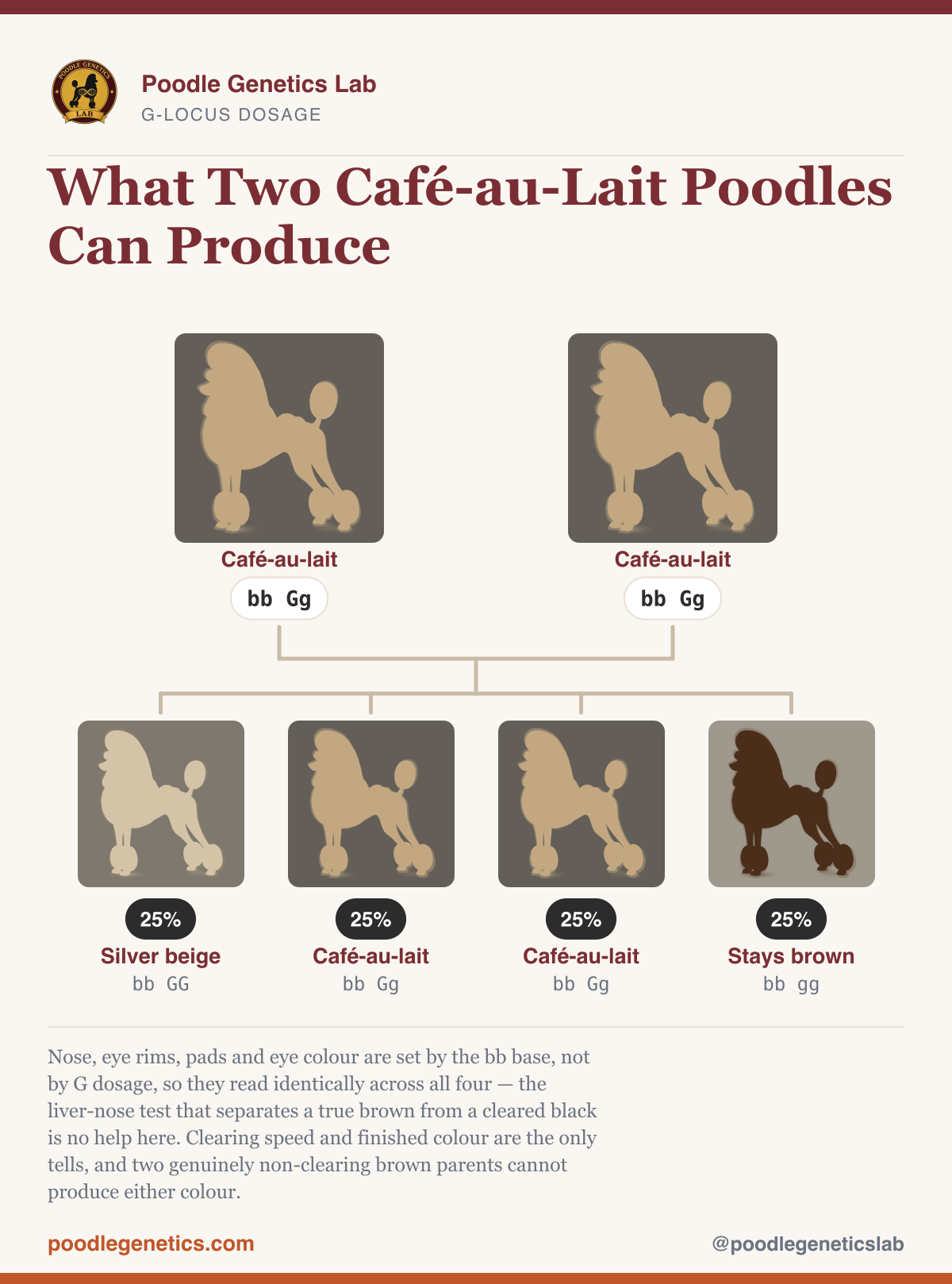
| Café-au-lait (Gg) | Café-au-lait (Gg) | 25% silver beige, 50% café-au-lait, 25% non-clearing brown |
| Café-au-lait (Gg) | Non-clearing brown (gg) | 50% café-au-lait, 50% non-clearing brown |
| Non-clearing brown (gg) | Non-clearing brown (gg) | 100% non-clearing brown — no café-au-lait or silver beige is possible |
The last row matters as much as any other: two brown parents that have each held their color to full maturity without clearing cannot produce either color, no matter how the rest of the pedigree looks. G is dominant — a dog that carries even one copy shows it by adulthood — so a genuinely non-clearing gg parent has no hidden dose to contribute.
One practical note for reading a pedigree instead of two known parents: a puppy several generations removed from a documented silver beige or café-au-lait can still carry G without anyone having written it down, the same way an unconfirmed black line can be quietly holding the G locus without ever being called a "blue carrier." If a pedigree includes ancestors that cleared to either color, treat the line as G-positive until a mature, non-clearing adult in recent generations rules it out — a young puppy still developing its coat can't rule anything out on its own.
How Rare Is Each Color?
This is the question buyers ask most and the one this site can least afford to guess at. There is no AKC, UKC, or breed-club registry that publishes coat-color frequency data broken out by café-au-lait versus silver beige specifically, and no peer-reviewed population study was found covering either color's prevalence. Consumer-facing poodle sites frequently rank one as "rarer" than the other, but they don't agree with each other on which one, and none of them cite a source that would let a reader check the number. That's not a basis for a claim on this site.
What can be said honestly is the mechanistic argument, and it's worth being precise about what kind of claim it is: it describes the probability of an outcome from a given cross, not a measured frequency in the living poodle population. A single G copy is, all else equal, the more probable result of a random pairing that produces any clearing at all — reaching GG requires both parents to contribute a G allele, while reaching Gg only requires one to. That reasoning is sound as far as it goes, but it assumes pairings are effectively random with respect to G status, which breeding programs are not — a breeder actively selecting for silver beige, or one whose whole brown line already runs GG, will produce more silver beige than the population-level math would suggest, and the reverse is just as possible.
The honest summary: expect café-au-lait to be the more frequently encountered color under a hands-off assumption, but treat that as a directional inference from the genetics, not a verified rarity ranking. If a firm number for either color surfaces from a credible registry or study, this section should be updated with it and a citation.
What This Means for a Breeding Plan
Because there's no direct test for G-locus dosage, you can't confirm which of the two you'll get from a genotype panel alone — the B locus (bb) is testable, but greying status and its dosage are read from the dog and its relatives, per the greying gene article. In practice:
- If both parents are confirmed bb and at least one has cleared to silver beige (GG), expect a meaningful share of silver beige puppies, with the rest depending on the other parent's own G status.
- If both parents are bb and the clearing you've seen in the pedigree tops out at café-au-lait, don't expect silver beige to appear — a Gg parent has no GG puppies to give, regardless of partner.
- If both parents are bb and neither has ever cleared as a mature adult, plan for non-clearing brown puppies — the table above has no route from two confirmed gg parents to either color.
- A puppy's birth coat won't tell you which one you're getting. Both are born dark brown, and non-clearing brown starts identically too; the distinction only becomes visible as the coat clears, and even then, not with full confidence until it's finished.
Run the actual cross through the calculator before committing to a pairing plan — entering both parents' observed coats, not just their B-locus status, is what turns "we think this pairing will throw some silver beige" into an actual probability spread you can plan a litter around.
For the full mechanism behind why greying happens at all, see the greying gene article; for how the brown base itself works, see the B locus article. For how these two colors fit into the complete inheritance picture alongside every other locus, see Volume I.
Download the Silver & Blue Prediction Guide for a printable summary.
This article is educational and is not veterinary advice. Discuss breeding and clinical decisions with your veterinarian.
Built on identified genes and validated tests. The claims here are supported by the peer-reviewed literature listed below.
- Published
- September 18, 2026
- Last reviewed
- September 3, 2026
References
- Schmutz SM, Berryere TG, Goldfinch AD (2002). TYRP1 and MC1R genotypes and their effects on coat color in dogs. Mammalian Genome 13(7):380–387. doi:10.1007/s00335-001-2147-2
Free Tool
Apply This Knowledge
Model any parent pair with our interactive genetics calculator.