Your Puppy Isn't Sick. It's Probably Just Doing What Poodles Do.
If you searched for this because your puppy's coat looks different than it did a few months ago, take a breath: for the overwhelming majority of poodles, a changing coat color is completely normal, not a sign of illness, poor nutrition, or something you did wrong. Poodles are one of the more dramatic color-changing breeds in all of dogdom. A puppy that looks jet black at eight weeks can be a shimmering silver adult by eighteen months. A puppy that looks like a rich mahogany red can settle into a soft apricot. Neither of those puppies is "losing" its real color. Both are becoming what they were always going to become.
This article is written for owners, not breeders. If you want the deeper genetic explanation, we link to it below. Here, the goal is simpler: help you recognize what's happening, roughly when to expect it to stop, and the (rare) situations where a coat change is actually worth a vet call instead of a shrug.
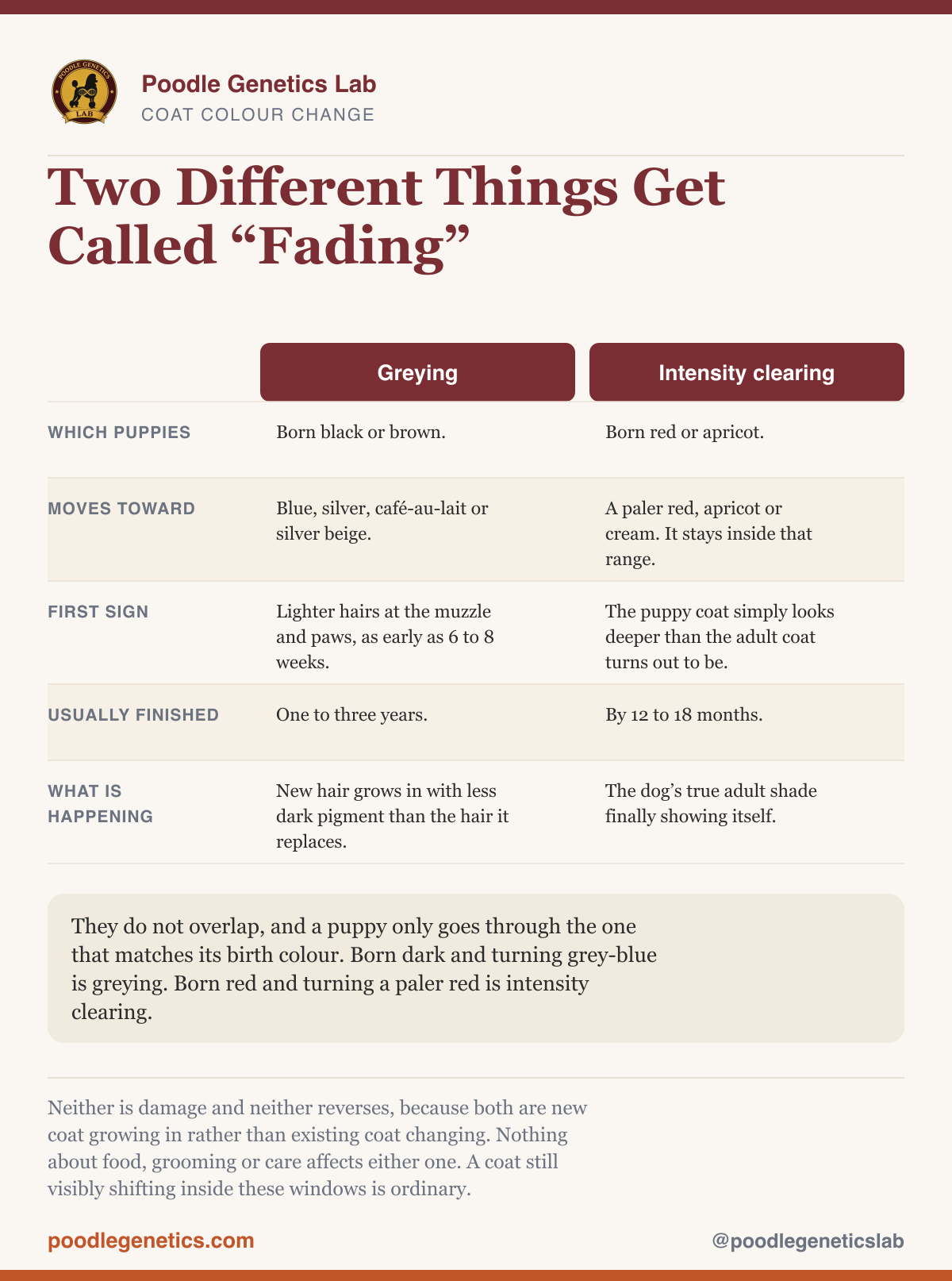
Two Different Things Get Called "Fading," and They Are Not the Same
This is the single most useful thing to understand, because owners frequently describe both of these as "my poodle is fading" when they're really talking about two unrelated processes.
1. Greying (a black or brown puppy going lighter)
Some poodles carry a factor that causes their dark pigment to fade progressively as they grow. A puppy born looking solid black may start showing lighter hairs around the muzzle and paws as early as 6 to 8 weeks old, then continue clearing over the following one to three years until it settles into its true adult color: blue, silver, café-au-lait, or silver beige, depending on how the dog is built genetically underneath.
This is not damage. It is not the coat "wearing off." It's new hair growing in with progressively less dark pigment than the hair it replaces, so the change is gradual and permanent, not something that reverses. A silver poodle isn't a black poodle that got bleached; it was always going to be silver, it just took a year or two of new coat growth to get there.
We cover the mechanics of this in detail, including why one dog stops at blue and another goes all the way to silver, in What Is the Greying Gene?. That article is written for breeders and gets into genotype notation; this one is here so you don't have to read all of that just to know your puppy is fine.
2. Intensity clearing (a red or apricot puppy going lighter)
A completely different process affects red, apricot, and cream poodles. These colors don't involve greying at all, they run on a totally different pigment. What happens instead is that the depth of that warm red/apricot color often looks more intense in puppy coat than it will as an adult. As the adult coat comes in, usually by 12 to 18 months, the coat settles into the dog's true, genetically set shade, which is very often noticeably lighter than the puppy coat suggested.
This is why a breeder who promised you a "deep red" puppy may end up handing you what looks, a year later, like a solid apricot. It's not a bait and switch (usually) and it's not the coat degrading, it's the true adult color finally showing itself. We go into why this is so hard to predict, and why no lab can test for it, in Why Red Poodles Fade.
What's Actually Normal, Timeline-Wise
Here's roughly what to expect, so you know whether your dog's timeline is ordinary or worth asking a vet or your breeder about:
- 6 to 8 weeks: The earliest hint of greying, if it's going to happen, usually shows first around the face and paws. This is genuinely the earliest reliable sign, because those areas' hair grows fastest.
- 4 months to 12 months: Most of the visible change happens here for both greying and intensity clearing. This is usually the stretch where an owner suddenly notices "wait, my puppy looks really different now."
- 12 to 18 months: Intensity clearing (red/apricot) is typically finished by this point, and the adult shade is basically set.
- 1 to 3 years: Greying (black/brown toward blue, silver, café-au-lait, silver beige) can keep progressing this long before it fully settles, especially in slower-clearing dogs.
If your dog's coat is still visibly shifting somewhere in these windows, that is ordinary. Nothing to worry about, nothing to change about food, grooming, or care.
When a Coat Change Actually Is Worth a Vet Visit
Both of the mechanisms above are slow, even, and follow a predictable pattern (face and paws first for greying; overall gradual softening for red/apricot). That's the key word: predictable. What is not part of either normal process, and is worth mentioning to your vet, includes:
- Patchy, uneven lightening that doesn't follow the face-and-paws pattern, especially if it's accompanied by hair thinning or loss in those same spots
- Redness, itching, or skin changes anywhere the color is shifting
- Sudden changes happening over days rather than months
- A previously light coat suddenly darkening, which isn't part of either greying or intensity clearing
None of these are common, and most owners reading this will never see them. They're included here so you have a genuine line between "normal poodle thing" and "go get this looked at," rather than being left to guess.
A Word on Merle (a Different Kind of "Change" Worth Knowing About)
One more thing worth a brief mention, not because it's likely to apply to you, but because it causes real confusion when it does: red and apricot poodles can carry the merle pattern without ever showing it, because merle only visibly patterns dark pigment, and red/apricot coats don't have any in the coat. This isn't a coat "change" in the sense this article covers, an ee merle dog looks like a normal solid red or apricot dog its whole life, but if you're planning to breed your dog, or already know your dog is red-based, it's worth knowing that a solid-looking coat doesn't rule merle out. That's a DNA-testing question, not something you'll ever see happen in the coat itself.
Bottom Line
If your poodle's coat is changing gradually, starting from the face and paws (for a greying dog) or softening evenly across the whole coat (for a red or apricot dog), and it's happening somewhere in that first one to three years of life: this is completely normal poodle biology, not a health problem, and not something anyone did wrong. Two different, well-understood mechanisms produce it, and neither one means your dog is unwell.
If you want to understand the genetics behind either mechanism in more depth than an owner typically needs, the two companion articles linked above go into the science; and if you're curious what your dog's parents' colors predict for future litters, the Poodle Color Genetics Calculator models the loci breeders track most closely.
For the full breeder-level treatment of how color moves through a poodle pedigree, see Poodle Color Genetics, 2nd Edition.
Download the Silver & Blue Prediction Guide for a printable summary.
This article is educational and is not veterinary advice. If you're ever unsure whether a coat change in your dog is normal, a quick check-in with your veterinarian costs little and puts the question to rest.
Built on settled, deterministic reasoning or a directly observable fact rather than a specific cited study, so no References section appears below.
- Published
- October 13, 2026
- Last reviewed
- April 27, 2027
Free Tool
Apply This Knowledge
Model any parent pair with our interactive genetics calculator.