Embark is the DNA test most poodle owners actually hold in their hand, and its report reads more simply than any other lab's — which is exactly what makes it easy to over-trust. This is a walkthrough of how Embark actually labels a result, not a repeat of what a health panel result licenses you to conclude — read that one first if you haven't; this article assumes it.
The three-word system
Embark's own site reports every screened condition one of three ways:
- Clear — zero copies of the variant Embark tests for
- Carrier — one copy
- At-Risk — two copies
This is confirmed directly from Embark's own published breeder summary report, cross-checked against real Poodle-panel percentages for several conditions — not a guess at their wording. If your Poodle's report says "Carrier" next to prcd-PRA, that is Embark's own word for one copy, not PGL's paraphrase of it.
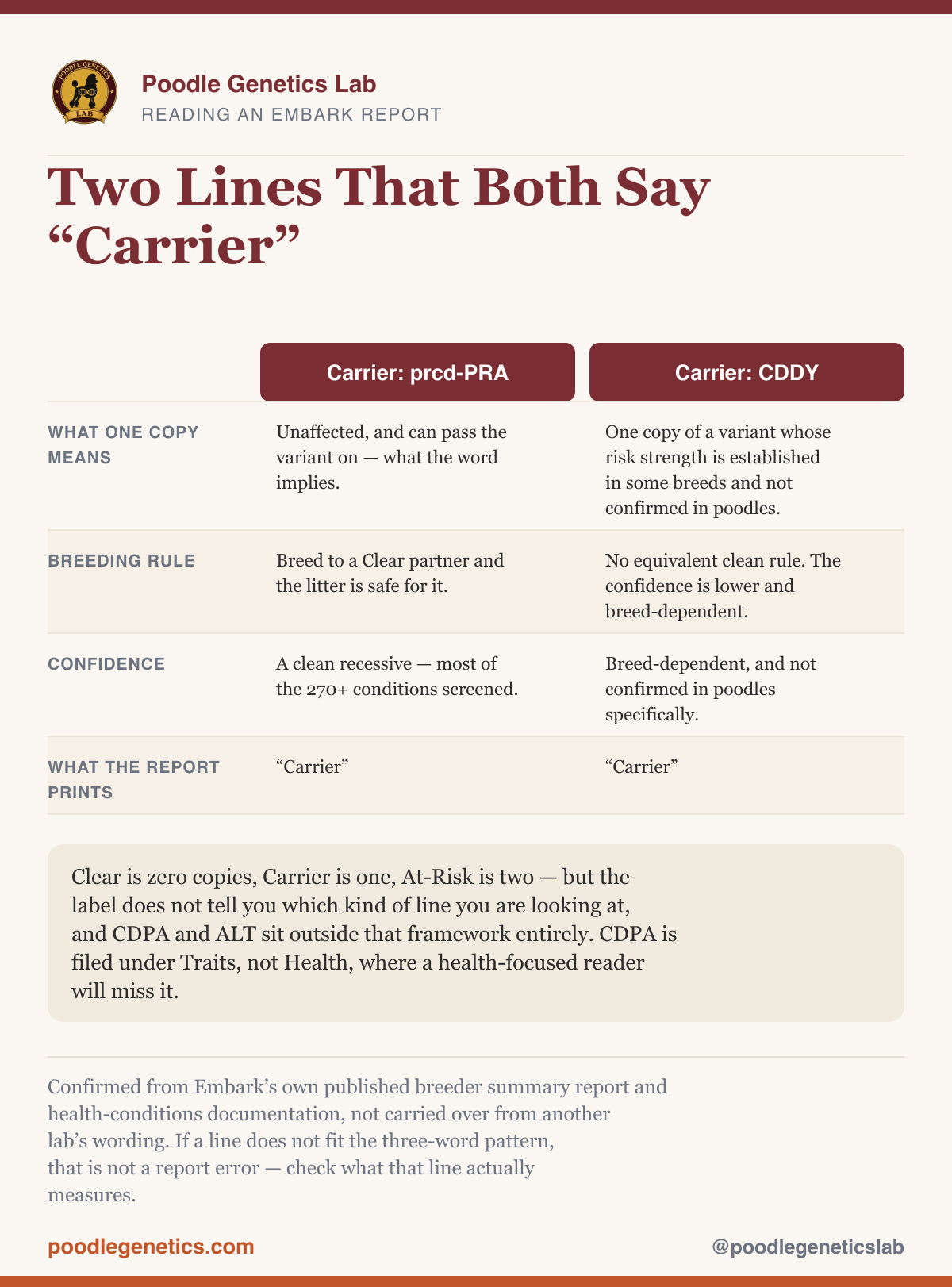
The trap: "Carrier" reads as a single, uniform category, and on Embark's report it visually is one. Underneath, it is not. A carrier for a clean recessive disease (prcd-PRA, most of Embark's 270+ screened conditions) really does mean what the word implies: unaffected, can pass the variant on, breed with a Clear partner and you are safe. A carrier for CDDY — the IVDD-associated variant Embark also screens — means something with a much lower, breed-dependent confidence, because CDDY's risk strength is established in some breeds and not confirmed in Poodles specifically. Embark's label does not tell you which kind of line you are looking at. You have to know that going in.
Where the pattern actually breaks
Embark's own three-word system does not cover every line on your report. CDPA and ALT (a copper-metabolism enzyme-activity marker, not a disease call) are reported outside the Clear/Carrier/At-Risk framework entirely — this is confirmed from Embark's own health-conditions documentation, not an assumption carried over from a different lab. If a line on your report doesn't fit the three-word pattern, that is not a report error. Check what that specific line is actually measuring before assuming it slots into the usual scale.
A real place this causes missed results: Embark places the CDPA result under the report's Traits section, not Health. A breeder scanning "the health results" to share with a puppy buyer or co-owner can miss it entirely — not because anyone hid it, but because it's filed somewhere a health-focused reader isn't looking. If you're sharing a Poodle's Embark results with anyone for a health-relevant reason, check the Traits section too, not just Health.
Where Embark's report earns its keep
One thing Embark reports that none of the other labs on this list do: a Red Intensity marker, scored 0–10. If you're breeding specifically for red, apricot, or cream shade prediction, this is the reason to test with Embark over the others — none of the other four labs in this cluster report an equivalent shade-intensity score. Embark does not offer merle base-pair- length testing at all, so if merle length class is what you need, this isn't the lab for it — see the UC Davis VGL guide for that.
What a Poodle-specific panel actually screens
Embark's dog-DNA-test product screens 270+ health conditions across 17 body-system categories and reports on 55 named coat/trait genes, alongside breed composition. Not every one of those 270+ conditions is relevant to Poodles specifically — a result being "on the report" does not mean it is a Poodle concern. This is exactly the judgment call the general health-panel guide walks through: evidence tier, not just genotype, decides whether a line means anything for your dog's breed.
One honest gap
This article is built from Embark's own published one-page breeder summary report — the source with the most confirmed, currently-verifiable wording. Embark's full multi-page consumer report (viewed inside a signed-in account) was not independently reviewed for this article, so if your own full report shows additional formatting beyond the three-word system described above, trust what's actually printed on your copy over this page.
How Embark compares to the other labs breeders use
No single lab covers everything. Here's where Embark sits against the other four labs this cluster covers, based on what each lab's product actually offers and, for the two flagged rows, what breeders in the field commonly report rather than an independent accuracy study:
| Lab | Breed ID | Merle Base Pair Test | Order by locus | Turnaround | Notable |
|---|---|---|---|---|---|
| Embark | Yes, generally accurate | Not offered | No — bundled panels only | Standard | Only lab here with a Red Intensity marker (0–10) |
| UC Davis VGL | Not offered | Yes — the only lab here with base-pair-length testing | Yes | Standard | The precise assay for merle length class |
| Wisdom Panel | Yes | Not offered | No | Standard | Improved over time, but see that guide's note on breeder-reported reliability |
| Animal Genetics | Not offered | Not offered (see that guide's note on merle-screening accuracy) | Yes | Fastest of the five | |
| Orivet / Paw Print Genetics | Not independently confirmed | Not independently confirmed | Not independently confirmed | Not independently confirmed | Report format not independently confirmed for this cluster |
Put your actual results through the tool
Once you know what each line on your Embark report is really claiming, the next step is running your dog's actual results — and, if you're evaluating a pairing, both parents' results — through a real calculation instead of eyeballing percentages.
Decode your Embark results in the DNA Report Interpreter →
The interpreter's Embark option uses this exact Clear / Carrier / At-Risk wording, so you enter what your report actually says rather than translating it into a generic scale first.
Download the Poodle Health Panel Worksheet for a printable summary.
Credible evidence supports what is described here, but the mechanism, the population studied, or its application to Poodles still has limits. The literature below is real and cited in full; where it stops short, the article says so rather than rounding up.
- Published
- September 11, 2026
- Last reviewed
- August 25, 2026
References
- Parker HG, VonHoldt BM, Quignon P, et al. (2009). An expressed Fgf4 retrogene is associated with breed-defining chondrodysplasia in domestic dogs. Science 325(5943): 995–998. doi:10.1126/science.1173275
Free Tool
Apply This Knowledge
Put two parents’ DNA panel results through the calculator and see the odds, line by line.