The Short Answer
A poodle's coat falls into one of two categories: a solid color (one color over the whole body, AKC-eligible for conformation) or a pattern/marking (two or more colors, or a distinct arrangement of one color — AKC-registerable but not conformation-eligible). There are 10 recognized solid colors and 9 common patterns and markings, and every one of them traces back to a small handful of genetic loci this site covers in depth elsewhere. This page is the complete reference for every recognized color and pattern: what each one actually is, what causes it, and links to the deep-dive article on the mechanism behind it. For a broader tour of the genetics behind them, from individual loci to health-linked traits, see the Genetics Guide hub.
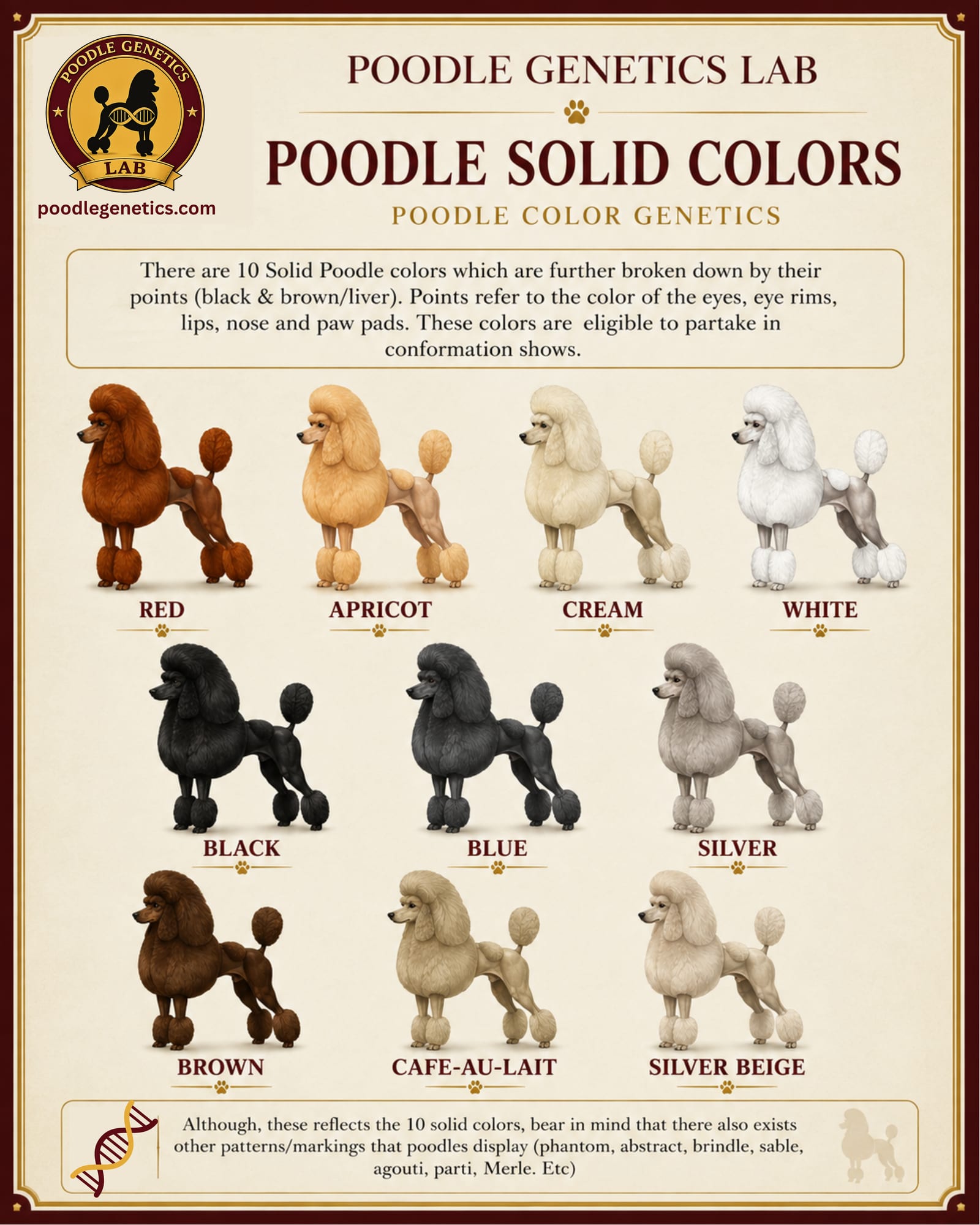
The 10 Solid Colors
"Solid" doesn't mean genetically simple — it means one color, uninterrupted, over the whole coat. Points (the eye rims, nose, lips, and paw pads) still vary by color and are part of how a solid color is judged.
Red
Phaeomelanin (ee)
High-intensity red/orange pigment. No eumelanin in the coat.
Apricot
Phaeomelanin (ee)
Mid-intensity phaeomelanin — the middle of the same range as red and cream.
Cream
Phaeomelanin (ee)
Low-intensity phaeomelanin. Pale, but with warmth.
White
Phaeomelanin (ee)
The palest end of the same ee intensity range — not S-locus spotting-white.
Black
Eumelanin, full pigment
B and D loci both fully pigmented. No clearing.
Blue
Eumelanin, black-based
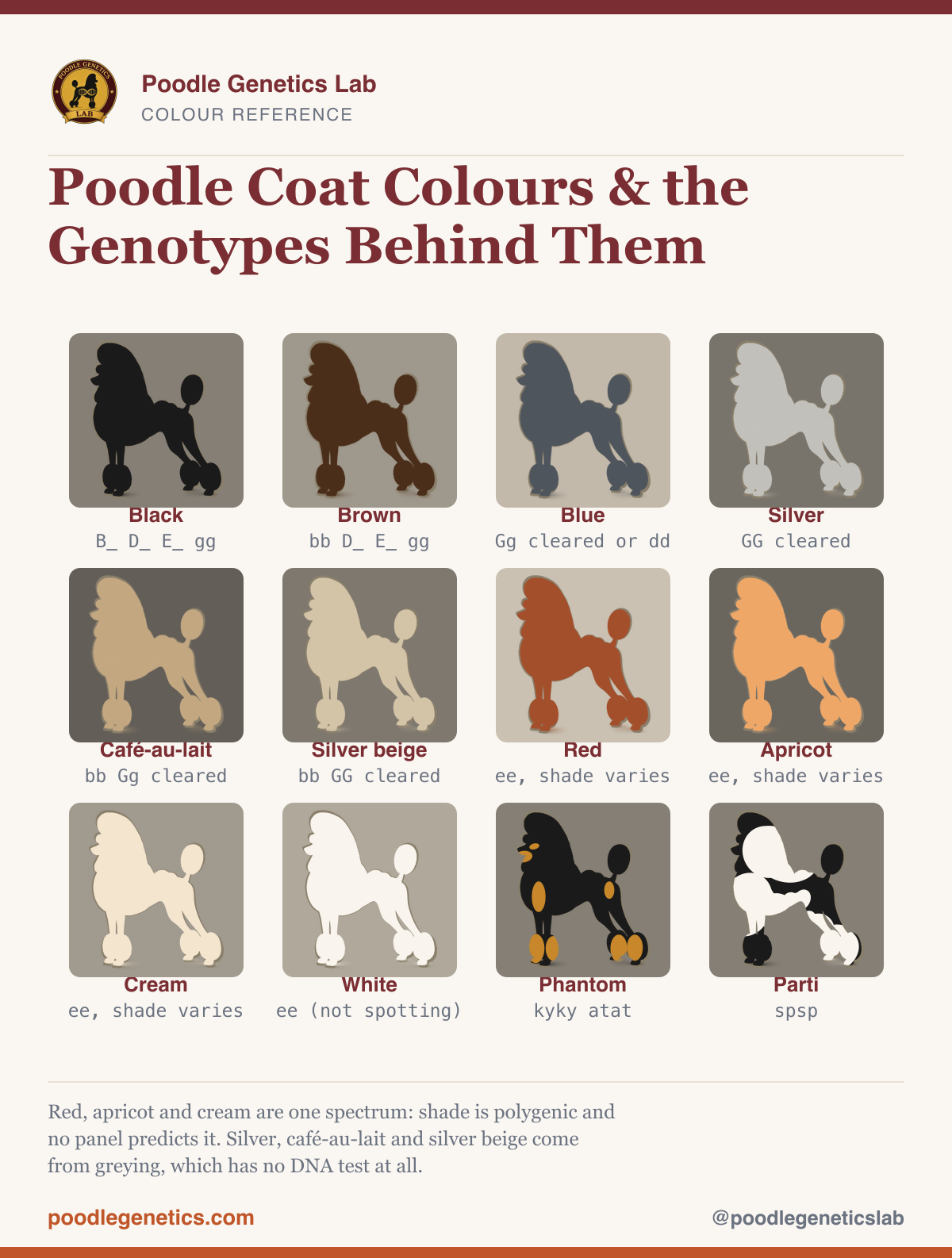
Most often born black, clears to blue over two to three years (Gg). True dilute-from-birth blue (dd) exists too, but is less common.
Silver
Eumelanin, black-based
Born black, progressively clears to silver by twelve to eighteen months (GG) — faster and further than blue.
Brown
Eumelanin, brown-based
bb at the B locus. Full brown pigment, no clearing.
Café-au-lait
Eumelanin, brown-based
Born dark brown, clears to café-au-lait over time (bb + one G copy).
Silver Beige
Eumelanin, brown-based
Born dark brown, clears further to silver beige (bb + two G copies).
Red, Apricot, Cream, and White
All four of these are the same underlying genotype — ee at the E locus, which blocks eumelanin from the hair shaft entirely and leaves only phaeomelanin. The difference between red, apricot, cream, and white is intensity, a polygenic trait no single test predicts. See the E locus explainer for the full mechanism, and why red poodles fade for what happens to that intensity as a puppy grows up. KITLG is one confirmed intensity contributor in poodles — see the KITLG deep dive — but it doesn't fully explain the range on its own.
Black and Brown: the Two Base Pigments
Every eumelanin-based color on this list starts as either black (the default) or brown (bb at the B locus, per the B locus article). Blue, silver, café-au-lait, and silver beige are all what happens next to one of those two bases.
Blue and Silver: Two Shades of the Same Clearing Process
Silver and blue are close relatives, not two unrelated colors. Both start as a black-based puppy born black, and both change color over the first months to years of life, driven by the G (greying) locus — the same mechanism, at two different doses, on two different timelines.
Café-au-lait and Silver Beige: the Brown-Based Pair
The 9 Patterns and Markings
Patterns and markings are AKC-registerable, but under the current breed standard they aren't eligible for conformation — they can still compete in performance and companion events. The distinction isn't a judgment on the dog; it's a category the standard draws around solid color specifically.
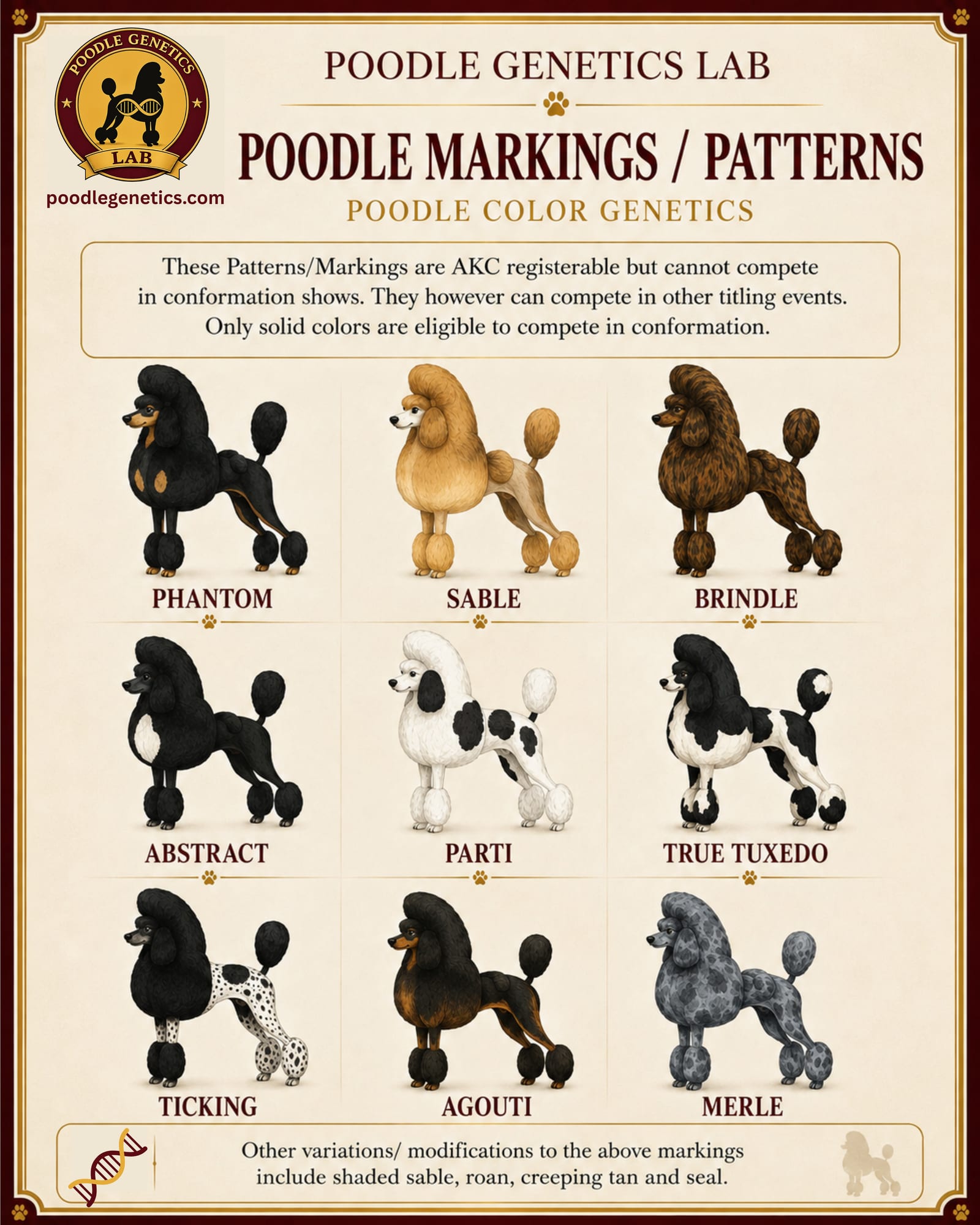
Phantom
Tan or cream points over a darker base — eyebrows, muzzle, chest, legs — governed by the at allele at the A locus, and only visible if the K locus isn't masking it (a phantom needs ky/ky; one copy of dominant black hides it completely, invisibly). One nuance worth knowing: what looks like classic phantom sometimes turns out to be creeping tan, whose points expand with age rather than staying fixed. The likely explanation is a related A-locus haplotype (black saddle), though no published series has haplotyped creeping-tan poodles to confirm it. Either way it is genuinely different biology from stable phantom, not just a variant name.
Sable
The opposite end of the A-locus hierarchy from phantom: a dominant Ay allele that produces dark-tipped hairs, either clearing toward a solid lighter color with age (often just called sable) or retaining more dark tipping throughout life (shaded sable). A sable puppy from a phantom parent is a real, expected outcome — the two patterns sit at different points in the same allelic series, not on a spectrum between each other.
Agouti
A less common A-locus presentation: banded hairs that alternate phaeomelanin and eumelanin along each shaft, giving a "wolf grey" ticked appearance rather than a solid or tipped one. Genetically it sits between sable and phantom in the A-locus dominance order, and it's uncommon in poodles specifically.
Brindle
Stripes over a base color, from the kbr allele at the K locus. Like every K/A-locus pattern, it needs actual pigment to stripe — it won't show on an ee (red/apricot/cream/white) dog, because there's no eumelanin there for it to pattern.
Parti and Abstract
Both come from the S locus, and both are the same gene at different doses. Parti is spsp: roughly half or more of the coat is white, in large, irregular patches. Abstract is the single-copy carrier presentation (Ssp) — a solid-looking dog with limited white: a chest flash, white toes, a chin spot, a blaze. It's not a separate pattern so much as parti's quieter sibling. See the parti poodle article for the full picture, including why the amount of white a parti carries isn't reliably predictable from genotype alone.
True Tuxedo
A specific, symmetric six-point pattern — a facial blaze, a full collar, a chest bib connected to that collar, a white underside, socks on all four legs, and a white tail tip — distinct from an abstract mismark or a generic parti presentation. spsp parti genetics is one confirmed route to it. Two further routes some breeders have observed — an "Irish spotting" modifier that can act even on solid-tested (SS) dogs, and that same modifier stacking with a proposed "Whitehead" factor — are genuinely provisional, not settled science, and the second carries an open question about a deafness association worth reading before treating it as a breeding strategy. The full framework, including that caveat, is in the Whitehead and Irish spotting hypothesis piece.
Ticking
Small, isolated colored spots that appear inside a white area as a puppy's coat matures — a clean white patch at birth isn't necessarily still clean at a year old. Ticking is its own locus, dominant, and independent of how much white the dog has to begin with.
Merle
Mottled patches of diluted color over a base coat, from the M locus — and the one pattern on this list with a real, well-documented health stake attached.
Why Solid vs. Pattern Matters for Showing
The current breed standard reserves conformation eligibility for the 10 solid colors above. Every pattern and marking on this list — phantom through merle — can still be AKC-registered, and all of them remain eligible for performance events, companion events, and every other titling path outside the conformation ring. The distinction is about the standard's current scope, not about the dog.
Common Questions
Can two solid parents produce a patterned puppy? Yes. Phantom, parti, and abstract in particular can hide invisibly in a solid-looking parent (a phantom masked by dominant black, or an abstract carrying just one S-locus copy) and appear in the next generation without warning. If pattern status matters to your program, test for it rather than judging by the parents' coats.
Is white a "clear" coat, or is it spotting-white? In this list, White is the palest end of the ee phaeomelanin range — the same mechanism as cream, just paler — not S-locus spotting. A dog that's white because of heavy S-locus spotting over a pale base is a different genetic story, even if the coat looks similar.
Which pattern is riskiest to get wrong? Merle, without question. Every other pattern on this list is a cosmetic classification. Merle is the one where guessing instead of testing has a real welfare cost.
The Bottom Line
Ten solid colors, nine patterns — nineteen names that all resolve to a short list of loci: E, K, A, B, D, G, S, T, and M. Once you know which locus is doing the work, the names stop being a list to memorize and start being a map you can read off a DNA panel. Use the color calculator to model a specific pairing, or start with Volume I if you want the full reference in one place.
Download the Full Loci Reference Card for a printable summary.
This article is educational and is not veterinary advice. Discuss breeding and clinical decisions with your veterinarian.
Built on identified genes and validated tests. The claims here are supported by the peer-reviewed literature listed below.
- Published
- August 17, 2026
- Last reviewed
- September 8, 2026
References
- Langevin M, Synková H, Jančušková T, Pekova S (2018). Merle phenotypes in dogs — SILV SINE insertions from Mc to Mh. PLoS ONE 13(9):e0198536. doi:10.1371/journal.pone.0198536
Free Tool
Apply This Knowledge
Model any parent pair with our interactive genetics calculator.