Three Dogs That Should Not Exist
Three boys from a recent litter came back from the lab as SS. No parti allele. Not carriers — clear.
All three are tuxedos.
That is the whole problem in two sentences. Under the standard account of white in poodles, a tuxedo is a parti, and a parti is spsp at MITF. These dogs have the pattern and not the genotype. Either the pattern is something other than parti, or the test is measuring the wrong thing.
What the S Locus Test Actually Tells You
The commercial S locus test is a good test. It looks for the MITF piebald variant, it finds it reliably, and when it says spsp you have a parti. Nothing here disputes that.
What it does not do is report white. It reports one variant at one gene. If white in poodles is written by more than one factor — and the dogs suggest it is — then a clear S locus result tells you only that this particular route to white is not in play. It does not tell you the dog will be solid, and these three boys are the demonstration.
The Proposal
Two untestable factors, both hypothetical, both named for convenience rather than by any authority:
Irish spotting (si). The pattern is real and long-recognised across dogs — white on the muzzle, collar, chest, feet and tail tip, in a distribution that is strikingly consistent. Its relationship to the S locus in poodles is unknown, and the reason for that is the finding above: most Irish-spotted poodles test SS. Whatever draws the pattern, the piebald test cannot see it.
The Whitehead modifier. A separate factor proposed to influence how far the white extends, particularly around the head. It is the one that carries a health question, and it is discussed further down.
Irish spotting may be dose-dependent
The proposal is straightforward:
| Copies | Proposed result |
|---|---|
| One | Minimal white — a bib, a partial collar, abstract markings |
| Two | The complete tuxedo |
The support for it is a comparison between two litters by the same sire.
Tellytubby tested SS and carries no parti. She produces white with a consistency that is hard to attribute to chance, and on both her own phenotype and what she throws, the suspicion is that she carries two copies — sisi under the proposed notation. Her litter gave the three tuxedo boys.
Jynx also tested SS. But she shows only a white bib and a partial collar — the minimal end. Suspicion: one copy. Bred to the same sire, her litter produced one complete tuxedo, with the rest scattered across a range from large bibs to partial socks.
Same sire. Different dams. One dam throwing tuxedos consistently, the other throwing a spread. If Irish spotting is dose-dependent, that is exactly the shape you would expect, and the difference between those two litters was difficult to ignore.
It is not proof. Two litters is not a study, and "difficult to ignore" is not a p-value. It is a reason to keep breeding, keep recording, and see whether the pattern holds.
The Whitehead Question, and Why It Matters
The sire tested Ssp. The suspicion is that he carries both an Irish spotting allele and the Whitehead modifier — and that suspicion did not come from his own coat. It came from a previous litter.
That litter produced an extreme white parti that tested only Ssp — one copy, not two — and the dog was unilaterally deaf.
Ssp should not, on the standard account, produce an extreme white dog. Something was pushing the white well past what a single piebald copy explains. That is the observation the Whitehead hypothesis exists to account for.
The breeding decision this implies
The whole point of the recent pairing was to test a prediction: put a suspected Whitehead carrier over an SS bitch with strong Irish spotting, and you should get heavily marked tuxedos without the extreme white that appears to carry the hearing risk.
That is what came back. Three tuxedos, no extreme white.
If further breedings hold up, the practical guidance follows:
- A suspected Whitehead carrier should not be paired with an spsp dog.
- It should be approached cautiously even with an Ssp dog.
The reasoning is stacking. Any one white factor may be well tolerated; the concern is what happens when several are loaded into the same dog and the white runs past the head. Since none of these modifiers can be tested for, the only instruments available are the pedigree, the phenotype, and an honest record of what each pairing actually produced.
Rethinking What a Tuxedo Is
Traditionally a true tuxedo has been treated as spsp, and therefore a parti. Trinity, who appears on the cover of Poodle Color Genetics Volume I, is exactly that dog.
These three boys break the definition. They have the phenotype and none of the genotype.
The way out is to stop making the definition do two jobs at once. A tuxedo is a pattern, not a genotype. Phenotypically, a true tuxedo is a dog with:
- A facial blaze
- A complete collar
- A chest bib, connected to the collar
- White extending along the underside of the body
- White socks or stockings on all four legs
- A white tail tip
A dog with a white chest and a bit of white on the feet is not automatically a tuxedo — that's the minimal end of a much broader white-marking range. The full pattern above is what the term should actually mean.
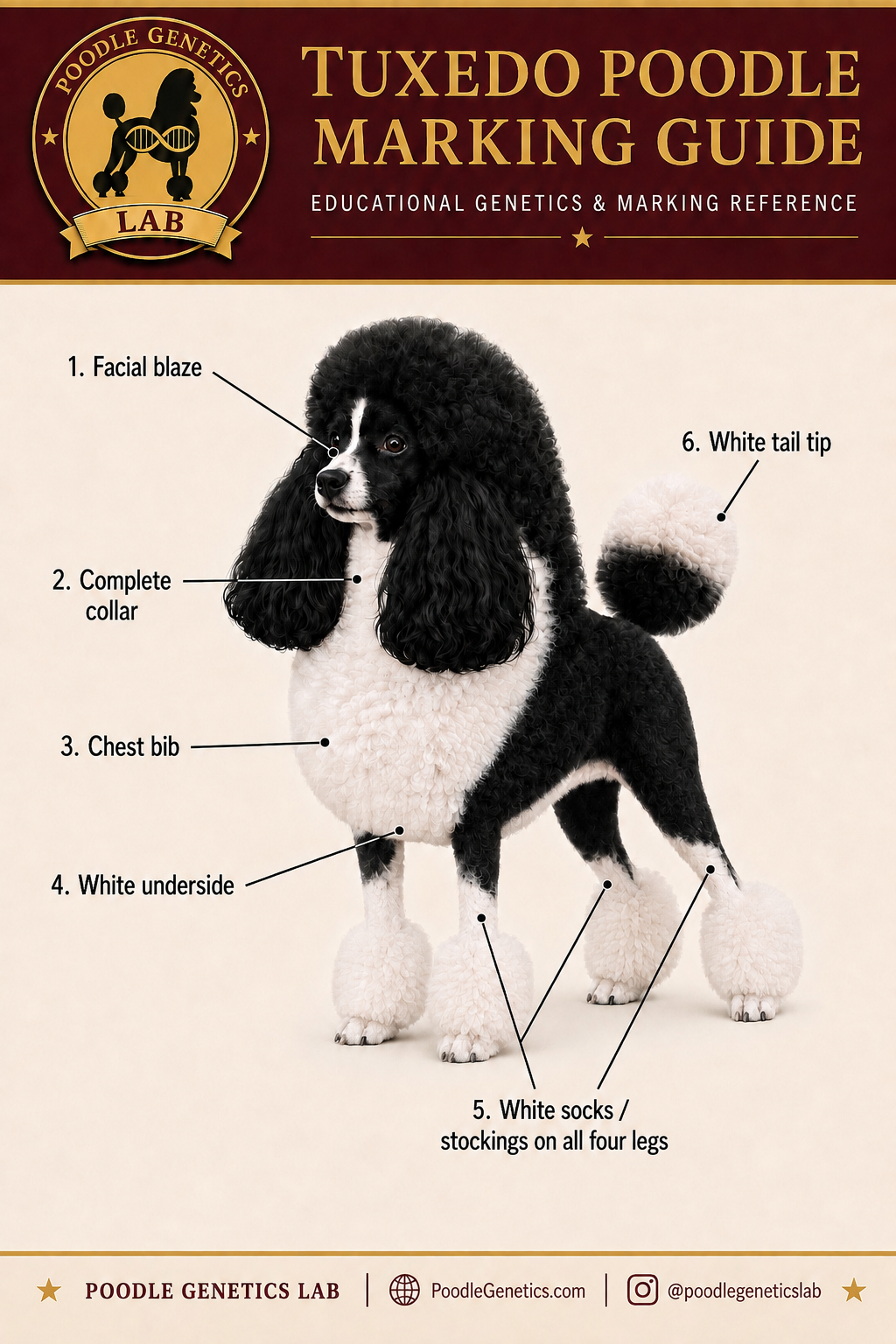
Read that way, a true tuxedo can be reached by any of three routes: the traditional parti genetics (spsp) at the S locus; Irish spotting alone, at two copies, on a dog the piebald test calls SS; or Irish spotting combined with the proposed Whitehead modifier, pushing the white pattern further, particularly around the head.
The dog in front of you is a tuxedo because of how it is marked. What produced the marking is a separate question, and it is the one the lab report answers — or, in this case, fails to.
Can a puppy carry tuxedo invisibly?
Not the way the question usually gets asked. Tuxedo is a pattern, not a hidden genotype waiting to reappear later — a puppy either shows the marking or it doesn't. What a DNA panel can miss is the mechanism: a dog can test SS (no parti allele) and still be a true tuxedo, because the piebald test only checks the first of those three routes. It has no way to see the other two, since no test for either exists yet.
That's the practical answer to "the test says solid but the dog says tuxedo" — the test isn't wrong, it's just only checking one of at least three ways to get there. A dog that tests clean at the S locus and shows no tuxedo markings at all isn't secretly holding the pattern in reserve for a later litter. If this hypothesis is right, what it might be holding, invisibly, is one of the proposed modifiers not expressing visibly on that particular dog — which is a different question from "carrying tuxedo."
It's also the open question PGL's research program exists to investigate. R001 is collecting exactly this kind of phenotype and pedigree data — Irish-spotted poodles that test SS, and extreme white on a single piebald copy — to eventually move this from a working hypothesis to something testable.
Where This Stands
What is documented: three SS tuxedos, two litters by one sire showing markedly different white distributions from dams with different degrees of Irish spotting, and one unilaterally deaf extreme-white dog carrying only a single piebald copy.
What is proposed: that Irish spotting is dose-dependent, that a separate Whitehead modifier influences the extent of white around the head, and that stacking them carries a hearing risk worth avoiding.
What is unknown: nearly everything else. Whether the pattern is Irish spotting alone, Irish spotting interacting with Whitehead, or some other modifier entirely has not been determined. No gene has been identified for either. No test exists for either. The notation si used above is a convenience for discussing the hypothesis, not a validated allele, and it should not be written on a pedigree as though it were one.
This remains a working hypothesis, not a conclusion. It is recorded here so that it can be checked against other people's dogs — and so that it can be shown to be wrong, if it is.
Download the Parti Litter Planner for a printable summary.
A proposal drawn from breeding observation, not a settled finding. There is no identified gene or validated test for what is described here. Read it as a hypothesis to be checked, not a conclusion.
- Published
- July 16, 2026
- Last reviewed
- August 27, 2026
- Last updated
- August 27, 2026
References
- Karlsson EK, Baranowska I, Wade CM, et al. (2007). Efficient mapping of mendelian traits in dogs through genome-wide association. Nature Genetics 39(11):1321–1328. doi:10.1038/ng.2007.10
- Baranowska Körberg I, Sundström E, Meadows JRS, et al. (2014). A simple repeat polymorphism in the MITF-M promoter is a key regulator of white spotting in dogs. PLoS ONE 9(8):e104363. doi:10.1371/journal.pone.0104363
Free Tool
Apply This Knowledge
Model any parent pair with our interactive genetics calculator.