A color panel is the most useful tool a poodle breeder has ever had, and it is routinely misread. Not because breeders lack intelligence, but because the report hands you a grid of letters without telling you which of them you can trust completely, which need a second look, and which describe things the test cannot actually see. This guide walks the panel locus by locus and marks each one for how far you can lean on it.
The single most important habit to build: a color panel reports the genotype, not the dog. It tells you what alleles are present. It does not tell you what the adult coat will look like, because several of the most visible things about a poodle, intensity of red, how far a greying dog will clear, how much white a spotted dog will carry, are governed by factors the panel does not measure. Read the report for what it is good at, and do not ask it questions it cannot answer.
Health results are read by a different set of rules, and they have their own guide: how to read a dog DNA health panel, line by line. This article is about the color half of the report.
The Loci You Can Trust Completely
These are solved. An identified gene, a validated test, clean inheritance. When the report speaks on these, believe it.
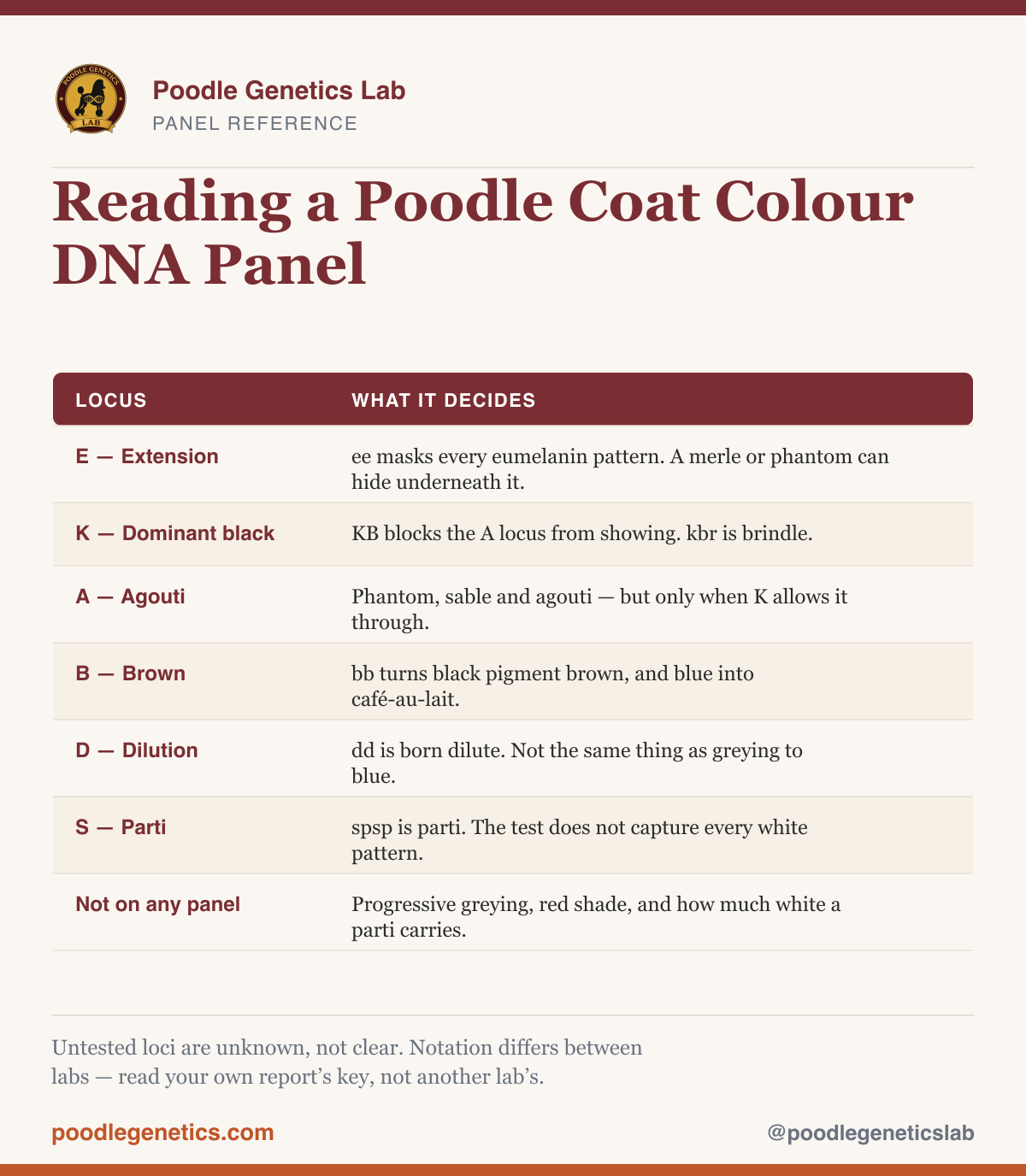
E (MC1R) — Extension
Reported as some combination of E-series alleles and the recessive e. The practical reading is simple and reliable: if the dog is e/e, it will be red, apricot, or cream, and no other colour locus will show in the coat. A single E-series allele permits eumelanin. This result is trustworthy and it is the first thing to read, because e/e status changes how you read everything else. A merle or a brown or an agouti dog that is also e/e will not SHOW any of those things in its coat, though it still carries and transmits them.
Note that modern panels report the E-series in more detail than a flat "E or e" because of the seven-allele framework. For most breeding decisions the E-versus-e split is what matters; the mask and grizzle alleles matter only if you are working with those specific patterns.
K (CBD103) — Dominant Black
Reported as K^B, k^y, and sometimes k^br (brindle). The reading: a single K^B masks the entire A locus. If your dog is K^B/anything, its agouti alleles are present but invisible and untransmissible as pattern until paired down to k^y/k^y in an offspring. Reliable result. The one thing to remember is that K^B hides A, so a K^B dog's A-locus report is telling you what it carries, not what it shows.
B (TYRP1) — Brown
Reported as B and b. The cleanest locus on the panel. b/b is brown; one B makes the dog black-based. The result is fully reliable and it is confirmed on the living dog by the nose: a b/b dog has a liver nose, always. If the panel says b/b and you are looking at a black nose, something is mislabelled, get it re-checked, because the biology does not allow it.
D (MLPH) — Dilution
Reported as D and d. d/d is dilute; the dog was born dilute, from day one. This is reliable, and it is the locus most worth understanding clearly, because dilution is constantly confused with greying (see below). A d/d dog has a diluted nose from birth, slate on a black-based dog, and that is visible in the whelping box before any coat change could occur. If the panel says d/d, the dilute nose confirms it.
M (PMEL) — Merle
Reported, on a good panel, as a base-pair length, not merely "M or not M." This is the most important reading habit for anyone touching merle: the number is the result. A dog reported at 265 bp and a dog reported at 230 bp are both "merle" in some sense, but they are very different dogs to breed. Read the base-pair value, not just the presence of an insertion, and treat any value near a class boundary as belonging to the more cautious class. A "positive/negative" merle result without a length is not a usable result for breeding decisions.
The Loci You Must Read With Care
These are real, but the report can mislead if taken at face value.
S (MITF) — White Spotting
Reported as S, s^p, and sometimes s^i. Here is the trap: the S-locus genotype does not predict how much white the dog will actually carry. Dosage sets a range, one copy of s^p tends toward under half white, two copies toward more, but within that range the amount of white is governed by modifiers the panel does not measure. Two dogs with identical S genotypes routinely produce litters differing wildly in white. Read the S result as a range, not a number, and never promise a buyer a specific amount of white based on a genotype.
A second subtlety: the MITF variants reported are best understood as haplotype effects, combinations of polymorphisms, rather than three clean mutations, and Irish spotting is not caused by the MITF piebald variant. If your panel reports something about Irish spotting specifically, treat it cautiously; the causal variant is not established.
R (USH2A) — Ticking and Roan
Reported on some panels as three haplotypes. The reading breeders most often get wrong: ticking and roan are different alleles, not the same thing at different densities. If your panel distinguishes them, good. If it reports only "ticking," it may not be capturing roan. Bear in mind that only roan has a sequenced causal variant (an intronic USH2A duplication, Kawakami et al. 2021); ticking's own variant is still unresolved, so a ticking call is provisional in a way a roan call is not, and neither has been validated in Poodles specifically. And note that ticking is expressed in the white areas as the dog matures, so a clean-white parti puppy may tick later; the panel can warn you that pigment will arrive in the white even when the newborn shows none.
The Things the Panel Does Not Test At All
This is the section that saves breeders from the most expensive mistakes, because it names the questions the report silently declines to answer.
G — Progressive Greying: NO TEST EXISTS
There is no validated DNA test for progressive greying in poodles. The gene has not been identified. Any product claiming to test "the greying gene" or "the G locus" is selling something the science cannot currently deliver. This matters enormously, because greying is responsible for silver, blue (the greyed black, not the dilute blue), café-au-lait, and silver beige, four of the colours breeders most want to predict. You predict them from the dog and its pedigree, by watching the face and feet in early puppyhood and by knowing whether the parents greyed. Not from the report.
If a silver breeder tells you they "tested for silver," they either mean they observed clearing, or they were sold a test that does not do what it claims.
Red Intensity: NO SINGLE-LOCUS TEST
The depth of a red-based coat, whether an ee dog is a deep red, a mid apricot, or a pale cream, is polygenic. In poodles the identified contributors include KITLG and a GPR22-linked variant (Batcher et al., 2022), and together the known intensity factors explain only part of the variation. No panel will hand you a genotype that predicts the shade of a red puppy. If you see "I/I" or "i/i" on a report as if it were a clean answer, treat it with suspicion: intensity does not reduce to a single locus, and a confident single-gene intensity call is ahead of the science.
Seal: NO IDENTIFIED LOCUS
If you have a dog with a black nose whose black coat carries a warm bronze cast, seal, the panel cannot confirm it, because seal has no identified locus and no test. The working hypothesis involves the A locus leaking through dominant black, but it is a hypothesis. Read the nose (black, which rules out brown) and the coat, and label it honestly as an untested phenotype.
The Four Places Breeders Misread the Panel
-
Reading a blue result as dilution. A panel that reports D/D or D/d on a grey-blue dog is telling you the dog is NOT dilute. That "blue" is a greyed black, and the panel confirms it by showing no d. The dilute blue is the one that reports d/d and carries a slate nose from birth. Same word, two genotypes, and the nose and the D result together tell you which you have.
-
Trusting the S genotype to promise a white percentage. It sets a range, not a number. See above.
-
Believing a greying test exists. It does not. See above.
-
Treating a merle "positive" without a length as actionable. The length is the result. A positive with no base-pair value tells you almost nothing about breeding risk.
A Worked Reading
Suppose a panel comes back: E/e, K^B/k^y, B/b, D/D, no merle, S/s^p.
Here is the honest interpretation. The dog shows eumelanin (has an E-series allele) and is dominant black (K^B), so it presents black and its A locus is hidden. It carries red (the e) and carries brown (the b), so bred to the right partner it can produce red, cream, apricot, or brown puppies that its own coat gives no hint of. It is not dilute (D/D) and not merle. It carries one copy of parti (s^p), so it may show some white and can produce parti puppies if bred to another s^p carrier, but how much white any of them carry is not something this report can tell you.
What the report does NOT tell you: whether this dog will grey (no test; watch it and check the pedigree), and if it produces red puppies, how deep their red will be (no test; polygenic). A breeder who reads only the letters and stops there will be surprised by both. A breeder who reads the letters AND knows what the panel is silent about will not.
The Bottom Line
The panel is excellent at the solved loci, E, K, B, D, M, and worth its price for those alone. It is a guide, not an oracle, at S and R. And it is silent on greying, intensity, and seal, three of the things breeders most want to know. Read it for its strengths, respect its silences, and confirm what you can on the living dog, above all the nose. The report and the nose together tell you far more than either alone. For the full locus-by-locus reference this panel draws on, see Volume I.
Model any parent pair against every locus at once with the Poodle Color Genetics Calculator, which flags the loci where the genotype sets a range rather than a fixed outcome. Download the Poodle Health Panel Worksheet for a printable summary.
Built on identified genes and validated tests. The claims here are supported by the peer-reviewed literature listed below.
- Published
- July 16, 2026
- Last reviewed
- September 8, 2026
References
- Bannasch DL, Kaelin CB, Letko A, et al. (2021). Dog colour patterns explained by modular promoters of ancient canid origin. Nature Ecology & Evolution 5(10):1415–1423. doi:10.1038/s41559-021-01524-x
- Langevin M, Synková H, Jančušková T, Pekova S (2018). Merle phenotypes in dogs — SILV SINE insertions from Mc to Mh. PLoS ONE 13(9):e0198536. doi:10.1371/journal.pone.0198536
- Honkanen L, Loechel R, Davison S, Donner J, Anderson H (2024). Canine coat color E locus updates: identification of a new MC1R variant causing ‘sable’ coat color in English Cocker Spaniels and a proposed update to the E locus dominance hierarchy. Animal Genetics 55(2):291–295. doi:10.1111/age.13398
- Schmutz SM, Berryere TG, Goldfinch AD (2002). TYRP1 and MC1R genotypes and their effects on coat color in dogs. Mammalian Genome 13(7):380–387. doi:10.1007/s00335-001-2147-2
- Drögemüller C, Philipp U, Haase B, Günzel-Apel A-R, Leeb T (2007). A noncoding melanophilin gene (MLPH) SNP at the splice donor of exon 1 represents a candidate causal mutation for coat color dilution in dogs. Journal of Heredity 98(5):468–473. doi:10.1093/jhered/esm021
- Candille SI, Kaelin CB, Cattanach BM, et al. (2007). A β-defensin mutation causes black coat color in domestic dogs. Science 318(5855):1418–1423. doi:10.1126/science.1147880
- Karlsson EK, Baranowska I, Wade CM, et al. (2007). Efficient mapping of mendelian traits in dogs through genome-wide association. Nature Genetics 39(11):1321–1328. doi:10.1038/ng.2007.10
- Batcher K, Varney S, Affolter VK, Friedenberg SG, Bannasch D (2022). An SNN retrocopy insertion upstream of GPR22 is associated with dark red coat color in Poodles. G3: Genes|Genomes|Genetics 12(11):jkac227. doi:10.1093/g3journal/jkac227
Free Tool
Apply This Knowledge
Model any parent pair with our interactive genetics calculator.