What Tests Does My Poodle Need?
Health screening requirements differ by variety, and the differences are not intuitive. This is what each one actually needs, and what still cannot be tested at all.
Last reviewed July 17, 2026
Test a specific pairing
Enter both parents’ DNA panel results in the health risk calculator and see the odds for each puppy.
CHIC requirements by variety
CHIC is a joint programme of OFA and the parent breed club. A dog earns a CHIC number when it has been screened according to the breed protocol and the results are publicly available in the OFA database. A CHIC number therefore records that testing was done and published. It is not a statement that a dog is healthy, and it is not a breeding recommendation.
Across all participating breeds, the dog must also be permanently identified by microchip or tattoo.


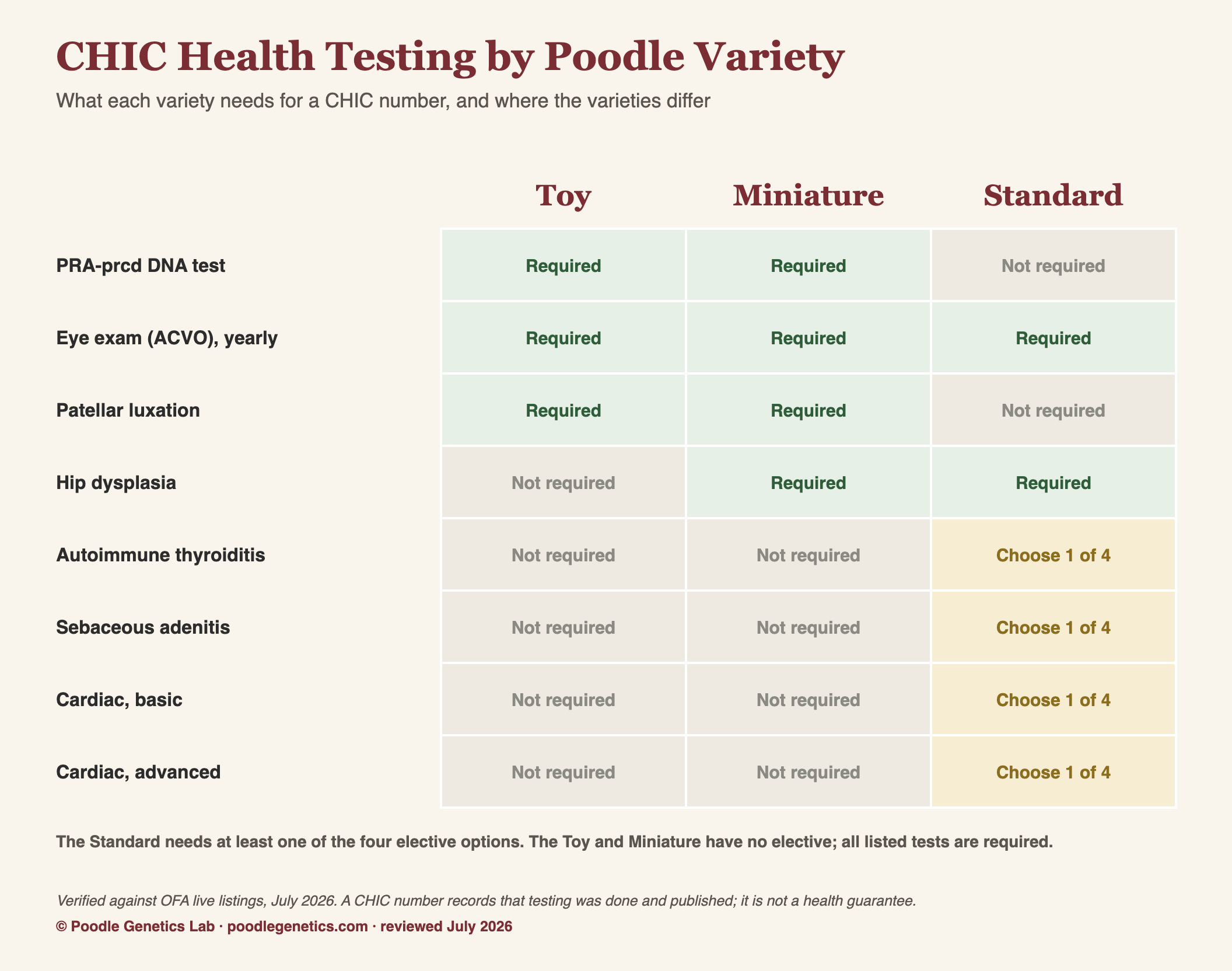
Toy Poodle
- REQUIREDPRA-prcd DNA testFrom an OFA-approved laboratory.
- REQUIREDEye examination (ACVO)Yearly, by a board-certified veterinary ophthalmologist.
- REQUIREDPatellar luxationOFA evaluation. Minimum age 12 months.
Miniature Poodle
- REQUIREDPRA-prcd DNA testFrom an OFA-approved laboratory.
- REQUIREDEye examination (ACVO)Yearly, by a board-certified veterinary ophthalmologist.
- REQUIREDPatellar luxationOFA evaluation. Minimum age 12 months.
- REQUIREDHip dysplasiaOFA or PennHIP evaluation.
Standard Poodle
- REQUIREDHip dysplasiaOFA or PennHIP evaluation.
- REQUIREDEye examination (ACVO)Yearly, by a board-certified veterinary ophthalmologist.
PLUS AT LEAST ONE OF:
- Autoimmune thyroiditisOFA evaluation from an approved laboratory.
- Sebaceous adenitisOFA evaluation by an approved dermatopathologist.
- Cardiac, basicAuscultation by a licensed veterinarian.
- Cardiac, advancedEchocardiography by a board-certified cardiologist.
The differences breeders most often miss
- PRA-prcd DNA testing is a CHIC requirement for Toy and Miniature, but not for Standard.
- Patellar luxation is required for Toy and Miniature, but not for Standard.
- Hip evaluation is required for Miniature and Standard, but not for Toy.
- The "choose at least one" elective structure exists only for the Standard, which picks one of four options.
A note on Moyen and Medium.CHIC recognizes three poodle varieties: Standard, Miniature, and Toy. There is no separate CHIC listing for Moyen or Medium. Some laboratories sell a “Moyen” profile, but that is a commercial category rather than a registry variety. Test according to the variety the dog is registered as.
DNA disease tests
These are the tests where a laboratory can read the genotype directly. A clear result here is meaningful and permanent, because a dog’s DNA does not change.
Progressive retinal degeneration leading to blindness.
Source: Zangerl et al. 2006, Genomics
Late-onset retinal degeneration, night and peripheral vision first.
Published poodle cases are one Standard and a small number of Miniatures; there is no published Toy Poodle case. The "five to twelve years" onset figure often quoted for this test comes from Gordon and Irish Setters, the breeds where the variant was first characterised; no poodle-specific onset data is published.
Sources: Downs et al. 2013, Animal Genetics · Downs et al. 2014, Veterinary Ophthalmology
A bleeding disorder caused by deficient clotting factor.
Some laboratories describe this as autosomal recessive, others as autosomal dominant with incomplete penetrance. Ask your laboratory how they interpret a carrier result before acting on it.
Affected puppies are small and weak at birth and many die in the first week. Survivors develop ataxia, tremor, and seizures by four to six weeks.
Source: Chen et al. 2008, Neurogenetics
Progressive degeneration of the spinal cord in adult dogs.
Incomplete penetrance means an at-risk result is not a diagnosis. Many at-risk dogs never develop clinical signs. The allele is widespread in poodles, but confirmed poodle cases in the literature are very few.
Sources: Awano et al. 2009, Proceedings of the National Academy of Sciences USA · Zeng et al. 2014, Journal of Veterinary Internal Medicine
A fatal lysosomal storage disease. Onset around nine to twelve months with tremor and incoordination.
Sources: Tamura et al. 2010, Journal of Veterinary Internal Medicine · Rahman et al. 2012, The Veterinary Journal
Stunted growth visible from about three weeks, with splayed hind limbs, enlarged joints, and bent long bones.
Source: Neff et al. 2012, PLoS ONE
Coat colour testing is a separate matter and is not a health test. If that is what you are looking for, start with the colour calculator or the merle reference centre.
Tests that apply to one variety only
Some poodle diseases are confined to a single variety. These are the ones most often missed, because a generic breed list lumps all three varieties together and a breeder reasonably assumes it applies to their dog.
Toy Poodle only
- GM2 Gangliosidosis (Sandhoff disease)GM2
A fatal lysosomal storage disease seen in the Toy. Onset around nine to twelve months.
Miniature Poodle only
- Osteochondrodysplasia (skeletal dwarfism)SLC13A1
Documented in the Miniature. A PLOS ONE survey of 318 dogs found about 10% were carriers, not confined to a few bloodlines, and the Poodle Club of America reports the same figure.
Standard Poodle only
- Neonatal Encephalopathy with SeizuresNEwS
A Standard Poodle disease. Affected puppies are weak at birth, most die in the first week, and survivors seize by four to six weeks.
- Day Blindness with Retinal DegenerationSPATA7
A Standard Poodle disease identified at the University of Pennsylvania. Unlike day blindness in other breeds, it does not stay stable: affected dogs are blind in bright light from puppyhood, and the retina then degenerates further. Progression varies: in the study that identified the variant, one dog was blind under all lighting by 2.7 years while another still had usable vision at 3.3 years.
Shared rather than exclusive, but worth knowing: CDDY matters mainly in the Toy and Miniature, and PRA-prcd is a CHIC requirement for those two varieties but not for the Standard.
The extended panel, and how much to trust it
Beyond the CHIC requirements, laboratories offer a longer list of tests for poodles. Not all of them carry the same weight. Some are validated in poodles, some are on the panel because the allele turns up at low frequency, and some appear on generic breed lists with no poodle evidence behind them at all.
We have sorted them by how strong the poodle-specific evidence actually is, rather than listing them as though they were equivalent. For the framework behind this table, and how to read your own report line by line, see how to read a dog DNA health panel.


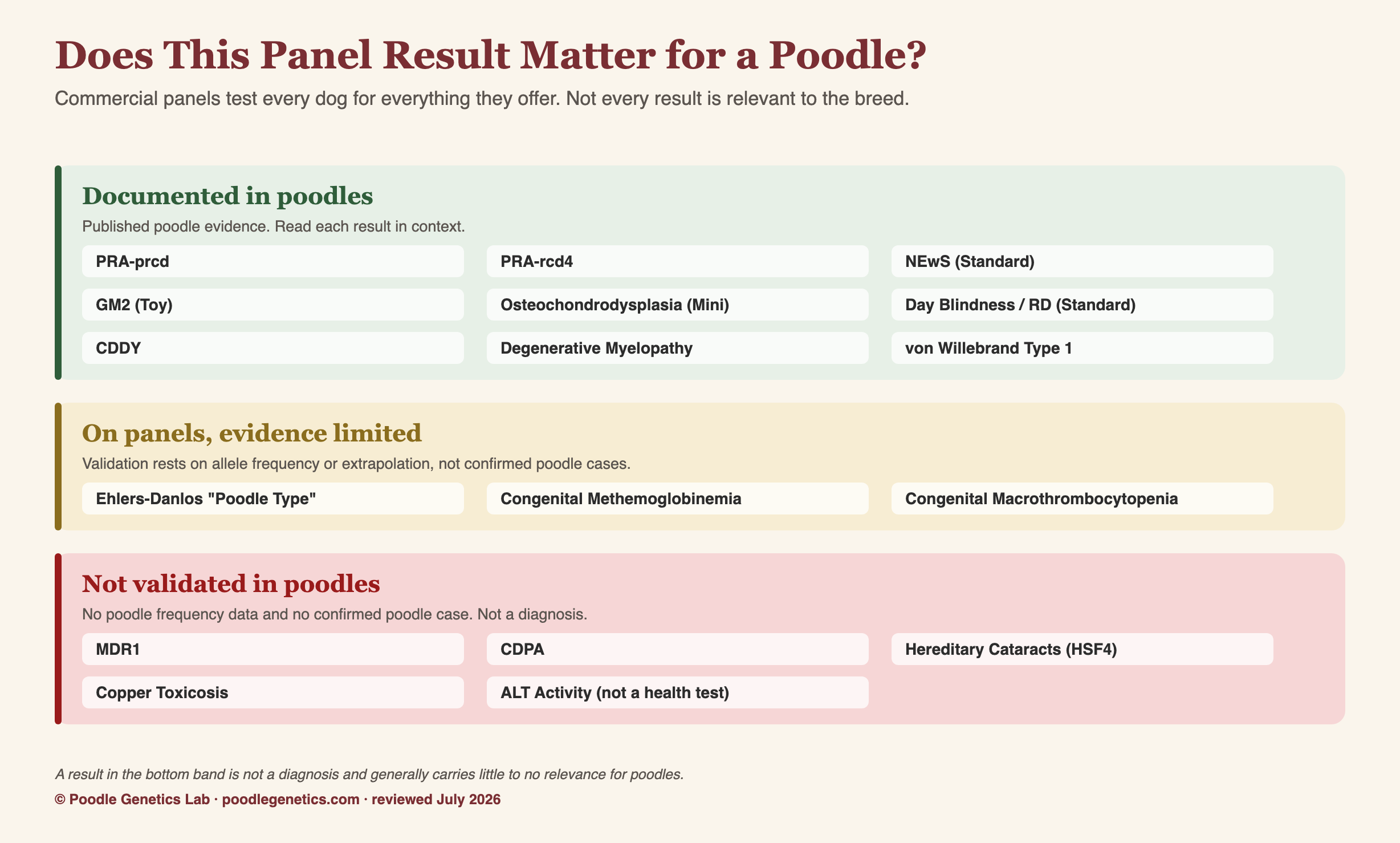
The variant is genuinely present in poodles with published evidence behind it. What a positive result means still depends on the variety and the condition, so read each entry rather than assuming a result is bad news.
In chondrodystrophic breeds such as the dachshund, this retrogene is associated with intervertebral disc disease. In poodles the picture is different, and a positive result is the norm rather than a warning sign.
Do not read a positive CDDY result in a poodle as a disc disease verdict. One copy is not established to raise IVDD risk within the breed, and in most cases two copies are not either. The variant segregates in poodles rather than being fixed, and no published poodle-specific frequency exists, but it is common enough in the Toy and Miniature that every breeding animal is worth testing. Treat it as one input to weigh alongside CDPA status, your veterinarian’s assessment, and the judgement of experienced breeders, not as a breeding disqualification on its own.
Sources: Brown et al. 2017, Proceedings of the National Academy of Sciences USA · Batcher et al. 2019, Genes
Affected dogs are blind in bright light from puppyhood, and the retina then degenerates further toward loss of vision in all lighting. Progression varies: in the study that identified the variant, one dog was blind under all lighting by 2.7 years while another still had usable vision at 3.3 years.
Included in commercial poodle panels, but the poodle-specific validation rests on allele frequency or extrapolation rather than confirmed poodle cases. Usually cheap as part of a panel; interpret a result cautiously.
A connective tissue disorder producing fragile, hyperextensible skin.
The name is misleading. The dog in the original study was a mixed breed, not a poodle. One of the two alleles was found at low frequency in poodle and chihuahua populations, and the authors recommended monitoring. There is no published confirmed case in a poodle.
Blood carries oxygen poorly. Affected dogs have blue-tinged gums and tire easily, but are often otherwise well.
Marketed as a poodle type, but the definitive study sequenced pit bull terriers and pomeranians rather than poodles. Older clinical literature does list the Miniature Poodle.
Sources: Jaffey et al. 2020, Scientific Reports · Harvey et al. 1991, Comparative Haematology International
Fewer but larger platelets. Clinically harmless in itself.
Its real value is diagnostic rather than for breeding. The variant produces fewer, larger platelets in dogs with no bleeding tendency, and knowing the genotype lets a veterinarian distinguish an inherited low platelet count from an acquired one before treating.
Source: Davis et al. 2008, Journal of Veterinary Internal Medicine
No published poodle frequency data and no confirmed poodle case. Some of these appear on generic breed lists; others arrive because a panel tests every dog for everything it offers. Either way, a result here is unlikely to tell you anything useful about a poodle, and none of them is a diagnosis.
In affected breeds, causes severe reactions to certain common drugs including some parasiticides and sedatives.
A herding breed variant. Collies, Australian Shepherds, Shetland Sheepdogs and related breeds carry it. No poodle appears in the published breed frequency studies, and the major laboratories do not include it in their poodle panels.
Sources: Neff et al. 2004, Proceedings of the National Academy of Sciences USA · Mealey et al. 2008, Journal of the American Veterinary Medical Association · Gramer et al. 2011, The Veterinary Journal · Beckers et al. 2022, PLOS ONE
Produces the short-legged conformation of breeds such as the dachshund and corgi.
Where laboratories list it for poodles it sits under traits rather than diseases, and poodles are expected to test clear. Do not confuse it with CDDY above: they are different retrogenes on different chromosomes. CDPA status is, however, worth knowing when interpreting a CDDY result, which is why the two are best read together rather than in isolation.
Source: Parker et al. 2009, Science
In the breeds where it is established, copper builds up in the liver because the dog cannot excrete it efficiently, eventually causing liver damage.
These are Labrador Retriever and Doberman Pinscher variants, sold by laboratories under names such as "Labrador Retriever Type." They arrive on a poodle report because the panel screens every dog for everything it offers, not because poodles were studied. A result carries little to no relevance for the breed and is not a diagnosis of liver disease.
Associated with a baseline level of the liver enzyme ALT that sits at the low end of the normal range. It does not cause liver disease and produces no symptoms.
This is not a health test at all, and Embark itself classifies it as a clinical tool rather than a health result. Its only practical use is that a dog with a naturally low baseline may not show an obviously raised ALT if its liver is later damaged, which is context your veterinarian can note. It is not diagnostic, it is not a clearance, and it is not a breeding consideration.
Early-onset cataract formation in the breeds where it is validated.
Established in the Staffordshire bull terrier, Boston terrier, and Australian shepherd. No poodle frequency data or case was found, and it is absent from the major poodle panels. Cataracts do occur in poodles, but this particular variant is not the reason, which is why the annual eye examination matters more here than a DNA test.
The bottom tier is included deliberately rather than left out. A breeder who reads a generic breed list will go looking for MDR1 or hereditary cataracts and wonder why we do not mention them. The answer is that the evidence does not support testing poodles for them, and that is more useful to know than silence.
Screening examinations
These are physical examinations rather than gene tests. Most expire, and several have a minimum age, which is the detail most often missed when a breeder plans a first litter.


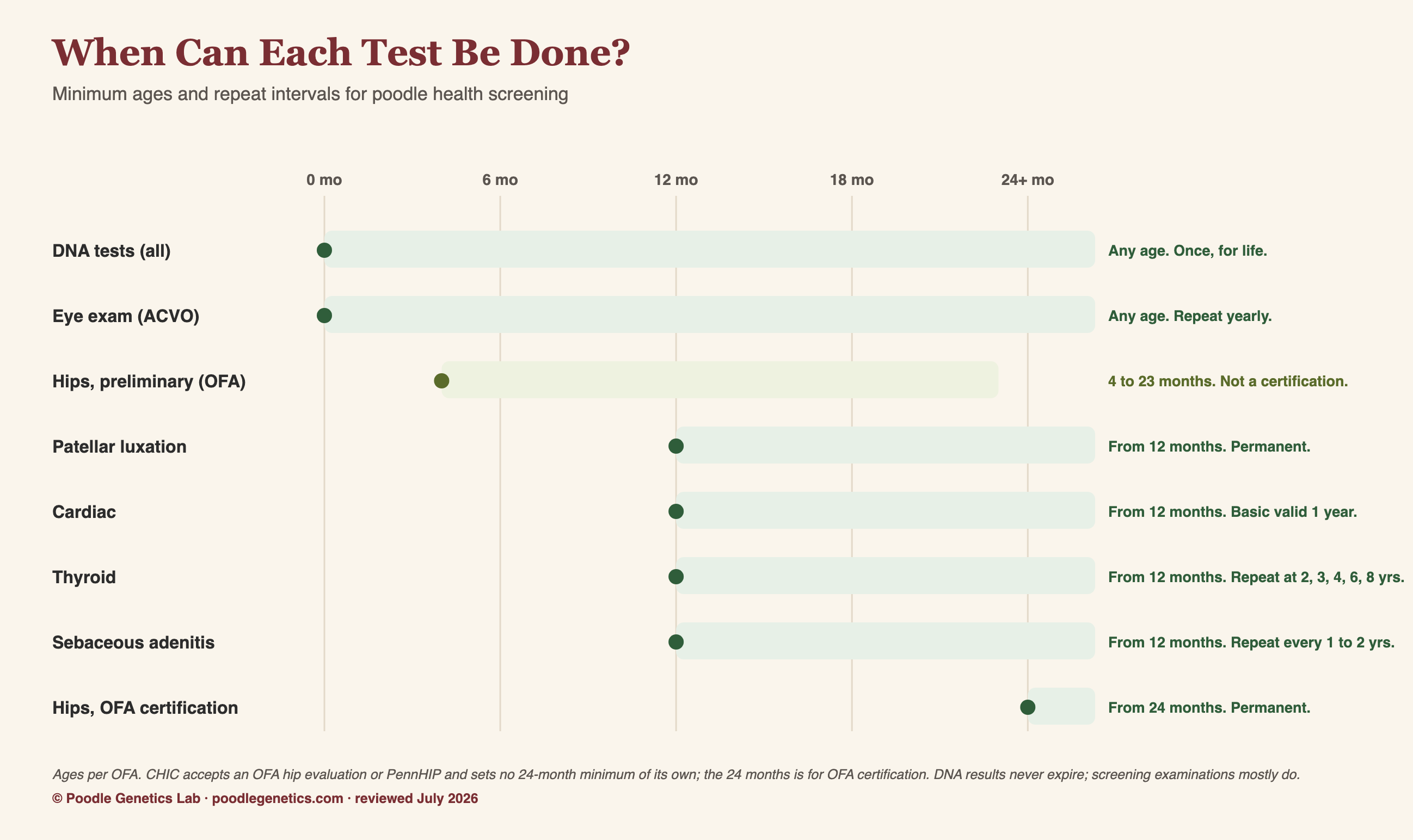
| Examination | Performed by | Minimum age | Valid for |
|---|---|---|---|
| Eye examination (CAER)Annual re-examination is recommended. OFA notes this is a screening exam, not a comprehensive ocular evaluation. | Board-certified ACVO ophthalmologist | Not specified by OFA | 12 months from the date of exam |
| Hip dysplasiaCHIC accepts either an OFA radiographic evaluation or PennHIP and does not itself impose a 24-month minimum. An official OFA hip certification does require 24 months; below that a dog receives a preliminary evaluation, which is not a certification. OFA grades run Excellent, Good, and Fair (normal), then Borderline through Severe. | OFA, or PennHIP as an accepted alternative | No CHIC minimum; 24 months for OFA certification | Permanent once certified |
| Patellar luxationExamined awake; chemical restraint is not recommended. Evaluations under 12 months are consultations only. | Attending veterinarian | 12 months | Permanent |
| Cardiac, basic | Any licensed veterinarian, by auscultation | 12 months | 12 months |
| Cardiac, advancedEchocardiography has been mandatory for the advanced database since October 2020. | Board-certified veterinary cardiologist | 12 months | Congenital clearance is permanent; adult-onset clearance is valid 12 months |
| Thyroid (autoimmune thyroiditis)Panel is free T4, cTSH, and thyroglobulin autoantibodies. OFA recommends testing at ages 2, 3, 4, 6, and 8. | OFA-approved laboratory | 12 months | Re-test periodically |
| Sebaceous adenitisRequires a minimum of two 6mm punch biopsies from the neck. Equivocal results should be re-tested in three to six months. | OFA-approved dermatopathologist | 12 months | Re-test every 1 to 2 years for breeding dogs |
What has no DNA test
This section matters more than it looks. Several of the conditions poodle breeders worry about most cannot be tested for genetically at all. The Standard Poodle’s “choose at least one” elective structure exists largely because of this: the phenotypic screens are proxies, standing in for gene tests that do not exist.
Sebaceous adenitis
No DNA test exists. Diagnosis is by skin biopsy only, and the screening method can produce false negatives.
Addison's disease (hypoadrenocorticism)
No predictive DNA test. Genetic and environmental components are both involved, and research is ongoing. Monitored through blood work.
Bloat and gastric torsion (GDV)
No predictive DNA test.
Idiopathic epilepsy
A genetic predisposition is described, with onset typically between one and five years, but there is no validated DNA test.
The practical consequence: a screened dog is a dog that passed a screen on the day it was examined. That is genuinely valuable, and it is not the same thing as being clear. Anyone presenting a screening result as a permanent guarantee has misunderstood what the test does.
Sources
- OFA, CHIC program and disease pages
- Poodle Club of America Foundation, Health Testing in Poodles (accessed 2026-08-06)
- AKC, breed-specific DNA testing recommendations
This page is an educational reference for breeders. It does not replace veterinary advice, laboratory consultation, or the current published requirements of OFA and the Poodle Club of America. Screening requirements change, and this page carries a review date so you can judge how current it is.