A DNA health panel hands you a stack of copy counts and interpretive labels. A pedigree hands you a family tree. A hip radiograph hands you a score. None of them, on their own, hands you a breeding decision. The gap between "here is a result" and "here is what I should do about it" is where most breeding mistakes actually happen, and it is not a gap DNA testing can close by itself.
Two failure modes live in that gap. Paralysis: a breeder sees a carrier line on a panel and treats it as disqualifying, regardless of what else the dog offers. Reductionism: a breeder optimizes one number, usually the one on the most recent test, while ignoring structure, temperament, pedigree depth, and everything the population needs from a sound dog. Both come from the same root cause: making the decision from one input instead of all of them.
This article lays out the framework this site uses to close that gap — the same one behind our own health calculator. It has five inputs, one load-bearing rule about carriers, a way of telling Mendelian problems from polygenic ones, and a seven-step sequence for reaching a decision you can defend.
The Five Inputs
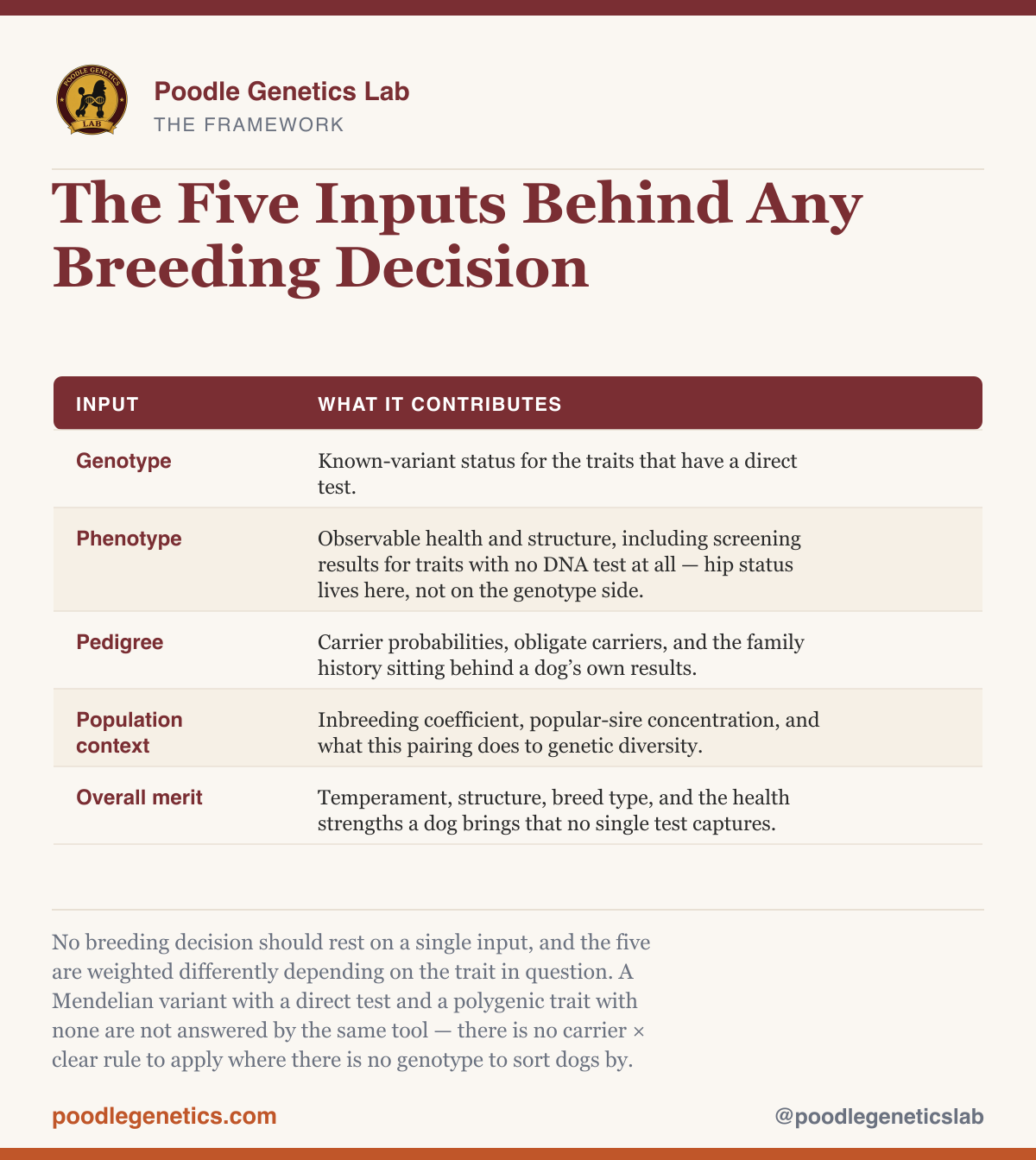
No breeding decision should be made from a single input. Every pairing worth evaluating draws on five, weighted differently depending on what kind of trait is in question.
| Input | What it contributes |
|---|---|
| Genotype | Known-variant status for traits with a direct test |
| Phenotype | Observable health and structure, including screening results for traits with no DNA test |
| Pedigree | Carrier probabilities, obligate carriers, and family history behind a dog's own results |
| Population context | Inbreeding coefficient, popular-sire concentration, and what the pairing does to genetic diversity |
| Overall merit | Temperament, structure, breed type, and the health strengths the dog brings that no single test captures |
The discipline is not adding these up — it is weighting them correctly for the trait at hand. For a clean recessive with a direct test, genotype is decisive for that variant, full stop. For a trait like hip conformation, phenotype and family screening carry almost all of the weight and genotype has nothing to say. For the health of the breed over the next several generations, population context can outweigh the convenience of any single pairing. A good decision is not the one that maximizes one input. It is the one that weights all five correctly for what is actually being decided.
The Carrier x Clear Rule
This is the rule the rest of the framework hangs on, and it is worth stating formally rather than leaving it as a vague impression.
That rule is not an opinion about tolerance for risk. It holds at three separate levels, and a breeder who can state all three has an answer for anyone who questions the pairing.
1. The individual level. This is deterministic Mendelian arithmetic, not a
judgment call. N/m x N/N produces, per puppy, 50% clear and 50% carrier, and
zero affected. Every puppy from a correctly matched carrier x clear pairing is
either clear or a carrier — never affected, for that variant. The math does the
containing; nobody has to guess.
2. The population level. Removing every carrier from a breeding program removes their entire genetic contribution — every unrelated strength, every unit of diversity they carry — to manage a single variant that correct pairing already neutralizes. In the numerically smaller poodle varieties, that kind of wholesale culling shrinks the pool of dogs actually being bred from. A smaller effective breeding population is the textbook precondition for two well-established mechanisms: faster loss of genetic diversity, and inbreeding depression, the general decline in fertility and vigor that follows when a population's breeding individuals become too few and too related. Neither of those mechanisms needs a specific percentage attached to make the point here — they are established population genetics, documented across dog breeds generally (see the evidence and citations in the coefficient of inbreeding article) — and culling a manageable problem with an irreversible tool is how a breed program runs into them.
3. The ethical and stewardship level. A breeding program does not own a gene pool outright; it holds a share of one, alongside every other breeder working with the same limited population of dogs. Discarding a structurally sound, temperamentally correct dog over a single manageable recessive variant optimizes one breeder's paperwork at the population's expense. That is not neutral — it is a stewardship failure, and it is the reason this site treats carrier status as data to be managed rather than a disqualification.
The forward-management corollary. The rule is not "breed the carrier once and be done with it." It is continuous: test the resulting puppies, know which are carriers, and keep pairing carriers to clears down the generations. That is how a variant is held at a safe, contained frequency indefinitely, without ever needing to remove a sound dog from the program. It is exactly the arithmetic the health calculator runs when you put two parents' panel results through it.
What the rule is not. It is not a license to ignore a variant — testing and tracking still matter. It does not apply in the same form to dominant conditions, where a single copy can itself carry risk rather than sitting hidden. And it is not a substitute for population-level judgment: a technically safe carrier x clear pairing can still be a poor population choice if it piles onto an already over-represented sire line. The rule solves the recessive-culling problem. It does not exempt anyone from the rest of the framework.
Mendelian and Polygenic Traits Need Different Tools
A recurring and costly error is applying Mendelian logic — the carrier x clear rule, a Punnett square, a percentage — to a trait that isn't Mendelian at all. The framework handles both kinds of trait, but not with the same tools.
| Mendelian trait (e.g., a direct-test recessive) | Polygenic trait (e.g., hip conformation) | |
|---|---|---|
| Primary input | Genotype, from a direct test | Phenotype, from screening plus family data |
| Prediction tool | Punnett square / carrier x clear rule | Trends across relatives, not a fixed ratio |
| What "clear" means | Free of the tested variant | Lower liability, not immunity |
| Decision logic | Avoid pairings that can produce affected puppies; manage carriers by pairing | Improve the odds across generations by selecting on phenotype and family screening |
| Calculator treatment | A deterministic percentage, with its assumptions disclosed | No percentage offered — routed to screening and family history instead |
The judgment that matters most here is simple to state and easy to get wrong in practice: identify which kind of trait you're looking at before you reach for a tool. Running a Punnett square on hip conformation is a category error — there is no single variant to track, so there is no ratio to compute. Building a screening program around a condition that already has a validated direct test is unnecessary effort spent solving a problem the DNA panel already solved. Getting this classification right, for each concern on the table, is what makes the rest of the framework work.
Triaging Several Risks in One Pairing
Real pairings rarely present one clean issue. A prospective dam might be a carrier for one recessive condition, have a borderline hip score, come from a somewhat overused sire line, and also have excellent structure and temperament — all at once. The framework's answer is triage, not panic.
Sort every concern into one of two bins. Manageable risks are the ones pairing can neutralize outright — a recessive carrier paired to a tested clear is the clearest example, since that pairing simply cannot produce an affected puppy. Unmanageable risks are the ones pairing cannot fix — a serious dominant condition, a double-merle pairing, a severe structural fault. Manageable risks essentially never justify walking away from an otherwise valuable dog. Unmanageable ones might.
Layered on top of that sort are two more checks: whether the pairing's population cost — its effect on inbreeding coefficient, or how much further it leans on an already popular line — outweighs its convenience, and whether the dog's structure, temperament, and the diversity it brings are being counted as the positive assets they are, not just subtracted against as risk.
Consider a Miniature bitch who is a carrier for a recessive condition with a direct test, has excellent structure and temperament, and comes from a sire line that is somewhat overused in the current gene pool. Proposed against her is a tested-clear, unrelated stud from a line that is under-represented. Read individually, her carrier status is fully contained by the pairing — no affected puppy is possible. Read at the population level, the unrelated, under-used stud is a net positive: it dilutes the over-represented line rather than adding to it. Read for merit, her structure and temperament are assets carried forward, not just risks to be managed around. Run through the full framework rather than reacted to on sight, this pairing comes out favorable — arguably more favorable than an all-clear pairing that piles onto the popular sire would have been. That is the framework doing its job: integrating several considerations into one recommendation, rather than reducing the decision to whichever single fact was most recently on a report.
The Seven-Step Decision Tree
The five inputs and the carrier x clear rule feed into one repeatable sequence. Run it on any proposed pairing, one concern at a time.
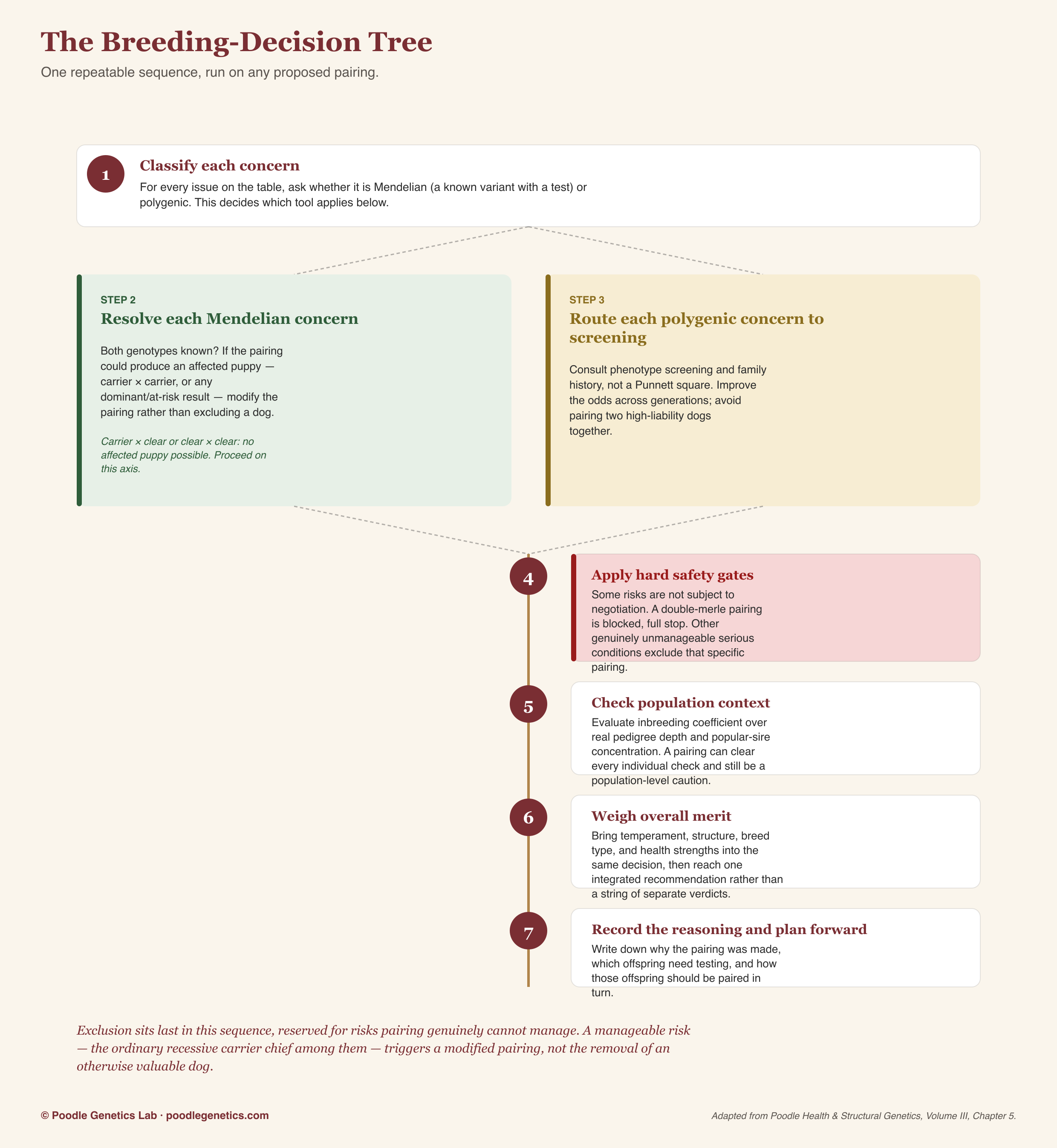
| Step | What to do |
|---|---|
| 1. Classify each concern | For every issue on the table, ask whether it is Mendelian (a known variant with a test) or polygenic. This decides which tool applies. |
| 2. Resolve each Mendelian concern | If both dogs' genotypes are known and the pairing could produce an affected puppy — carrier x carrier, or any pairing involving a dominant or at-risk result — modify the pairing rather than excluding a dog outright. If the pairing is carrier x clear or clear x clear, no affected puppy is possible; proceed on that axis. |
| 3. Route each polygenic concern to screening | Consult phenotype screening and family history, not a Punnett square. The goal is improving the odds across generations, and avoiding pairing two high-liability dogs together, not computing a ratio. |
| 4. Apply hard safety gates | Some risks are not subject to negotiation. A double-merle pairing is blocked, full stop. Other genuinely unmanageable serious conditions exclude that specific pairing. |
| 5. Check population context | Evaluate inbreeding coefficient (ideally calculated over real pedigree depth) and popular-sire concentration. A pairing can clear every individual check and still be a population-level caution. |
| 6. Weigh overall merit | Bring temperament, structure, breed type, and health strengths into the same decision, then reach one integrated recommendation rather than a string of separate verdicts. |
| 7. Record the reasoning and plan forward | Write down why the pairing was made, which offspring need testing, and how those offspring should be paired in turn. |
The tree's defining feature is where exclusion sits in it: last, and reserved for risks that pairing genuinely cannot manage. A manageable risk — the ordinary recessive carrier chief among them — triggers a modified pairing, not the removal of an otherwise valuable dog from a program. Working the merle calculator or the health calculator alongside this sequence is a reasonable way to run steps 2 through 4 concretely rather than from memory.
The Ethical Guardrails
The framework operates inside limits that do not bend for a favorable-looking outcome elsewhere in the sequence. A decision can be genetically defensible at every other step and still fail here, and failing here ends the discussion.
Three more guardrails bound the framework alongside welfare. Honesty to buyers means health testing gets disclosed accurately and scoped honestly — a clear result on one tested variant is not sold as a clean bill of health for a condition the panel never looked for. Stewardship over expedience means the breed's long-term health outweighs a single litter's convenience or a passing color trend. Test matings and comparable research tools carry their own welfare obligations and are never routine.
These are not add-ons bolted onto an otherwise complete framework. They are its boundary conditions. A decision that is mathematically sound and population-neutral but ethically unacceptable is not a valid output of this framework — it is a sign that a step got skipped.
Glossary
| Term | Plain-English meaning |
|---|---|
| Carrier (N/m) | One copy of a recessive variant. Healthy dog; the mate's status is what determines the litter's risk. |
| Carrier x clear rule | The management rule that a carrier bred only to a tested-clear mate cannot produce an affected puppy. |
| Mendelian trait | A trait tied to a single gene with a direct test and a computable ratio. |
| Polygenic trait | A trait shaped by many genes of small effect; assessed by screening and family data, not a single test. |
| Inbreeding depression | The general decline in fertility, vigor, and health that follows from breeding too few, too related individuals over generations. |
| Population context | How a single pairing affects the wider gene pool: inbreeding coefficient, diversity, and sire-line concentration. |
| Hard safety gate | A risk, like double-merle production, excluded from the framework outright rather than weighed against other merits. |
The Bottom Line
A DNA result, a hip score, and a pedigree are each one input among five, and none of them is a decision by itself. Classify each concern as Mendelian or polygenic before reaching for a tool. Manage recessive carriers by pairing them to clears, never by removing them from the program. Route polygenic concerns to screening and family history instead of a Punnett square. Gate hard on the risks pairing cannot fix — double-merle production above all — and weigh population cost alongside individual merit for everything else. Run that sequence and write down the reasoning, and the decision is one you can defend to a puppy buyer, a mentor, a breed club, or anyone else who asks why. That defensibility, built from an explicit and integrated process rather than a reflexive read of one line on a report, is what separates a credible breeding program from a lucky one. Breeders who want to build that judgment systematically, rather than one pairing at a time, can go deeper with PGL Academy's structured curriculum.
Download the Breeding & Population Health Reference for a printable summary of the COI and hip-screening tools that feed the population-context and phenotype inputs above.
This article is educational and is not veterinary or breeding advice for any specific dog. It has been through our scientific review. Its individual-level reasoning is deterministic Mendelian arithmetic, and its population-level and ethical reasoning rests on established, general principles rather than any single cited study or breed-specific statistic, which is why it carries no numbered references. How we source and label claims across the site is set out in our editorial standards.
Built on settled, deterministic reasoning or a directly observable fact rather than a specific cited study, so no References section appears below.
- Published
- August 6, 2026
- Last reviewed
- September 5, 2026
Free Tool
Apply This Knowledge
Put two parents’ DNA panel results through the calculator and see the odds, line by line.