Why Bother Building One By Hand?
The color calculator will do this math for you in a fraction of a second, across every locus at once. So why learn to build a Punnett square at all?
Because the calculator is a black box until you understand what it's doing inside. Once you can build a Punnett square yourself, "25% chance of a brown puppy" stops being a number the site handed you and becomes something you derived, and can defend, from the two genotypes you started with. That matters the first time a co-breeder or a puppy buyer asks why a cross came out the way it did, and it matters even more the first time your own math and the calculator's output disagree, because then you have a way to check which one is wrong.
This article is not about any single locus's biology. The B locus and E locus are already covered in full elsewhere on this site, B locus (brown) and E locus (red/cream), and this piece leans on both without repeating them. What's new here is the method: how to take two known genotypes, cross them by hand, and arrive at the same probabilities the calculator would show you.
The Method, in Four Steps
A Punnett square answers one question: if I know both parents' genotypes at a locus, what genotypes can their puppies have, and in what proportions?
- Identify each parent's two alleles at the locus. Every dog carries two, one from each of its own parents.
- Write one parent's alleles across the top of a grid, and the other parent's down the side. Each column and each row is one of that parent's two possible gametes (egg or sperm), and because meiosis is fair, each gamete is equally likely, 50/50.
- Fill in each cell with the pairing of the row and column allele. A 2×2 grid has four cells, so each cell represents exactly one puppy in four, 25% of the time you conceive one, whatever combination lands there.
- Group identical genotypes together and add their probabilities. This is where a 1-in-4 cell becomes a 50% outcome, because two of the four cells often produce the same genotype.
That's the entire method. Everything below is that same four-step process applied to real poodle loci.
Worked Example 1: A Single Locus (Bb × Bb)
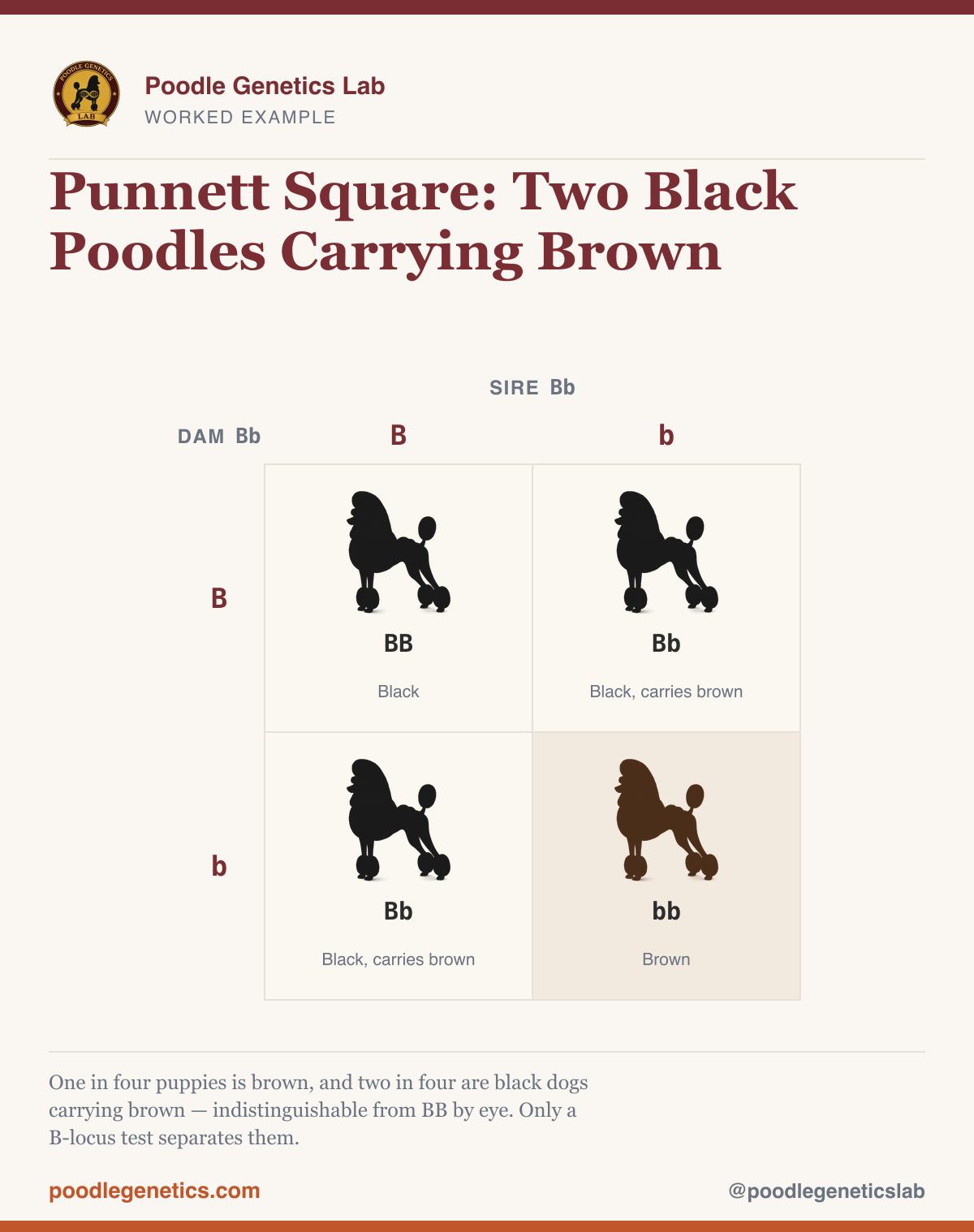
Start with the simplest possible cross: two black poodles that are each carriers of brown, genotype Bb at the B locus. Neither parent looks brown, both have one functional B allele and one non-functional b allele.
Step 1: Each parent's alleles. Both parents are Bb, so both can pass either B or b to any given puppy.
Step 2 and 3: Build the grid.
| B locus | B (sire) | b (sire) |
|---|---|---|
| B (dam) | BB | Bb |
| b (dam) | Bb | bb |
Step 4: Group and total.
| Genotype | Cells | Probability |
|---|---|---|
| BB | 1 | 25% |
| Bb | 2 | 50% |
| bb | 1 | 25% |
Two of the four cells land on Bb, once from B(dam)×b(sire) and once from b(dam)×B(sire), and those are the same genotype, so they combine into a single 50% outcome. This is the step people skip when they eyeball a Punnett square and undercount the heterozygote.
Because B is dominant over b, both BB and Bb puppies are visibly black. Only bb puppies are brown. So the genotype ratio of 1 BB : 2 Bb : 1 bb collapses to a phenotype ratio of 3 black : 1 brown, exactly the classic 3:1 monohybrid ratio, and exactly what the B locus article reports for this same cross.
Worked Example 2: Two Independent Loci (B and E Together)
Now add a second locus. Cross two poodles that are each BbEe, carriers of brown at the B locus and carriers of the red/cream-causing e allele at the E locus.
Because the B and E loci sit on different chromosomes, they assort independently, each locus's inheritance doesn't influence the other's. That means you can build each locus's Punnett square separately, then combine the results by simple multiplication.
The B locus alone (from Example 1): 25% BB, 50% Bb, 25% bb → 75% B_ (eumelanin-capable), 25% bb (brown, if eumelanin is expressed at all).
The E locus alone, same 2×2 mechanics as before, Ee × Ee:
| E locus | E (sire) | e (sire) |
|---|---|---|
| E (dam) | EE | Ee |
| e (dam) | Ee | ee |
25% EE, 50% Ee, 25% ee → 75% E_ (eumelanin permitted), 25% ee (no eumelanin in the coat at all, red/apricot/cream regardless of what B says).
Combine the two loci. With independent assortment, the probability of any specific two-locus genotype is just the product of each locus's individual probability:
| Combination | Math | Probability |
|---|---|---|
| B_ E_ | 3/4 × 3/4 | 9/16 (56.25%) |
| B_ ee | 3/4 × 1/4 | 3/16 (18.75%) |
| bb E_ | 1/4 × 3/4 | 3/16 (18.75%) |
| bb ee | 1/4 × 1/4 | 1/16 (6.25%) |
That's the standard 9:3:3:1 dihybrid ratio, the genotype-category outcome you'd get from any two independently-assorting heterozygous loci. If you built the full 4×4, sixteen-cell grid (four B-locus gametes worth of combinations against four E-locus gametes worth) instead of multiplying the two 2×2 grids together, you'd land on the exact same sixteen combinations in the exact same proportions. Multiplying is just the shortcut once you trust that the loci are independent.
Where It Gets More Interesting Than 9:3:3:1
Here's the part a bare dihybrid ratio doesn't warn you about: genotype categories and visible phenotypes aren't the same thing, because the E locus doesn't just add its own color, it can erase the B locus's visible effect entirely. As the E locus article explains, an ee dog cannot place eumelanin in its coat at all, so whatever the B locus is doing underneath becomes invisible. This is epistasis: one locus masking another, not just adding to it.
Walk through what that does to the four genotype categories above:
- B_ E_ (9/16): eumelanin is expressed and B locus is intact → black
- bb E_ (3/16): eumelanin is expressed and B locus is bb → brown
- B_ ee (3/16): no eumelanin in the coat at all → red/apricot/cream, B locus status invisible
- bb ee (1/16): no eumelanin in the coat at all → red/apricot/cream, indistinguishable in the coat from the row above
The two ee categories look identical in the coat (both are simply "red-spectrum," with the shade itself set by separate polygenic factors this cross doesn't determine), so they merge into one visible outcome. The genotype-level 9:3:3:1 becomes a phenotype-level 9:3:4:
| Visible outcome | Probability |
|---|---|
| Black | 9/16 (56.25%) |
| Brown | 3/16 (18.75%) |
| Red-spectrum (apricot, cream, or red) | 4/16 (25%) |
9:3:4 is itself a recognized, named pattern in Mendelian genetics, the ratio you get whenever a recessive genotype at one locus is epistatic to (masks) another locus. It isn't a special poodle rule, it's what a dihybrid cross always does once one of the two loci can hide the other.
Where the Punnett Square Method Stops Working
Everything above relies on one clean assumption: a locus with exactly two alleles, one clearly dominant, one clearly recessive, behaving in a simple, predictable way. A lot of poodle color genetics fits that mold. Not all of it does, and it's worth being upfront about where a simple 2×2 or 4×4 grid stops being the right tool, rather than letting the method quietly overclaim.
Merle isn't a two-allele system. The M locus doesn't reduce to a clean dominant/recessive pair the way B and E do. It's an allelic series built on repeat-length variation, with alleles that range from fully non-expressing through cryptic and threshold expression up to fully expressing and double-merle. A single-row Punnett square can't represent that gradient, and treating merle as "just another Mm × Mm cross" is exactly the kind of oversimplification that leads a breeder to underestimate double-merle risk. See the merle article for the real allelic model and why merle is never described as "carried".
The A locus is haplotype-based, not simple-Mendelian in the legacy sense. What most lab reports still print as four letters, Ay/aw/at/a, is actually a modular system of two separate regulatory regions recombining into distinct haplotypes, several of which the legacy four-allele notation collapses into a single letter that behaves in more than one way. A Punnett square built on the wrong four "alleles" will get the dominance order roughly right but miss real distinctions the haplotype model captures. See the A locus haplotype article for the full picture.
Independent assortment itself is an assumption, not a guarantee. Every worked example above depends on the two loci being unlinked, on separate chromosomes, or far enough apart on the same chromosome to assort as if they were. That's true for B and E. It is not automatically true for every locus pair, and the calculator's own logic notes this simplification rather than hiding it.
None of this means the Punnett square is the wrong tool, it's the right tool for exactly the kind of locus B and E represent, and a real share of poodle color genetics is built from loci that behave this cleanly. It just means the method has a scope, and knowing where that scope ends is part of using it correctly.
The Takeaway
A Punnett square is nothing more than a systematic way to enumerate every possible gamete pairing and weight each one correctly. For a single locus with clean dominant/recessive behavior, that means a 2×2 grid and a 3:1 ratio when both parents are heterozygous. For two independent loci, it means either a 4×4 grid or, more practically, multiplying two 2×2 results together, and watching for cases like E's epistasis over B where the genotype ratio and the visible-phenotype ratio diverge.
Once you've built a few of these by hand and checked them against the color calculator, the calculator stops being a black box. It's running the same four steps above, just across every locus in the site's model simultaneously, and handling the loci, like merle and the modern A-locus haplotypes, where a simple grid genuinely isn't enough. For the complete inheritance tables and worked crosses across every color locus, see Volume I of the Poodle Genetics series. Download the Full Loci Reference Card for a printable summary.
Built on settled, deterministic reasoning or a directly observable fact rather than a specific cited study, so no References section appears below.
- Published
- August 27, 2026
- Last reviewed
- September 2, 2026
Free Tool
Apply This Knowledge
Model any parent pair with our interactive genetics calculator.