A DNA panel tells you what one dog carries. A coefficient of inbreeding tells you something a panel cannot: how related the two dogs behind a proposed pairing actually are, and by extension, how much of the wider gene pool that pairing draws on. It is a population-level number sitting next to individual-level ones, and it answers a different question than either a genotype or a pedigree chart answers on its own.
What COI Actually Measures
The coefficient of inbreeding (COI) is the probability that two alleles at a given locus, one inherited from the sire and one from the dam, are identical because they descend from the same shared ancestor rather than merely because they happen to match. A COI of 12% does not mean a dog is "12% inbred" in some vague sense. It means that, on average across the genome, there is roughly a 12% chance that any given pair of alleles in that dog is homozygous by descent rather than by coincidence. Higher COI means more of the genome is expected to be identical by descent, which means less of the genetic variation present in the breed as a whole survives in that individual.
That distinction, identical by descent versus identical by chance, is the whole reason COI is useful. Two unrelated dogs can still produce a homozygous puppy at any given locus by chance alone. What COI tracks is the excess of homozygosity a pairing produces because the parents share ancestors, which is the part a breeder actually controls by choosing who to pair.
Two Ways to Calculate It, and They Are Not the Same Number
Pedigree-based COI
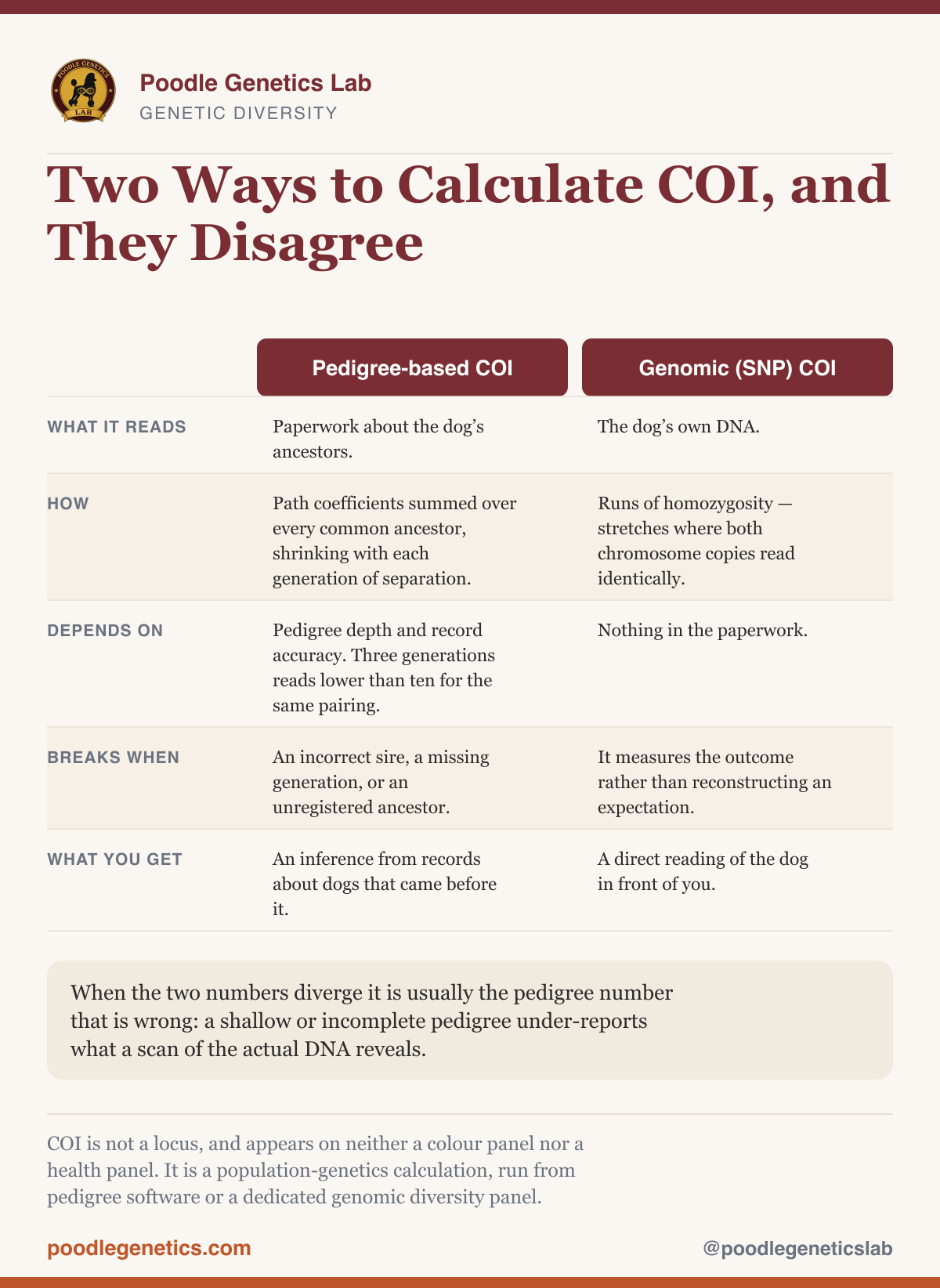
The classical method, in use since the early twentieth century, calculates COI from a written pedigree using Wright's path-counting method: trace every path back to each common ancestor, and sum a term that shrinks with each additional generation of separation. This is what most pedigree software and registry tools report.
Its accuracy is capped by two things that have nothing to do with the math. First, depth: a COI calculated over three generations will read lower than the same pairing's COI calculated over ten, because ancestors further back that both dogs share simply are not counted if the pedigree does not go back far enough. A shallow pedigree systematically understates relatedness. Second, completeness and accuracy of the records themselves: an incorrect sire, a missing generation, or an unregistered ancestor all bias the number, and there is no way to detect the bias from the pedigree alone.
There is a second, more fundamental limit worth naming alongside depth and record accuracy: Wright's method treats whichever ancestors sit at the edge of the pedigree you enter as unrelated and non-inbred, by construction. Any relatedness among those founding dogs that predates your pedigree's own starting point is invisible to the calculation, no matter how many generations you add. For a breed with a documented earlier bottleneck, like the Standard Poodle's own mid-century history, this means even a carefully researched ten-to-fifteen-generation pedigree COI can still sit below the dogs' true relatedness, because the dogs you are treating as founders were themselves not independent. This is the deeper reason a genomic COI, measured directly from a dog's own DNA rather than assumed from a family tree, is not just more convenient than a deep pedigree search; it answers a question pedigree depth alone cannot fully close.
Genomic (SNP-based) COI
A genomic COI is calculated directly from a dog's own DNA rather than from paperwork about its ancestors, typically by scanning for runs of homozygosity (ROH), stretches of the genome where both chromosome copies read identically. A dog inherits long unbroken ROH stretches specifically where both parents passed down DNA from a recent shared ancestor, so the total length of ROH across the genome is a direct, empirical measurement of realized relatedness. It does not depend on pedigree depth or record-keeping accuracy, because it is measuring the outcome in the DNA itself rather than reconstructing an expectation from the family tree.
The two methods do not always agree, and when they diverge it is usually because the pedigree-based number is the one that is wrong: a shallow or incomplete pedigree under-reports what a genomic scan of the actual DNA reveals. This is the same distinction the health calculator draws elsewhere on this site between recording a result and predicting one: a genomic COI is a direct reading of the dog in front of you, while a pedigree COI is an inference from records about dogs that came before it.
Why This Matters for a Standard Poodle Program Specifically
The honest starting point is that most breed-wide inbreeding depression research is not poodle-specific — it is drawn from other breeds and then reasoned to apply generally, which is a real limitation covered below. But one directly relevant, peer-reviewed, Standard-Poodle-specific study exists, and it is worth reading carefully rather than summarizing loosely.
Pedersen and colleagues (2015) examined the Standard Poodle's own breeding history: a mid-twentieth-century bottleneck in which a small number of show-winning founders came to dominate the breed's gene pool. Using pedigree analysis alongside a 33-marker short tandem repeat (STR) panel across the worldwide population, the study measured pedigree-based COI over 10 and 15 generations and compared it against the incidence of two autoimmune conditions in the breed's own health registry: sebaceous adenitis (SA) and Addison's disease (AD) (what each disease actually is).
For sebaceous adenitis, the association held and, if anything, sharpened over time. When SA first appeared in the health registry in the 1960s, affected dogs carried an average COI of 17.7% against a general-population average of 12.7% at the same period. By the 1970s–80s, SA-affected dogs' average COI had risen further, to roughly 26%, well above contemporary breed averages. Internal relatedness analysis on the STR panel corroborated the pedigree finding: dogs with SA were significantly more inbred than healthy controls (61 SA cases versus 314 controls).
For Addison's disease, the picture is more complicated, and this is the part worth stating plainly rather than folding into a single tidy claim. When AD was first documented in the 1970s, affected dogs likewise showed a markedly elevated COI (27.4% versus 15.3% for the population). But by the 2000s–2010s, COI among newly-diagnosed AD-affected dogs had declined to roughly 13.7%, essentially in line with the general breed population at that time. The authors' own reading is that the underlying genetic variants entered the breed through separate founder lineages and became fixed by mid-century linebreeding, after which AD's association with the most inbred segment of the population weakened as those variants spread more broadly through the breed. That is a different, more specific claim than "Addison's is caused by inbreeding," and the difference matters if you are the one deciding how much weight to put on it.
The authors are also explicit about a methodological limit worth carrying forward: their disease figures come from voluntarily reported cases to a breed health registry, and they state directly that these numbers represent reporting patterns, not confirmed population-wide incidence. A study built on voluntary reporting can show a real, statistically meaningful pattern in the data it has — which this one does — while still not settling what fraction of the whole breed is actually affected.
Put together, this is real, verified, breed-specific evidence that a documented mid-century genetic bottleneck in the Standard Poodle is linked to elevated disease risk for two autoimmune conditions, with that link considerably stronger and more current for sebaceous adenitis than for Addison's disease. It is not evidence that inbreeding causes either condition outright, and it is not license to treat every COI point as a linear increment of measurable risk. That is a fair, honestly stated description of what one real paper found, in one real breed, and it is why this article carries a supported-but-incomplete status rather than a stronger one.
The Broader Literature: Real, But Mostly Not About Poodles
Beyond that one Standard Poodle study, a substantial body of general canine population-genetics research supports the underlying mechanism, even where the specific breed studied was not the poodle.
Calboli et al. (2008) analyzed UK Kennel Club pedigrees across ten breeds and found extremely inbred populations in nine of them, with inbreeding effective population sizes of only 40–80 individuals for most, and more than 90% of unique genetic variants lost within six generations in all but three breeds studied. The poodle was not among the ten breeds analyzed, but the mechanism it demonstrates, a closed studbook concentrating relatedness generation over generation, applies to any closed-registry breed, poodles included.
Leroy et al. (2015) examined seven French dog breeds and found that both litter and dam inbreeding negatively affected litter size, and that inbreeding was also associated with reduced survival to two years of age. Again, no poodle variety was among the breeds studied, but the direction of the effect is consistent with the wider inbreeding-depression literature in mammals generally.
Chu et al. (2019), working with the Morris Animal Foundation's Golden Retriever Lifetime Study, used genomic (SNP-based) COI rather than pedigree COI, and found a statistically significant negative correlation between genomic inbreeding and fecundity: roughly one fewer live puppy per litter for every 10% increase in genomic COI, in a sample of 93 genotyped females. The authors describe this finding as preliminary and call for larger studies before generalizing it, which is worth repeating here rather than smoothing over — it is real, but it is one relatively small study in one other breed.
None of this is poodle-specific proof of a litter-size or longevity effect. It is a consistent, cross-breed pattern in the wider dog inbreeding-depression literature, which is exactly why this article treats "genetic diversity matters for poodle breeding programs generally" as supported by real evidence, while treating any specific numeric claim about poodle litter size or lifespan as outside what has actually been measured in this breed.
What This Has to Do With a DNA Health Panel
Reading a DNA health panel line by line will not surface any of this. Sebaceous adenitis and Addison's disease are both conditions with no validated DNA test — they do not appear on a commercial panel at all, which means a clear result across every line a lab offers says nothing about either condition. COI is not a substitute DNA test for SA or AD. It is a different kind of evidence entirely: a population-level signal, visible in pedigree and genomic data, for conditions that single-variant testing cannot reach. A breeder relying on panel results alone to evaluate a Standard Poodle pairing is, for these two diseases specifically, working from a page that was never going to have the answer.
What a Breeder Can Practically Do
| Tool | What it measures | Status |
|---|---|---|
| Pedigree-based COI (registry software) | Expected relatedness from recorded ancestry, as deep as the pedigree goes | Only as accurate as pedigree depth and record accuracy |
| UC Davis VGL genetic diversity panel | STR-based genome-wide diversity and DLA class I/II (immune-region) diversity, plus internal relatedness against the breed's tested population | Real, currently offered, with dedicated Standard, Miniature, and Toy Poodle breed pages |
| Genomic COI from a consumer SNP panel | Realized homozygosity (ROH) from a dog's own DNA | Not pedigree-dependent, but panel-density and breed-reference-dependent |
The most concrete, currently-real tool available to a poodle breeder wanting to measure this directly, rather than estimate it from a pedigree, is the UC Davis Veterinary Genetics Laboratory's canine genetic diversity test. Built around a 33-marker STR panel developed with input from Standard Poodle breeders and Dr. Niels Pedersen's research group (the same Pedersen behind the 2015 SA/Addison's study above), it measures genome-wide diversity and diversity specifically within the DLA region, the canine equivalent of the immune-regulating MHC region that the wider autoimmune-disease literature ties to narrowing diversity. VGL maintains dedicated enrollment pages and breed baselines for Standard, Miniature, and Toy Poodles, each built from hundreds of submitted samples, so a result comes back benchmarked against the dog's own variety rather than the species generically. Practically, this makes it possible to compare two prospective mates' internal relatedness scores directly, and to select for a pairing that adds diversity back into a line rather than concentrating it further.
Short of ordering that test, the lower-cost step is simply demanding pedigree depth before trusting a COI number at all. A three-generation pedigree COI on a Standard Poodle from a heavily linebred background can read misleadingly low for exactly the reason this article's COI-calculation section explains: the shared ancestors doing the real work are further back than three generations, and a shallow pedigree cannot count what it does not include.
None of this replaces the five-input framework this site already runs breeding decisions through. Population context — inbreeding coefficient and popular-sire concentration specifically — is one of the five inputs that framework weighs alongside genotype, phenotype, pedigree, and overall merit, and a favorable COI is not a veto over the other four any more than a carrier result is. What this article adds is the substance behind that one input: what the number actually measures, how it is actually calculated two different ways, and what real, verified research does and does not show it predicts in this specific breed.
For breeders who want the fuller treatment, including how population-level reasoning interacts with individual health testing and structural evaluation across a whole breeding program, Volume III covers poodle health and structural genetics against the same peer-reviewed standard used throughout this site.
The Bottom Line
COI is a real, calculable measure of how related a pairing's two dogs actually are, computed either from a pedigree (as accurate as its depth and records allow) or directly from DNA (independent of paperwork, but panel-dependent). In the Standard Poodle specifically, one verified 2015 study ties a documented mid-century breeding bottleneck to elevated inbreeding coefficients in dogs diagnosed with sebaceous adenitis, an association that has held and strengthened over decades, and, more equivocally, in dogs diagnosed with Addison's disease, where the same association was strong when first documented but has since narrowed toward the population average. Beyond that one breed-specific paper, a consistent body of general canine research across other breeds supports inbreeding depression as a real, measurable phenomenon affecting litter size, survival, and genetic diversity broadly. Neither body of evidence licenses treating a COI figure as a precise health forecast for an individual dog. Both license treating population context as a real, evidence-backed input into a breeding decision — which is exactly the role it already occupies in this site's own decision framework.
Download the Breeding & Population Health Reference for a printable summary of COI, the Standard Poodle autoimmune-risk data, and hip screening in one page.
This article is educational and is not veterinary or breeding advice for any specific dog. It has been through our scientific review. Where a claim rests on research conducted in a breed other than the poodle, that limitation is stated directly in the text rather than left implicit. How we source and label claims across the site is set out in our editorial standards.
Credible evidence supports what is described here, but the mechanism, the population studied, or its application to Poodles still has limits. The literature below is real and cited in full; where it stops short, the article says so rather than rounding up.
- Published
- August 27, 2026
- Last reviewed
- September 5, 2026
References
- Pedersen NC, Brucker L, Tessier NG, Liu H, Penedo MCT, Hughes S, Oberbauer A, Sacks B (2015). The effect of genetic bottlenecks and inbreeding on the incidence of two major autoimmune diseases in standard poodles, sebaceous adenitis and Addison's disease. Canine Genetics and Epidemiology 2:14. doi:10.1186/s40575-015-0026-5
- Chu ET, Simpson MJ, Diehl K, Page RL, Sams AJ, Boyko AR (2019). Inbreeding depression causes reduced fecundity in Golden Retrievers. Mammalian Genome 30(5-6): 166–172. doi:10.1007/s00335-019-09805-4
- Leroy G, Phocas F, Hedan B, Verrier E, Rognon X (2015). Inbreeding impact on litter size and survival in selected canine breeds. The Veterinary Journal 203(1): 74–78. doi:10.1016/j.tvjl.2014.11.008
- Calboli FCF, Sampson J, Fretwell N, Balding DJ (2008). Population Structure and Inbreeding From Pedigree Analysis of Purebred Dogs. Genetics 179(1): 593–601. doi:10.1534/genetics.107.084954
Free Tool
Apply This Knowledge
Put two parents’ DNA panel results through the calculator and see the odds, line by line.