Most of the health content on this site skews Toy and Miniature, because that is where the single-gene, direct-test variants sit: CDDY, GM2 gangliosidosis, skeletal dwarfism. Standard Poodles carry a different kind of health burden, and it is not one a DNA panel was ever going to catch. Sebaceous adenitis (SA) and Addison's disease (AD) are the two conditions most associated with the Standard Poodle specifically, and both trace back to the same documented mid-century bottleneck in the breed's history. Neither has a gene to test for. This article is about what the two diseases actually are, what the real research does and does not show about their connection to inbreeding, and what a Standard Poodle breeder can practically do about a risk that no panel will ever report.
What Sebaceous Adenitis Actually Is
Sebaceous adenitis is an inflammatory disease in which the body's own immune system attacks and destroys the sebaceous glands, the small glands in the skin that produce the oils keeping a coat healthy and skin barrier intact. Without those glands, the coat dries out, breaks, and thins, and the skin develops the fine white or grey scale breeders describe as "sebaceous adenitis dandruff." Hair loss typically starts along the topline, the ears, and the top of the head, and can progress to a musty odor and secondary bacterial skin infections as the compromised skin barrier lets opportunistic organisms in.
Severity varies enormously between dogs, from a subtle dulling of coat quality that a casual observer would never flag, to extensive alopecia that changes a dog's whole appearance and quality of life. There is no blood test for it. The only reliable diagnosis is a skin biopsy, usually multiple punch biopsies read by a veterinary dermatopathologist, looking for the granulomatous inflammation surrounding and destroying the sebaceous glands under the microscope. That is why it sits on the Standard Poodle's CHIC elective list as a screening item, not a DNA line: it is diagnosed by looking at tissue, not by reading a genotype.
What Addison's Disease (Hypoadrenocorticism) Actually Is
Addison's disease, formally hypoadrenocorticism, is a different autoimmune process with a much higher stakes failure mode. Here the immune system attacks the adrenal cortex, the outer layer of the adrenal glands responsible for producing cortisol and, in most cases, aldosterone. Cortisol helps the body handle stress and regulate metabolism; aldosterone controls sodium and potassium balance. When both fail, the result is a dog that cannot mount a normal stress response and cannot maintain its own electrolyte balance.
The disease has earned the nickname "the great pretender" in veterinary medicine because its early signs, lethargy, poor appetite, intermittent vomiting or diarrhea, are vague and often wax and wane, making it easy to mistake for a dozen more common problems. Left undiagnosed, a dog can crash into an Addisonian crisis: collapse, severe electrolyte derangement, and a genuine medical emergency. Diagnosis rests on an ACTH stimulation test, a blood test that measures how the adrenal glands respond to a synthetic hormone challenge, not a DNA test. Standard Poodles are consistently overrepresented among diagnosed cases relative to the general dog population, which is exactly why the breed's own health registry has enough data to study.
The Bottleneck, and What One Real Study Found
Both diseases trace back to the same documented event: a mid-twentieth-century bottleneck in which a comparatively small number of show-winning founders came to dominate the Standard Poodle's gene pool worldwide. Pedersen and colleagues (2015) examined this directly, comparing pedigree-based coefficient of inbreeding against the incidence of SA and AD in the breed's own health registry, corroborated with a 33-marker STR panel across the world population.
The fuller generation-by-generation numbers behind that summary, and the study's own caveat that its disease figures come from voluntary registry reporting rather than confirmed population-wide incidence, are laid out in this site's companion piece on the coefficient of inbreeding, which this article assumes rather than repeats.
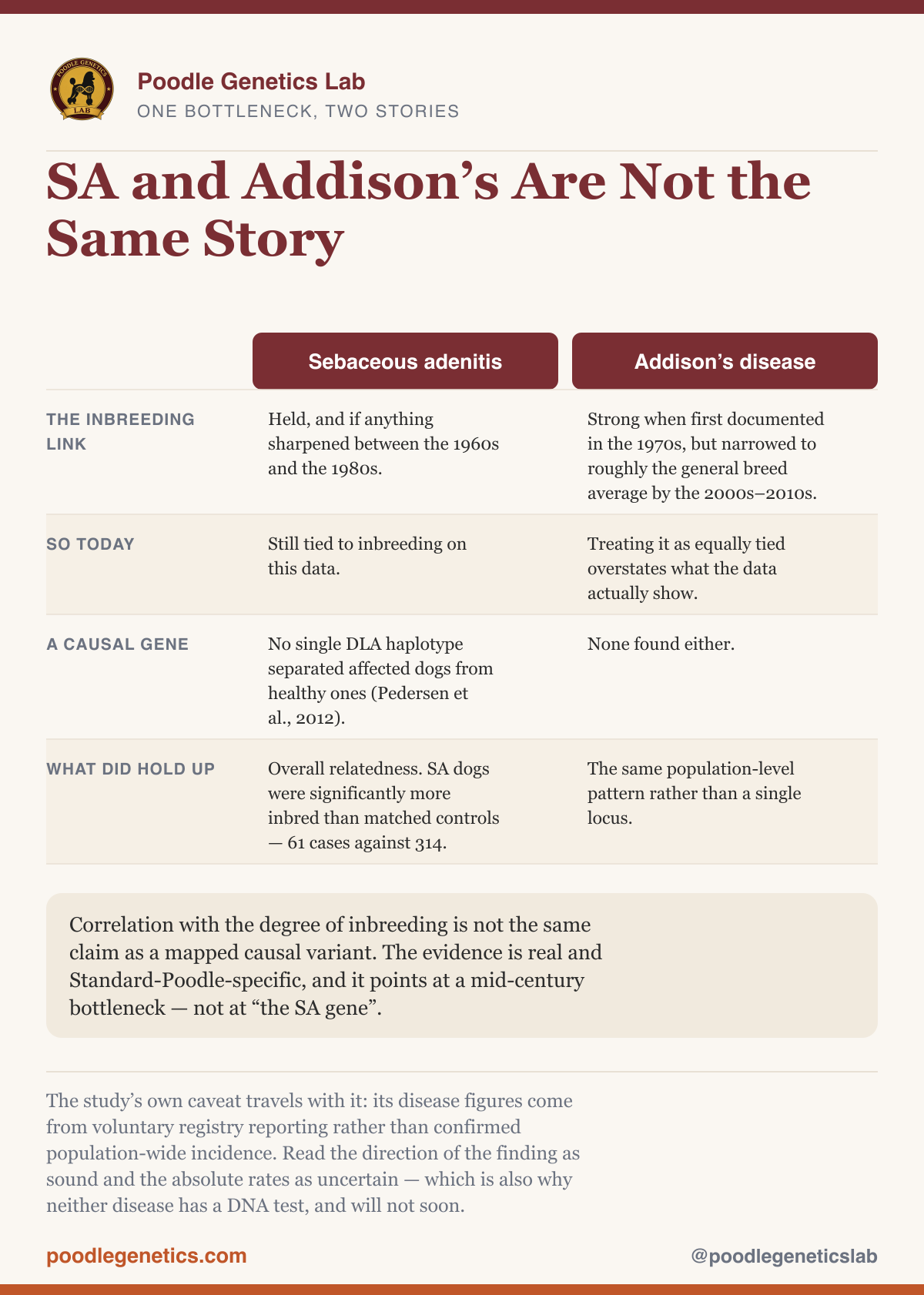
What is worth adding here, because it speaks directly to why neither disease has a DNA test, is what the same research program found when it went looking for a specific causal gene. A related, earlier genetic characterization of SA-affected and healthy Standard Poodles from the US and UK (Pedersen et al., 2012) used STR markers to profile the same population, including the DLA region that governs immune self/non-self recognition and is the first place autoimmune-disease genetics usually looks. No single haplotype in that region distinguished affected dogs from healthy ones. The signal that did hold up, in both that earlier work and the 2015 study, was overall relatedness: dogs with SA were significantly more inbred than matched healthy controls (61 SA cases against 314 controls), a population-level pattern rather than a single-locus one.
That is the honest shape of the evidence. It is real, it is Standard-Poodle-specific, and it points at a genuine mid-century bottleneck concentrating whatever combination of variants produces these diseases. It is not a discovery of "the SA gene" or "the Addison's gene," because no search for one has succeeded. Correlation with the degree of inbreeding is not the same claim as a mapped causal variant, and this article is careful not to conflate the two.
Why Neither Disease Has a DNA Test, and Won't Soon
Reading a DNA health panel line by line makes this same point from the report-reading side: sebaceous adenitis and Addison's disease both belong to the small group of conditions with no validated DNA test at all, meaning they never appear as a line on a commercial panel regardless of which laboratory a breeder uses or how extensive the panel is. A clear result across every test a report offers says nothing about either disease, because neither was ever a question the panel was built to answer.
This is different from a condition like CDDY, which does appear on poodle reports but whose meaning within the breed is unsettled. SA and Addison's are not unsettled panel lines; they are diseases that, on the evidence gathered so far, behave like the polygenic or complex-inheritance conditions this site distinguishes from clean single-gene recessives throughout its health content. A test may eventually exist if a future, larger genomic study succeeds where STR-based DLA scans have not. It does not exist now, and a breeder planning around one arriving soon is planning around a discovery that hasn't happened.
What a Breeder Can Practically Do
| Tool | What it actually does here |
|---|---|
| Skin biopsy (SA) and ACTH stimulation test (AD) | The only real diagnostic tools for each disease; Standard Poodle CHIC electives, not DNA lines |
| Pedigree research across close relatives | Flags whether SA or AD has appeared in the dog's own siblings, parents, or produced offspring |
| Pedigree-based or genomic coefficient of inbreeding | The population-level signal the 2015 research actually validated, not a per-dog diagnosis |
| UC Davis VGL genetic diversity panel | Measures genome-wide and DLA-region diversity directly, benchmarked against the Standard Poodle's own tested population |
Because neither disease is a clean recessive with a direct test, the carrier x clear rule that governs most of this site's other health content does not apply here in its usual form. There is no genotype to sort dogs by. What the research actually supports is population-level thinking: favoring pairings that add diversity back into an already bottlenecked gene pool over pairings that concentrate it further, using a real coefficient of inbreeding, calculated over enough pedigree depth to be meaningful or measured directly from a genomic diversity panel, as one input among the five this site's breeding-decision framework already weighs.
That does not mean ignoring family history. A dog whose close relatives are affected by SA or AD carries real information worth recording and disclosing, the same way any phenotype-only health concern does under that framework. It does mean not treating a single affected relative as an automatic disqualification the way a positive genotype for a clean recessive would be, because the evidence behind these two diseases has never supported that level of certainty. The health-testing checklist covers where the SA and thyroid/cardiac electives fit into a Standard Poodle's testing calendar; this article is about what to do with the results once a pattern across a pedigree starts to show.
The Bottom Line
Sebaceous adenitis and Addison's disease are two real, well-characterized autoimmune diseases in Standard Poodles, diagnosed by biopsy and blood test rather than DNA, and both are tied to a documented mid-century breeding bottleneck. The best available research shows that connection held and strengthened for SA, and held only initially before narrowing toward the population average for AD, while genetic searches for a specific causal variant behind either disease have not succeeded. That combination, a real population-level signal without a mapped gene, is exactly why this article carries a supported-but-incomplete status rather than a stronger one, and exactly why the practical answer for breeders is population-level management rather than a test that does not exist.
Download the Breeding & Population Health Reference for a printable summary of the SA and Addison's COI numbers alongside COI and hip-screening basics.
This article is educational and is not veterinary or breeding advice for any specific dog. It has been through our scientific review. Where a claim rests on voluntarily-reported registry data rather than confirmed population-wide incidence, that limitation is stated directly in the text and in the companion coefficient of inbreeding article. How we source and label claims across the site is set out in our editorial standards.
Credible evidence supports what is described here, but the mechanism, the population studied, or its application to Poodles still has limits. The literature below is real and cited in full; where it stops short, the article says so rather than rounding up.
- Published
- September 1, 2026
- Last reviewed
- September 8, 2026
References
- Pedersen NC, Brucker L, Tessier NG, Liu H, Penedo MCT, Hughes S, Oberbauer A, Sacks B (2015). The effect of genetic bottlenecks and inbreeding on the incidence of two major autoimmune diseases in standard poodles, sebaceous adenitis and Addison's disease. Canine Genetics and Epidemiology 2:14. doi:10.1186/s40575-015-0026-5
- Pedersen NC, Liu H, McLaughlin B, Sacks BN (2012). Genetic characterization of healthy and sebaceous adenitis affected Standard Poodles from the United States and the United Kingdom. Tissue Antigens 80(1): 46–57. doi:10.1111/j.1399-0039.2012.01876.x
Free Tool
Apply This Knowledge
Put two parents’ DNA panel results through the calculator and see the odds, line by line.