Standard, Miniature, and Toy Poodles are one breed by kennel-club rule and three genetically distinguishable populations by the data. UC Davis Veterinary Genetics Laboratory (VGL) runs a dedicated genetic diversity panel for each variety separately, and its own published overview documents for Standard and Miniature Poodles report real, measured numbers, not the same figure repeated three times with the variety name swapped. This article walks through what those numbers actually say, what they don't yet say for Toy Poodles specifically, and why the three varieties would be expected to differ in the first place.
This is the natural companion to the coefficient of inbreeding article, which covers how COI is calculated and what one real 2015 study found linking the Standard Poodle's own breeding history to two autoimmune diseases. This article looks at the same underlying dataset from a different angle: not one variety's history, but how the three compare to each other.
The Test Behind the Numbers
VGL's canine genetic diversity panel, developed with Dr. Niels Pedersen's research group, genotypes each dog at 33 short tandem repeat (STR) loci spread across the genome, plus additional STR markers linked specifically to the DLA region, the canine equivalent of the immune-regulating MHC region implicated in autoimmune disease. From those markers, VGL calculates standard population-genetics statistics for each variety: average alleles per locus, observed and expected heterozygosity, and a breed-wide coefficient of inbreeding, alongside internal relatedness (IR), a per-dog score describing how related that individual's own parents were to each other.
Standard Versus Miniature: The Real Numbers
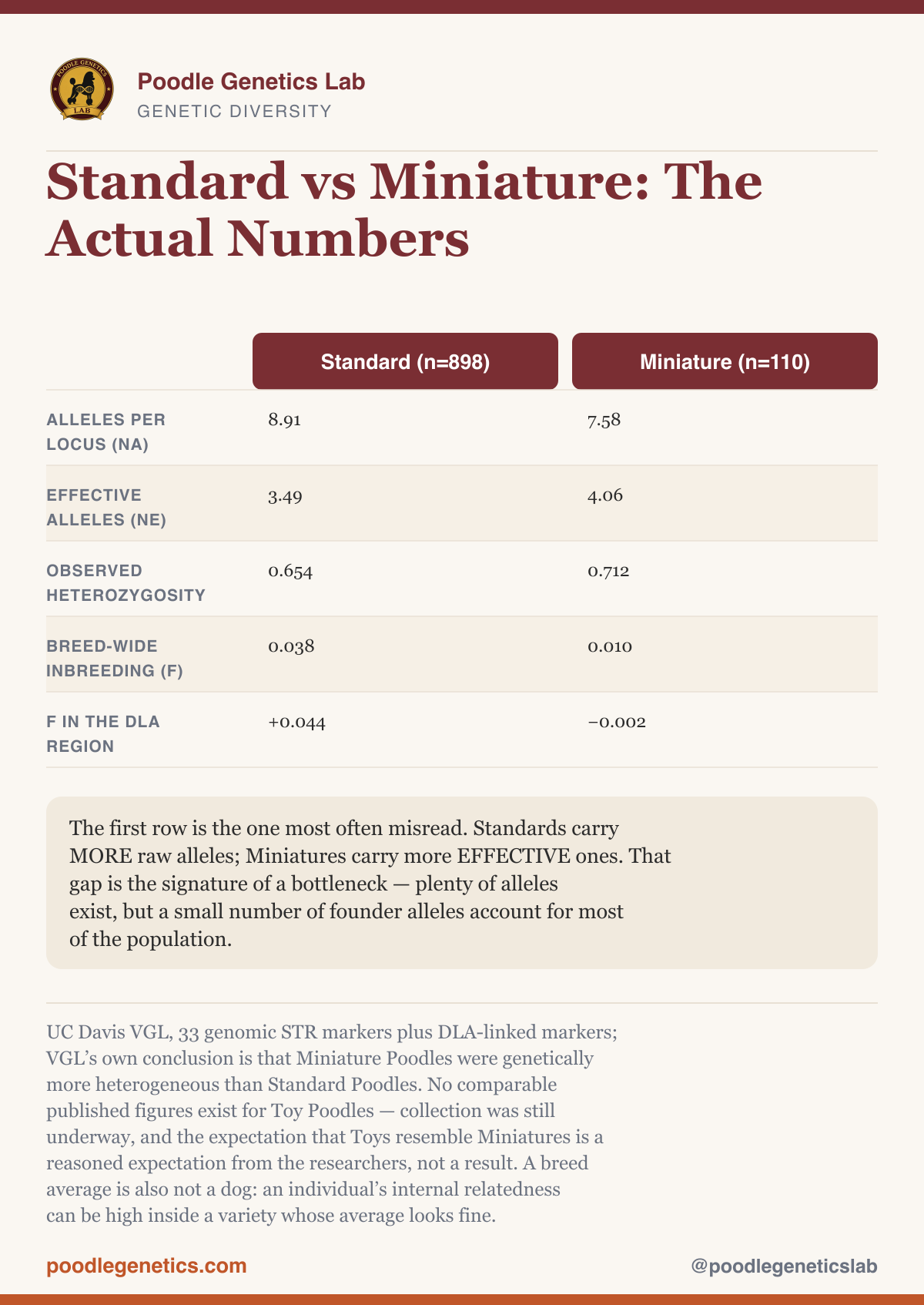
VGL's own published comparison, using the same 33 genomic STR markers across both varieties, is direct enough to quote rather than paraphrase. Comparing 898 Standard Poodles against 110 Miniature Poodles:
| Measure | Standard (n=898) | Miniature (n=110) |
|---|---|---|
| Average alleles per locus (Na) | 8.91 | 7.58 |
| Effective alleles per locus (Ne) | 3.49 | 4.06 |
| Observed heterozygosity (Ho) | 0.654 | 0.712 |
| Expected heterozygosity (He) | 0.680 | 0.720 |
| Breed-wide inbreeding coefficient (F) | 0.038 | 0.010 |
The first row is the one worth reading carefully, because it is the row most likely to be misread. Standard Poodles actually show more raw alleles per locus (Na) than Miniatures. If allele count alone were the measure of diversity, Standards would look more diverse. But effective alleles per locus (Ne), which weights each allele by how evenly it's actually distributed in the population rather than simply counting how many exist, runs the other direction: 4.06 for Miniatures against 3.49 for Standards. That gap between Na and Ne is the signature of a bottleneck: Standard Poodles carry plenty of different alleles in total, but a comparatively small number of them, the ones concentrated in the mid-century founders, account for most of the population, while the rest sit at low frequency. Heterozygosity and the breed-wide inbreeding coefficient tell the same story from a different angle: Miniatures run more heterozygous and less inbred at the population level than Standards do, on this dataset.
VGL's own conclusion, stated directly in its published overview, is unambiguous: "Miniature Poodles were genetically more heterogeneous than Standard Poodles."
The DLA Region Specifically
The same comparison run on just the DLA-linked markers, the region most directly tied to autoimmune disease susceptibility, shows the gap widening rather than narrowing. Standard Poodles carry a breed-wide inbreeding coefficient of +0.044 in this region against Miniatures' -0.002, and VGL's own overview attributes this directly to a "marked imbalance in DLA class I and II haplotype frequencies in Standard Poodles": a small number of founder haplotypes, the same ones tracing to the mid-century bottleneck, dominate the Standard Poodle's immune-region diversity far more than any single haplotype dominates in Miniatures. This is the same population-level pattern behind the real, Standard-Poodle-specific research on sebaceous adenitis and Addison's disease, both autoimmune conditions with a documented tie to the breed's own bottleneck. It is not a coincidence that the variety showing the tightest bottleneck in its immune-region diversity is also the variety carrying the clearest documented autoimmune-disease association with inbreeding.
Why the Varieties Differ at All
The explanation VGL offers for Miniature Poodles' broader diversity is not a mystery reserved for statisticians. It comes down to founder population history and how each variety was actually bred over the twentieth century. VGL's own overview attributes the Miniature's greater heterogeneity to a combination of a wider genetic base, apparently involving genetic contributions from breeds outside the Standard and Toy lines at some point in the variety's history, the Miniature's popularity and correspondingly large breeding population favoring more random mate selection rather than concentration around a small number of sires, and a comparatively loose written standard permitting a wider range of coats, colors, and body types than bred true from a narrower founder set.
Standard Poodles took a different path. The same mid-twentieth-century bottleneck this site's COI article documents, in which a comparatively small number of show-winning founders came to dominate the worldwide gene pool, concentrated the variety's diversity into fewer effective lineages even where the raw allele count remained high. Popularity did not protect the Standard from this the way it appears to have helped the Miniature, because the concentration happened around specific influential sires within an already large population, not from the population being small to begin with.
Toy Poodles: What Isn't Yet Established
This is the section where honesty matters more than a tidy answer. VGL's published, numbered comparison above covers Standard and Miniature Poodles directly, and a Toy Poodle baseline does exist: VGL describes it as built from samples submitted by breeders and owners, over 100 dogs as of this writing, and this site's own Volume III says the same. What was not located as a single published document at the time of writing is a full Na/Ne/Ho/He/F statistical table for Toy Poodles in the same format as the Standard-versus-Miniature comparison above, and this article is not going to guess at numbers it has not verified directly. Toy Poodle breeders wanting the specific figures should check VGL's current Toy Poodle diversity-testing page, since a baseline of this size is very likely to have produced, or to shortly produce, the same kind of table already published for the other two varieties. Until that direct verification happens, treat the conceptual expectation below (that Toy Poodles likely resemble Miniatures, for the same founder-population reasons) as a reasoned expectation, and treat any specific number you find as needing its own source check before you rely on it.
That expectation is plausible and consistent with the same founder-population logic laid out above. It is not the same thing as a published number, and this article is not going to manufacture one. Where the Standard-versus-Miniature comparison above carries real, verified figures, the Toy Poodle comparison is a reasoned expectation from the researchers closest to this data, not yet a result. Toy Poodle breeders should read this article's conceptual explanation as applying to their variety, and should treat the specific numbers as pending rather than assume they already exist.
What This Means Practically
None of this changes the population-context step of this site's breeding-decision framework: population context is one of five inputs, not a veto, and a favorable breed-wide average is not a substitute for checking the specific pairing in front of you. But the practical weight it carries differs by variety.
Standard Poodle breeders are working with a variety where the breed-wide average itself is less favorable, and where the immune-linked DLA region specifically shows a tighter bottleneck than the genome overall. A genomic diversity panel or a pedigree-based COI calculated over real depth is worth the cost here specifically because the population starting point is already constrained.
Miniature Poodle breeders are working with a more favorable breed-wide average, but VGL's own individual-level IR data makes clear that favorable average does not mean every dog is equally outbred: a real spread exists, with a meaningful minority of Miniatures showing IR scores in the range expected of full-sibling matings even though the breed average looks healthy. The population being diverse overall is not a substitute for checking the two specific dogs in a proposed pairing.
Toy Poodle breeders are working from the least-published data of the three varieties. The conceptual reasoning above is a reasonable basis for optimism, but it is not yet a verified number, and a Toy breeder wanting a real figure rather than an expectation should watch for VGL's baseline to be published rather than assume the Miniature's numbers already apply.
The Bottom Line
Genetic diversity is not a single breed-wide fact for "the poodle." UC Davis VGL's own data shows Standard and Miniature Poodles differing measurably, Miniatures more heterogeneous overall and specifically less concentrated in the immune-linked DLA region, with the gap traceable to different twentieth-century breeding histories rather than to chance. Toy Poodles very plausibly follow the Miniature's pattern for the same population-history reasons, but that is an expectation from the researchers closest to the data, not yet a published result, and this article says so directly rather than rounding an educated guess up to a fact. Whichever variety a breeder works in, a breed-wide average is a starting point, not a verdict on any one pairing; the tools to check the pairing itself, a genomic diversity panel or a real pedigree-based COI, are the same ones the companion COI article already covers in depth.
Download the Breeding & Population Health Reference for a printable summary of COI, pedigree depth, and hip-screening basics.
This article is educational and is not breeding advice for any specific dog. It has been through our scientific review. Its Standard-versus-Miniature figures are drawn directly from UC Davis VGL's own published breed diversity overviews rather than from a peer-reviewed journal article, and its Toy Poodle discussion is explicitly framed as an expectation rather than a verified result, which is why this article carries a supported-but-incomplete status. How we source and label claims across the site is set out in our editorial standards.
Credible evidence supports what is described here, but the mechanism, the population studied, or its application to Poodles still has limits. The literature below is real and cited in full; where it stops short, the article says so rather than rounding up.
- Published
- September 29, 2026
- Last reviewed
- April 20, 2027
References
- Pedersen NC, Brucker L, Tessier NG, Liu H, Penedo MCT, Hughes S, Oberbauer A, Sacks B (2015). The effect of genetic bottlenecks and inbreeding on the incidence of two major autoimmune diseases in standard poodles, sebaceous adenitis and Addison's disease. Canine Genetics and Epidemiology 2:14. doi:10.1186/s40575-015-0026-5
Free Tool
Apply This Knowledge
Put two parents’ DNA panel results through the calculator and see the odds, line by line.