If you have searched for "merle Goldendoodle genetics," you likely already suspect the answer: merle does not come from the Golden Retriever side. It comes from the Poodle. This article explains why that is true, what it means for a specific dog's genotype, and what it means for anyone breeding or buying a merle Goldendoodle.
The short answer
Golden Retrievers do not carry the merle gene as part of their documented breed genetics. Merle has never been a recognized or naturally occurring color in the Golden Retriever, and it does not appear in the breed's standard color genetics. So when a merle allele shows up in a Goldendoodle, it did not come from the Golden Retriever parent or ancestor in that pairing. It came from a Poodle ancestor somewhere in the dog's pedigree, because the Poodle is the only side of a Goldendoodle's family tree where merle exists as a real, documented allele.
This is worth restating plainly because it gets muddled in casual conversation: a merle Goldendoodle is not a "Golden Retriever color variant." It is a Poodle trait expressed in a mixed-breed dog. For the full picture of what else a Goldendoodle inherits from its Poodle half, including how that side of the pedigree drives most of the coat and color genetics conversation in doodles generally, see the Poodle half of your doodle.
There is one other route worth naming honestly, without pointing at any specific breeder or line: an undisclosed outcross to a merle breed somewhere in a dog's ancestry is a known phenomenon in mixed-breed and designer-dog history. It happens, and it is part of why some Golden Retriever breeders view merle Goldendoodles with skepticism, since a documented merle allele appearing on the Golden side of a pedigree would imply exactly this kind of undisclosed cross at some point. PGL takes no position on that debate. The genetics and the safety facts are what matter here, not the ethics argument.
Why some Golden Retriever breeders find this controversial
Because merle has no place in documented Golden Retriever genetics, its appearance in Goldendoodle litters marketed as an exciting or premium color has drawn real pushback from parts of the Golden Retriever breeding community. That controversy is well documented and genuine. This article is not the place to adjudicate it. What matters for a breeder or buyer making a decision today is the genetics: where the allele comes from, how it behaves, and what it does to risk in a breeding program.
Merle is not one gene switch, it is a graded series
A common misunderstanding, in Goldendoodles as much as in Poodles, is treating merle as a simple on-or-off trait: a dog either "has merle" or does not. The reality is more layered. Merle results from a SINE insertion in the PMEL gene, and the length of that insertion varies. Labs report merle as a base-pair length, and those lengths fall into seven recognized classes ranging from cryptic, where the dog shows no visible pattern at all, through classic merle, up to harlequin-range lengths with the strongest and most unpredictable expression.
This matters directly for Goldendoodles because a merle-patterned puppy, or even a puppy that looks solid but has a merle parent, could be any one of those length classes. Visual coat assessment tells a breeder nothing reliable about which class an individual dog is, and it tells a buyer even less. A dog can look completely solid and still have a merle allele that will express, or interact dangerously with another merle allele, in the next generation. Only a DNA test that reports the specific insertion length answers that question. The full mechanics of the seven-class system, including the complete length table and how expression and risk rise with insertion length, are covered in Merle in Poodles; this article summarizes only what a Goldendoodle breeder needs to act on.
The real risk: double merle
The core health risk in merle genetics has nothing to do with which breed the allele traces back to. It is what happens when two merle alleles land in the same dog.
A single merle dog, Mm, is generally healthy and shows the mottled merle coat pattern. A non-merle dog is mm. The danger appears specifically when two merle dogs, or two dogs that both have any merle-class allele including a cryptic one, are bred to each other. On average, a quarter of that litter will be MM, and that quarter carries the sharply elevated deafness and eye-defect rates described above.
Why this risk is specifically elevated in Goldendoodles
Goldendoodles are one of the highest-volume doodle breeds produced commercially. Merle is also actively marketed within this breed specifically as a rare or premium coat pattern, often commanding a price premium over standard Goldendoodle colors. That combination, high breeding volume plus a commercial incentive to produce merle puppies, creates a real and predictable pressure: breeding merle to merle to increase the odds of an "extra rare" merle litter, or to guarantee merle puppies rather than leaving it to a fifty-fifty split from a single merle parent.
This is exactly the pairing that produces double merles. It does not require bad intentions. It can happen simply because a breeder does not realize that both parents have a merle-class allele, particularly if one of those alleles is cryptic and invisible in the coat, or because a breeder underestimates how easily "the odds work out to a rare and valuable litter" collides with "the odds work out to a quarter of the litter being MM."
The practical rule does not depend on tracing which side of the pedigree, Poodle or otherwise, a given merle allele is believed to have come from. Once an allele is in a dog, its ancestry is a historical question, not a safety one. What matters for a breeding decision is the tested M-locus status of both dogs being paired, full stop. Any Goldendoodle breeder working with merle-patterned or merle-lineage stock needs both parents DNA tested for M-locus length before any pairing is planned, regardless of belief about lineage or visual coat assessment.
What to actually check before a pairing
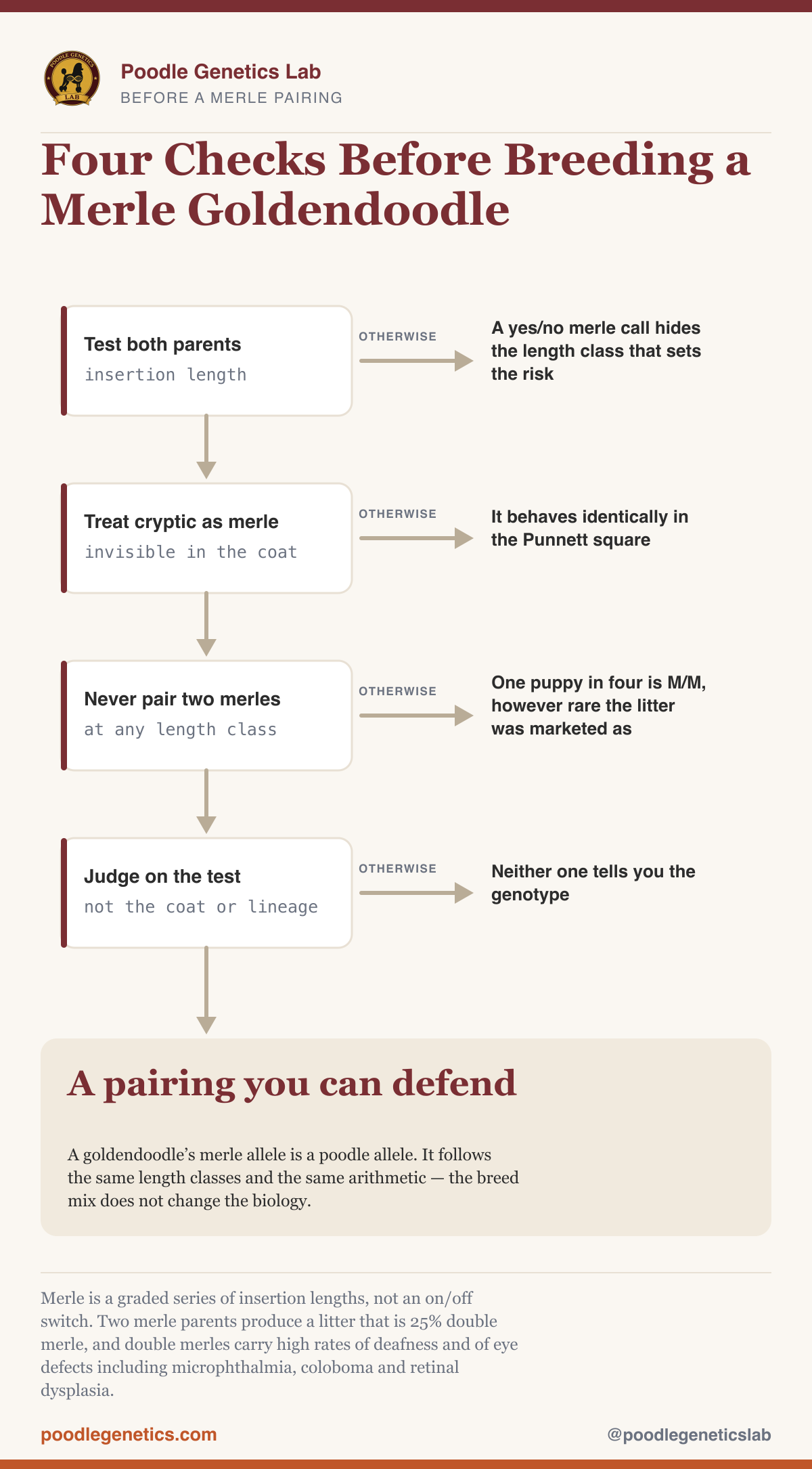
- DNA test both prospective parents for M-locus status, reported as an insertion length, not just a positive or negative merle call.
- Treat a cryptic result the same as a visibly merle result for pairing purposes. A cryptic allele does not show in the coat, but it behaves identically in the punnett square.
- Never pair two dogs that are each merle at any length class, regardless of how "rare" the resulting litter would be marketed as.
- Do not rely on a dog's apparent solid coat, or an assumption about which parent breed the allele came from, as a safety check. Neither tells you the genotype.
The bottom line
Merle in a Goldendoodle is not a Golden Retriever trait. It traces to Poodle ancestry, with an undisclosed outcross to another merle breed remaining a known, if less common, alternative explanation. Regardless of the source, once the allele is present in a breeding dog, the safety rule is the same one that governs merle Poodle breeding: test both parents, never pair merle-class alleles together, and do not let coat appearance or commercial demand for a rare pattern substitute for a DNA result. High breeding volume and a market premium for merle make this discipline more important in Goldendoodles, not less.
Check a real pairing in the Merle Calculator →
Download the Merle Health Risk Chart for a printable summary.
Built on identified genes and validated tests. The claims here are supported by the peer-reviewed literature listed below.
- Published
- October 6, 2026
- Last reviewed
- August 25, 2026
References
- Langevin M, Synková H, Jančušková T, Pekova S (2018). Merle phenotypes in dogs — SILV SINE insertions from Mc to Mh. PLoS ONE 13(9):e0198536. doi:10.1371/journal.pone.0198536
Free Tool
Apply This Knowledge
Model a merle pairing across all seven length alleles and see where it falls on the risk matrix.