A Poodle Genetics Question Nobody Has Answered Yet
Most of what a commercial DNA panel reports back is settled science. Test a poodle for the S locus and you get a real answer, grounded in a gene that's been mapped, sequenced, and validated across thousands of dogs: does this dog carry the variant behind parti/piebald white patterning, yes or no. That result is one of the more reliable things a coat-color panel can tell you.
But plenty of poodles show white markings that don't fit that answer at all — a blaze, a white chest patch, white feet, or the fuller pattern usually called Irish spotting or tuxedo patterning — in dogs whose S-locus result doesn't explain it. A dog can test clear of the piebald variant and still show the pattern. A dog can test as a carrier and show none of it. That's not a measurement error or a fluke in one lab's report. It's a real, open genetics question: nobody has identified the gene, locus, or inheritance model behind Irish/tuxedo-type white spotting in dogs, poodles included, and no validated genetic test exists for it anywhere.
That's the actual hook of this article, and it's worth sitting with before getting to anything about participating in research. This isn't a marketing gap where a company just hasn't gotten around to building a test yet. It's a real, unresolved question in canine coat genetics, and understanding why it's stayed open says something useful about how commercial genetic testing works and where its limits are.
What the S Locus Actually Explains — and Where It Stops
The genetics of piebald/parti white spotting in dogs is genuinely well-characterized. The relevant gene is MITF (microphthalmia-associated transcription factor), and the specific mechanism is a repeat-length polymorphism in the MITF-M promoter — the regulatory region controlling how much MITF gets expressed in melanocyte precursor cells during development. Longer repeats are associated with more extensive white patterning; shorter repeats, less. That finding comes from a genome-wide study of the trait across multiple breeds and is well established in the canine genetics literature (Baranowska Körberg et al., 2014). It's the biological basis for every commercial S-locus/piebald panel on the market, including the one behind PGL's own color calculator.
What that same body of research does not claim is that MITF-M repeat length explains every white-spotting pattern seen in dogs. Irish spotting — the specific, symmetrical pattern of a white blaze, chest, feet, and tail tip seen across many breeds, not just poodles — has long been treated in the literature as a distinct phenomenon from classic piebald, and it isn't resolved by the same variant. In other words: the S locus is real, it's testable, and it explains a lot of white patterning in dogs. It was never built to explain this particular pattern, and nothing has stepped in to fill that space since.
That's the actual shape of the gap. It isn't that Irish spotting is a fringe curiosity nobody's noticed — breeders see it, describe it, and try to predict it every whelping season. It's that the specific kind of data needed to even start investigating it — multi-generation pedigrees, littermates with different outcomes, known parent-offspring pairs, all annotated consistently — has never been assembled at any scale. That's a data problem sitting in front of a genetics problem, and it's the reason PGL's working hypothesis on Irish spotting and the Whitehead modifier is labeled exactly that: a hypothesis drawn from breeding observations, not a finding.
Citizen Science in Dog Genetics Is a Real, Established Model
The idea of breeders and owners contributing structured data to answer questions commercial testing hasn't solved isn't new or unique to poodles. It's a recognized approach in canine genetics more broadly, and a few existing efforts are worth naming honestly, as context rather than comparison — PGL's research pilot is far smaller in scope and isn't affiliated with any of them:
- The NHGRI Dog Genome Project, run out of Elaine Ostrander's lab at the National Institutes of Health, has built much of its work on citizen participation — owners submitting samples and phenotype data that fed directly into mapping trait and disease genes across breeds.
- Darwin's Ark, a nonprofit community-science project, has enrolled thousands of dogs whose owners complete behavior and health surveys, paired with donated DNA, specifically to give researchers the scale that studying complex, polygenic traits requires.
- The Doberman Diversity Project and the International Working Dog Registry apply the same owner/breeder-contributed model to breed-specific health and genetic-diversity questions, working directly with breed communities rather than around them.
None of those projects have anything to do with Irish spotting in poodles. What they demonstrate is that the underlying model — breeders and owners contributing carefully structured pedigree, phenotype, and sometimes genetic data toward a real research question — is an established, credible way canine genetics gets done when a trait falls outside what a commercial panel was designed to answer. PGL's research program is a small application of that same idea to one specific, real gap in poodle coat genetics.
Why This Particular Gap Has Sat Open So Long
It's fair to ask why, with commercial DNA testing now routine, no lab has simply added an Irish-spotting test to its panel. A few real constraints are worth being specific about, rather than treating this as a mystery:
It may not be a single gene. The S locus is a clean, single-gene story — one variant, a clear allelic series, a predictable inheritance pattern. Traits that don't resolve to one gene are structurally harder and slower to map; they need larger, more carefully structured family datasets to even detect a signal, let alone validate one. Nobody has published an inheritance model for Irish/tuxedo spotting because nobody has assembled the family data that would let a model be tested in the first place — that's the actual bottleneck, not a lack of interest in the question.
It's a cosmetic trait, not a disease. Commercial genetics labs prioritize R&D spending the way any company does: toward tests with clear commercial demand and, often, toward traits tied to health outcomes, where funding, urgency, and publication interest tend to concentrate. A white marking pattern with no health implication doesn't carry that same pull, even when it's a pattern breeders genuinely want explained. That's not a criticism of commercial labs — it's just where their incentives point.
The data doesn't exist yet, and nobody else is positioned to collect it. A commercial lab's R&D pipeline is generally built around validating a candidate gene once academic research has already identified one, not around years of unpaid, ground-floor pedigree collection on a non-disease trait with an uncertain payoff. That kind of patient, structured data-gathering — the littermates raised together with different outcomes, the multi-generation pedigree, the parent whose own pattern is documented — is exactly the kind of work a breeder-facing research pilot is positioned to do and a commercial lab typically isn't.
What a Breeder-Contributed Dataset Can Actually Do
This is the concrete reason a program like R001 exists instead of everyone simply waiting for a commercial lab to solve it. A dataset built from real breeding families — where the pattern is present in some individuals and absent in close relatives — is exactly the structure a qualified statistical or canine geneticist would need to start asking whether Irish spotting segregates like a single gene, several genes acting together, or something more diffuse. No commercial panel produces that kind of dataset as a byproduct of testing; it has to be built deliberately, from breeders who already hold the pedigree knowledge and are willing to document outcomes consistently, including the unaffected ones.
That's the actual, current state of R001 — a controlled data-collection pilot, not a diagnostic tool and not a genomic discovery program yet. Nothing submitted to it is used to make any claim about what causes Irish spotting, and it won't tell any individual participant what's going on in their own dog. What it can do is add real family data to a dataset that, over time, might be the thing that finally lets someone ask the causal question properly.
R001 is deliberately small, working from a handful of already-identified families rather than a broad open call. The families it's most interested in are specific: a litter where the puppies didn't all turn out the same, a pair of siblings split between patterned and clean, a multi-generation pedigree with some sense of whether the pattern showed up earlier too, or a parent and offspring pair where the parent's own pattern is known. Ambiguous or borderline patterns aren't a disqualifier — they're recorded as exactly that. No existing DNA panel results are required, and it isn't limited to one variety.
Your Dog Doesn't Have to Show the Pattern to Matter
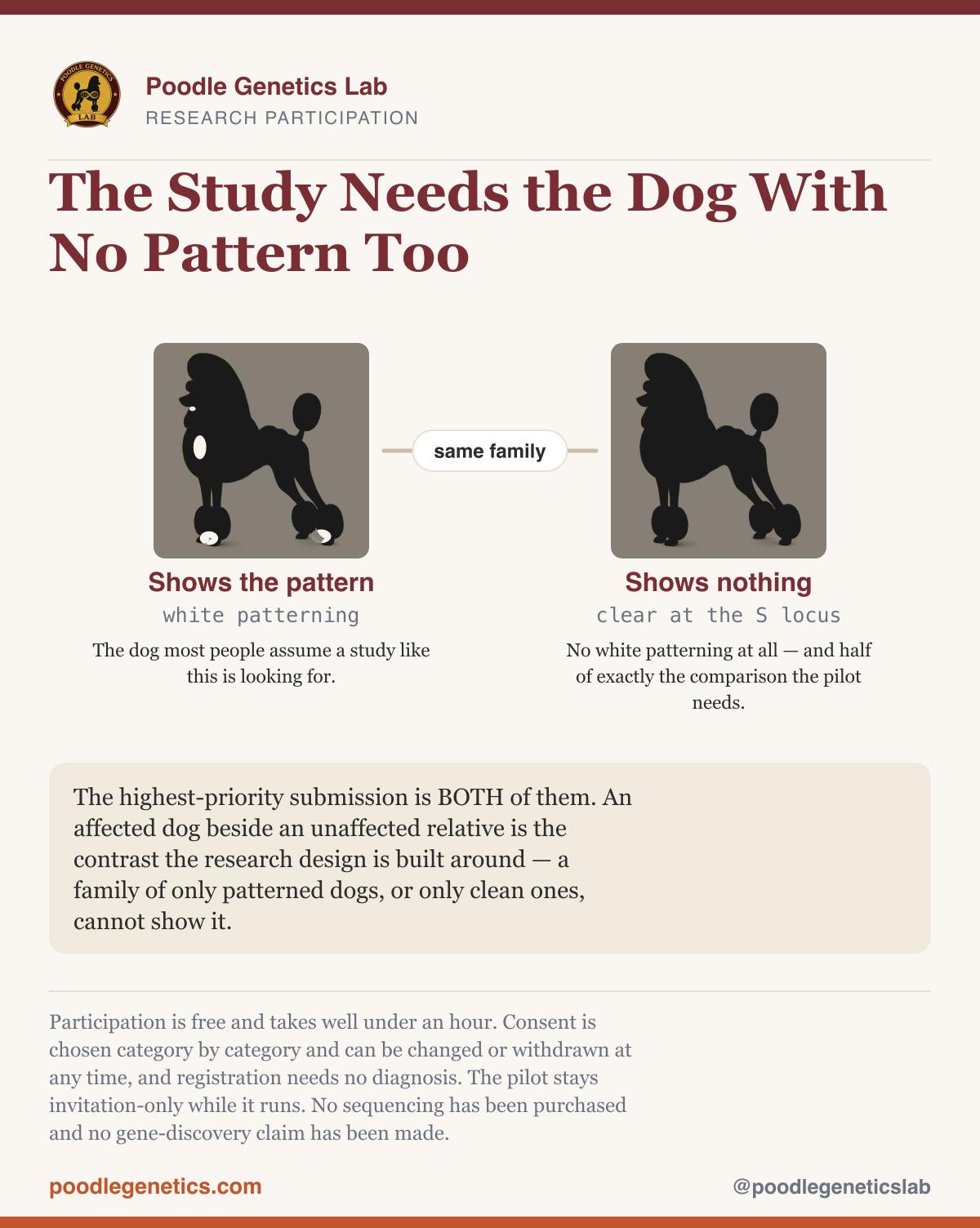
It's easy to assume a study like this only wants dogs that visibly show Irish spotting. R001's own criteria say otherwise. Its highest-priority submissions pair an affected dog with an unaffected one in the same family — because that contrast is the comparison the research design is actually built around. A family of only patterned dogs, or only clean ones, doesn't show it. A family with both does. If your dog tests clear at the S locus, shows no white patterning at all, and has a littermate or relative that does, that unaffected dog is half of exactly the comparison the pilot needs.
What Participating Involves
The real process, briefly: sign in with a one-time email link, review and choose consent settings category by category (research use of your dog's data, sharing with academic collaborators, publication, future contact, and several others are each a separate, explicit choice you can change later), register your dog with no diagnosis required, submit a phenotype observation using a standardized scoring rubric, and optionally link known relatives and add photos or existing DNA results. It's free, typically takes well under an hour, and you can withdraw at any time — though withdrawal can't undo use of data already folded into a completed analysis or publication.
Participation stays by invitation while the pilot is underway, prioritizing a small number of well-documented families over a broad open call. A genomic step — sequencing, candidate-gene analysis, anything that could actually identify a cause — only becomes worth considering once the collected family data shows a pattern informative enough to justify it, and only with qualified external genetics expertise involved. No sequencing has been purchased and no gene-discovery claim has been made for either study.
Why This Matters Beyond One Program
The Irish-spotting gap is a small, specific example of something true more broadly in canine genetics: commercial testing is excellent at answering questions that are already well-mapped, and it isn't built to be the place where a new, unmapped trait gets solved from scratch. That work — patient, unglamorous, family-structured data collection — tends to fall to the people who already hold the pedigrees: breeders. Projects like Darwin's Ark and the NHGRI Dog Genome Project exist because that model works at scale. R001 is a much smaller attempt at the same idea, aimed at one real, specific, currently unexplained pattern in poodles.
PGL is written by Xyon Marley, whose academic background — Animal Biology, Biochemistry, and General Chemistry at the University of the West Indies, followed by medical studies grounding him in anatomy, physiology, and molecular biology — is the framework applied to reading and citing the peer-reviewed genetics literature the rest of this site is built on. That same standard is why this program collects real family data carefully, before asking a genetic-cause question, rather than publishing a guess dressed up as an answer.
If you have poodles in families like the ones R001 is looking for — littermates with different white-marking outcomes, a multi-generation pedigree, a parent and offspring pair — the PGL research page is the place to start. It lays out both studies in full, and if you've already received an invitation, you can sign in from there to register a dog.
This article describes the current state of canine coat-genetics research and a research data-collection program. It is not veterinary advice. Discuss breeding and clinical decisions with your veterinarian.
Download the Poodle Health Panel Worksheet for a printable summary.
Built on identified genes and validated tests. The claims here are supported by the peer-reviewed literature listed below.
- Published
- October 2, 2026
- Last reviewed
- August 27, 2026
References
- Baranowska Körberg I, Sundström E, Meadows JRS, et al. (2014). A simple repeat polymorphism in the MITF-M promoter is a key regulator of white spotting in dogs. PLoS ONE 9(8):e104363. doi:10.1371/journal.pone.0104363
Free Tool
Apply This Knowledge
Model any parent pair with our interactive genetics calculator.