Most of this site's health content is about DNA: a variant, a copy count, a mode of inheritance. Hip dysplasia does not fit that pattern, and pretending otherwise would be the kind of overreach this site exists to avoid. There is no gene to test for hip conformation. What exists instead is a pair of physical screening programs, OFA and PennHIP, that examine the joint itself rather than the DNA behind it. This article explains what hip dysplasia actually is, why no panel will ever report it, and what OFA and PennHIP each actually measure, since the two are genuinely different tests read very differently.
What Hip Dysplasia Actually Is
Hip dysplasia is a malformation of the coxofemoral joint, the ball-and-socket joint connecting the femur to the pelvis. In a normal hip, the femoral head sits snugly in a deep, well-formed socket (the acetabulum). In a dysplastic hip, the joint is loose, the socket shallow, or both, and that laxity lets the femoral head shift and grind against the socket instead of rotating smoothly within it. Over time that abnormal mechanical loading wears down cartilage and produces osteoarthritis, the degenerative joint disease that actually causes the pain, stiffness, and reduced mobility owners notice. A dog can carry meaningful joint laxity for years with no outward sign before osteoarthritis becomes visible, which is exactly why screening a young dog before breeding it matters more than waiting for symptoms.
Hip dysplasia is polygenic and multifactorial. It is shaped by many genes of small effect, not one, and how much of that genetic liability actually shows up as a dysplastic joint is also shaped by real environmental inputs during growth: rate of weight gain as a puppy, body condition, the type and timing of exercise, and flooring and surface type during the growth-plate-open period. Two puppies with identical genetic liability can land in different places depending on how they are raised, which is part of why hip dysplasia behaves so differently from the clean single-gene recessives elsewhere on this site's health content.
The largest genetic analysis of hip dysplasia on record is a 2017 study of OFA's own database spanning 1970-2015: over one million hip evaluations across 60 dog breeds with enough records to calculate genetic parameters (Oberbauer et al., 2017). Heritability for hip dysplasia averaged 0.57 across those breeds, ranging from 0.46 to 0.76 depending on breed, high enough that a meaningful share of the variation in hip conformation is attributable to additive genetic variance rather than environment alone. The same study found that decades of breeders selecting away from dysplastic-scored parents measurably shifted OFA scores toward "excellent" over the study period, which is exactly the pattern a genuinely heritable trait should show under sustained selection.
That combination, real heritability and a real environmental component, is why hip dysplasia is screened rather than tested. A DNA panel can only report what a fixed list of known variants says about a dog. Hip dysplasia was never going to be on that list, because there is no small number of variants to look for; there is a polygenic liability interacting with how the dog was actually raised, and the only way to measure the outcome is to look at the joint itself.
What OFA Actually Measures
The Orthopedic Foundation for Animals (OFA) evaluates a single radiograph: the dog is positioned on its back with hips extended and legs parallel, typically under sedation to get a properly relaxed, symmetrical view. That image is read independently by a panel of board-certified veterinary radiologists, who assign a subjective grade on a seven-point scale, from Excellent and Good through Fair, Borderline, and into Mild, Moderate, and Severe dysplasia, based on how well the femoral head fits the socket and how much secondary joint change is already visible.
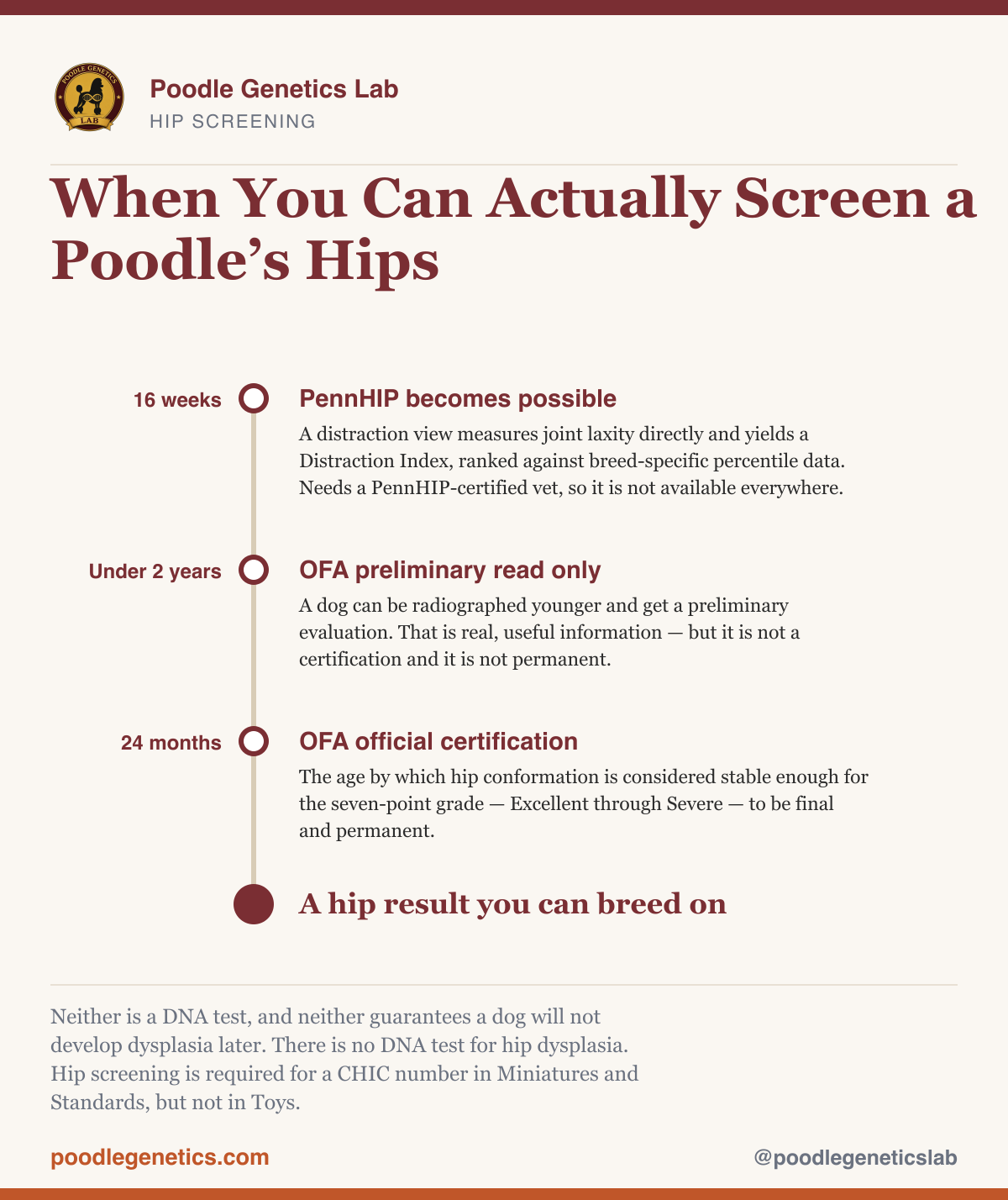
An official, permanent OFA certification requires the dog to be at least 24 months old, the age by which hip conformation is considered stable enough for the grade to be final. A dog can be radiographed younger and receive a preliminary evaluation, which is real, useful information, but it is not a certification and is not permanent. OFA scores are widely used because the database is enormous and because the seven-point grade is easy to communicate, but the read is fundamentally a subjective one: a trained radiologist's judgment of joint congruity from a static image, not a direct measurement of laxity.
What PennHIP Actually Measures
PennHIP (the University of Pennsylvania Hip Improvement Program) takes a different approach built around a quantitative measurement rather than a subjective grade. The method uses three radiographic views: a standard hip-extended view similar to OFA's, a compression view showing the joint fully seated, and a distraction view, taken with a specialized device that gently pushes the femoral head away from the socket to reveal exactly how much the joint can subluxate. From the distraction view, PennHIP calculates a Distraction Index (DI), a number describing how loose the joint actually is, which is then compared against breed-specific percentile data to show where a given dog's laxity ranks relative to others of the same breed.
Two things distinguish PennHIP from OFA in practice. First, because it measures laxity directly rather than reading a static joint outline, DI has been shown to correlate with a dog's likelihood of developing osteoarthritis later in life, which makes it useful earlier in a dog's development. Second, PennHIP can be performed as young as 16 weeks, far earlier than OFA's 24-month certification minimum, because the distraction technique measures the physical property of laxity directly rather than waiting for skeletal maturity to read a final joint shape. The tradeoff is that PennHIP requires a veterinarian specifically certified in the distraction technique, so it is not available everywhere OFA radiographs are.
| OFA | PennHIP | |
|---|---|---|
| What it measures | Subjective joint conformation, read from a single hip-extended film | Quantitative joint laxity (Distraction Index), from three films including a distraction view |
| Result format | Seven-point grade: Excellent through Severe | A number (DI), ranked against a breed-specific percentile |
| Minimum age for a final result | 24 months for official certification; preliminary reads earlier | 16 weeks |
| Who can perform it | Any veterinarian can take the film; OFA's radiologist panel reads it | Only a PennHIP-certified veterinarian, using the distraction device |
| What it is not | A DNA test, or a guarantee against dysplasia developing later | A DNA test, or a guarantee against dysplasia developing later |
Neither program is a competitor to a DNA panel, because neither is testing DNA. Both are reading the physical joint, by different methods, at different points in the dog's development, and reporting the result in different formats. A breeder is not choosing between "the DNA test" and "the X-ray test." There is no DNA test for this trait, on either the CHIC list or anywhere else, and there will not be one until the underlying genetic architecture is mapped in a way it currently is not, even in the 60-breed analysis above.
Where This Fits in an Actual Testing Program
This site's health-testing checklist already lays out which varieties actually require a hip evaluation for a CHIC number, hip screening is required for the Miniature and Standard, but not the Toy, and at what age to book it. What this article adds is the substance behind that requirement: what the evaluation is actually measuring, and why "hip dysplasia" never appears as a line on a DNA report the way PRA-prcd or CDDY do.
Inside the breeding-decision framework, hip status belongs firmly on the phenotype side of the five inputs, not the genotype side. There is no carrier x clear rule to apply here, because there is no genotype to sort dogs by. The tools that actually improve the odds across generations are the ones that framework already names for polygenic traits: screening the dog itself, reading trends across its close relatives, and selecting toward better scores generation over generation, the same logic this site applies to structural traits generally rather than a Punnett square that a joint with no single causal variant cannot support.
Practical Guidance
Screen every breeding Miniature and Standard's hips, on the age timeline that actually matches each method, PennHIP as early as 16 weeks if a certified veterinarian is accessible, OFA's official read no earlier than 24 months. Where both are available, running both is not redundant: PennHIP's early, quantitative laxity measurement and OFA's later, conformation-based grade answer related but different questions, and together they give a fuller picture than either alone. What neither answers, and what no future panel should be expected to answer either, is the environmental half of the equation. Growth rate, body condition, and exercise during puppyhood are real, controllable inputs into where a genetically-predisposed dog actually lands, and they belong in a breeder's own management of every puppy that leaves, not just in the screening paperwork on the parents.
The Bottom Line
Hip dysplasia is real, heritable, and has no DNA test, and it is not going to get one soon, because the trait itself is polygenic and its expression depends on real environmental factors a genotype cannot capture. OFA and PennHIP are the two established ways to actually measure it, and they are not interchangeable: one is a later, subjective conformation grade from a single film, the other an earlier, quantitative laxity measurement from a specialized technique. Neither belongs on the same shelf as a DNA panel, and neither should be mistaken for one. Screening the joint itself, on the right timeline, remains the only real answer this trait currently has.
Download the Breeding & Population Health Reference for a printable OFA-vs-PennHIP comparison alongside the COI and autoimmune-risk material.
This article is educational and is not veterinary advice. It has been through our scientific review. Its central heritability figure comes from a large cross-breed analysis rather than poodle-specific data, which is stated directly in the text and is why this article carries a supported-but-incomplete status rather than a stronger one. Confirm current CHIC and certification requirements directly against ofa.org and PennHIP's own program materials before scheduling a screening. How we source and label claims across the site is set out in our editorial standards.
Credible evidence supports what is described here, but the mechanism, the population studied, or its application to Poodles still has limits. The literature below is real and cited in full; where it stops short, the article says so rather than rounding up.
- Published
- September 15, 2026
- Last reviewed
- April 13, 2027
References
- Oberbauer AM, Keller GG, Famula TR (2017). Long-term genetic selection reduced prevalence of hip and elbow dysplasia in 60 dog breeds. PLOS ONE 12(2): e0172918. doi:10.1371/journal.pone.0172918
Free Tool
Apply This Knowledge
Put two parents’ DNA panel results through the calculator and see the odds, line by line.