Start Here If You're Trying to Identify a Pattern From a Photo or a Puppy in Front of You
If you're reading this because you're looking at a poodle, in person or in a listing photo, and trying to figure out whether what you're seeing is a "tuxedo," a "parti," or something else, this guide is built for exactly that. It skips the genetics almost entirely and focuses on what to actually look at: where the white sits, how much of the dog it covers, and how symmetrical it is.
If you want the deeper genetic explanation of any of this, including why some of these patterns don't have a DNA test at all, we link out to the technical articles at the end of each section. This piece is the practical, look-at-the-dog version.
The Three Patterns at a Glance
| Pattern | How much white | Where it sits | Shape |
|---|---|---|---|
| Abstract / minimal marking | A small patch or two, well under 50% | Chest, chin, toes, sometimes a small blaze | Irregular, small |
| Tuxedo | Variable, but often well under 50% | A specific, repeatable set of spots (see below) | Symmetrical, patterned |
| Parti | At least 50% white | Anywhere, no set locations | Irregular, patchy, large areas |
| Irish spotting | Variable | The same specific spots as tuxedo | Symmetrical, patterned |
Notice that tuxedo and Irish spotting occupy the same row in terms of where the white shows up. That's not a mistake, they may be the same underlying pattern described by two different names, or closely related patterns. More on that below.
How to Identify a Parti
This is usually the easiest of the three to spot, because the defining feature is simply quantity: a parti poodle is at least half white, with patches of another color scattered across the body.
Look for:
- At least 50% of the coat is white. This is the single clearest tell. If you're looking at a mostly-white dog with big, irregular patches of color, you're looking at a parti.
- No consistent location for the color patches. Unlike a tuxedo, a parti's colored patches don't follow a pattern. One parti might have a large patch over one eye and a saddle of color on the back; another might have color concentrated on one side of the body. No two partis look quite the same.
- Irregular, patchy shapes, not clean lines or symmetrical spots.
- The colored patches can be any poodle color underneath, black, brown, red, apricot, blue, even merle, so a parti's "color" isn't itself informative about the pattern.
For the full genetics behind parti (it's the S locus, and it's dosage-dependent in a way that surprises a lot of people), see Parti Poodles and the S Locus.
How to Identify a True Tuxedo
A tuxedo is not just "a dog with some white on it." It's a specific, recognizable set of markings that, together, form a repeatable pattern. Look for all six of the following:
- A facial blaze — a white stripe running up the muzzle, often between the eyes
- A complete collar — a ring of white around the neck
- A chest bib — a white patch on the chest, connected to the collar
- White extending along the underside of the body, belly-line
- White socks or stockings on all four legs, typically stopping partway up
- A white tail tip
A dog with only one or two of these, say, a bit of white on the chest and a couple of white toes, isn't a true tuxedo. That's the minimal end of the same spectrum, usually just called an abstract marking. A true tuxedo has the whole set, and it tends to look strikingly symmetrical and "designed" rather than random, which is the visual giveaway that separates it from parti at a glance: parti looks patchy and irregular, tuxedo looks patterned and deliberate.
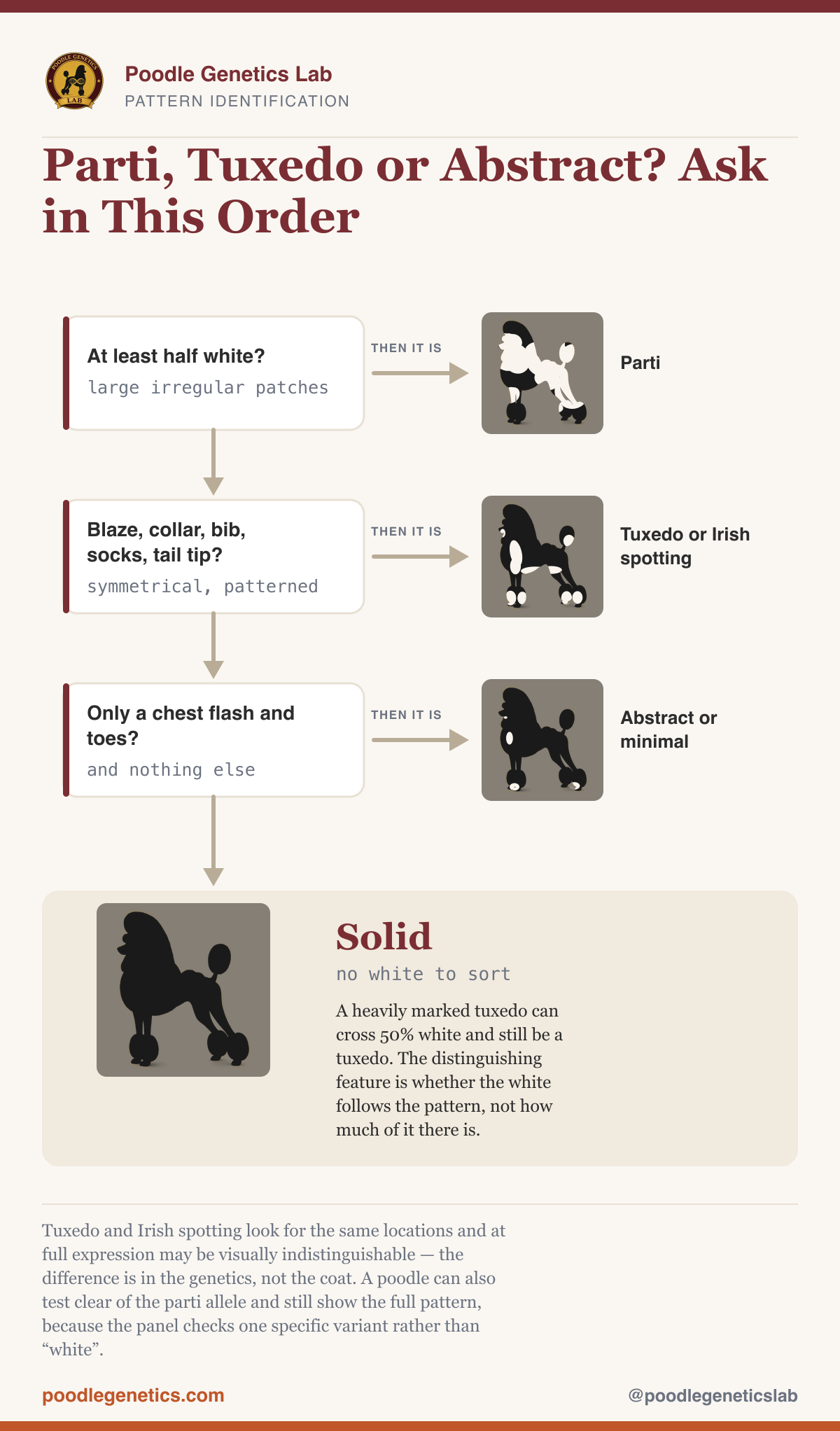
Here's the visual test that trips people up: a heavily marked tuxedo can approach, and even cross, 50% white if the pattern is extensive enough. When that happens, the dog may register or be described as parti too, since "at least 50% white" is purely a quantity threshold, not a statement about pattern. The distinguishing feature isn't the white percentage, it's whether the white follows the six-point pattern above (tuxedo) or scatters irregularly (parti).
How to Identify Irish Spotting
Irish spotting looks for the same locations as a tuxedo: face, collar, chest, feet, tail tip. In fact, at its fullest expression, Irish spotting and a "true tuxedo" as described above may be visually indistinguishable, they're currently believed to be the same or closely related patterns, observed and named from two different traditions.
What makes Irish spotting worth calling out separately for a buyer:
- It can appear at partial strength. A dog might show only a small chest bib and a partial collar, not the complete six-point set. This "minimal" end of the range is proposed to be a single-copy version of the same underlying pattern that produces a full tuxedo at a stronger dose, though this remains a working hypothesis rather than settled genetics.
- It doesn't reliably show up on a standard DNA panel. This is the detail that causes the most buyer confusion. A poodle can test clear of the parti gene (a result of "SS," no parti allele at all) and still be visibly, unmistakably marked with this pattern. The test isn't broken, it's just checking for a different, specific variant that isn't the one producing this particular dog's white.
If you've seen a listing or a lab report where the seller seems genuinely confused, "the test says solid but the dog is clearly marked", this is very likely why. It's not a scam and it's not a bad test. It's a real, documented gap in what current DNA panels can check for. The full case history behind this, including litters bred specifically to test the pattern, is in The Untestable Whitehead and Irish Spotting Hypothesis. Read the warning label at the top of that article before treating any of it as settled science, it's explicitly framed there as a working hypothesis, not a finding.
A Quick Visual Checklist
When you're looking at a specific dog and trying to sort it into one of these buckets, ask in this order:
- Is at least half the coat white, in large irregular patches with no set locations? → That's parti.
- Does the white follow the blaze / collar / bib / underside / socks / tail-tip pattern, whether complete or partial? → That's tuxedo or Irish spotting (visually the same question; the difference is in the genetics, not the coat).
- Is the white just a small chest flash, a bit on the toes, maybe a chin spot, and nothing else? → That's a minimal or "abstract" marking, the low end of the same spectrum as tuxedo/Irish spotting.
For the complete rundown of every recognized poodle color and pattern, including how each one interacts with the others, see Poodle Colors and Patterns: The Complete Guide.
Bottom Line
Quantity and location are almost everything, visually. A mostly-white dog with random patches is a parti. A color-majority dog with white in a specific, repeatable set of spots is a tuxedo or Irish-spotted. A dog with just a chest flash or a bit of white on the toes is at the minimal end of that same spotted spectrum. The genetics underneath these patterns are more complicated than the coat alone reveals, especially for tuxedo and Irish spotting, where a clear DNA test result doesn't always match what your eyes are telling you, but you don't need to untangle that genetics to correctly describe what you're looking at.
The Poodle Color Genetics Calculator models S-locus inheritance for parti breeding plans. For the full treatment of white spotting genetics, from the validated S locus test through the open questions around Irish spotting, see Poodle Color Genetics, 2nd Edition.
Download the Parti Litter Planner for a printable summary.
This article is educational and is not veterinary advice. Discuss breeding and clinical decisions with your veterinarian.
Credible evidence supports what is described here, but the mechanism, the population studied, or its application to Poodles still has limits. The literature below is real and cited in full; where it stops short, the article says so rather than rounding up.
- Published
- October 27, 2026
- Last reviewed
- October 30, 2026
References
- Karlsson EK, Baranowska I, Wade CM, et al. (2007). Efficient mapping of mendelian traits in dogs through genome-wide association. Nature Genetics 39(11):1321–1328. doi:10.1038/ng.2007.10
- Baranowska Körberg I, Sundström E, Meadows JRS, et al. (2014). A simple repeat polymorphism in the MITF-M promoter is a key regulator of white spotting in dogs. PLoS ONE 9(8):e104363. doi:10.1371/journal.pone.0104363
Free Tool
Apply This Knowledge
Model any parent pair with our interactive genetics calculator.