Short answer: not from the Cavalier side. Merle is not a documented part of Cavalier King Charles Spaniel genetics, so two purebred Cavaliers cannot produce a merle puppy between them, and neither can a Cavapoo whose merle coloring is supposed to come from the Cavalier parent. If a true F1 Cavapoo (a purebred Cavalier crossed with a purebred Poodle) is merle, that trait came from the Poodle parent.
This question shows up constantly in doodle-breeder search traffic, and it gets answered badly on forums more often than not, usually with some version of "it's rare but it happens" that doesn't explain where the gene actually came from. It has a real answer, and PGL is positioned to give it because the Poodle side of this cross is exactly what this site documents. This article is part of a cluster built around that idea; if you haven't read The Poodle Half of Your Doodle, it's worth reading first for the broader picture of how doodle coat genetics trace back to the Poodle parent.
Why the Cavalier side is not the source
Merle is caused by a SINE insertion at the M locus (PMEL17). It's a real, well-documented mutation in a number of breeds, but the Cavalier King Charles Spaniel is not one of them. Merle is not part of the breed standard, and it is not documented in the breed's genetic makeup. A litter of two purebred Cavaliers producing a merle puppy is not something the breed's genetics support.
That's the limit of what can be said with confidence about the Cavalier side. It would be overreaching to claim no Cavalier anywhere has ever carried an undisclosed cross somewhere back in a pedigree. What can be said plainly is that merle is not a recognized or expected part of the breed, and any Cavalier or Cavapoo line producing merle puppies did not get that trait from verified Cavalier genetics.
So where does a "merle Cavapoo" actually come from
There are two real possibilities, and they are not equally common.
The Poodle parent is merle. This is the straightforward, honest explanation, and it's almost certainly the most common one. Merle exists in Poodle lines. If the Poodle parent used in a Cavapoo breeding is Mm or has any merle allele, that allele can pass to the puppies exactly like any other M-locus allele would.
An undisclosed non-Cavalier ancestor is somewhere in the pedigree. This is a known general phenomenon across doodle breeding more broadly, not something specific to any breeder or seller. Multi-generation doodle programs sometimes introduce outside blood without full disclosure, and merle can enter a line that way. This article isn't in a position to say that happened in any specific case, and it shouldn't be read as an accusation against any particular breeder. It's a real possibility worth knowing about, not a default assumption.
For a specific puppy, the only way to actually tell these apart is a DNA test, not a coat guess.
The trap: a "solid" Poodle parent is not proof of anything
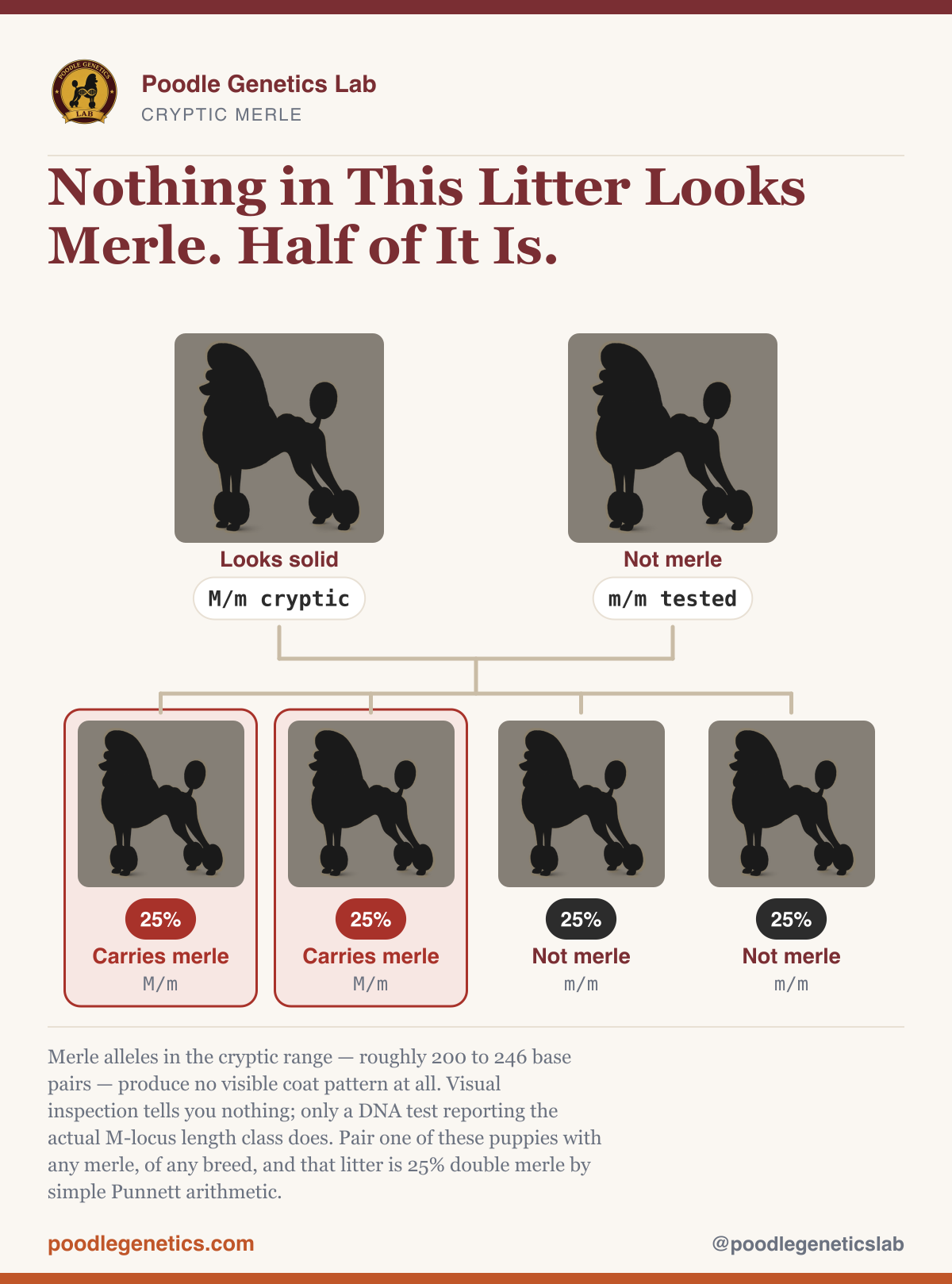
This is the single most useful point in this article for anyone actually planning a Cavapoo litter. Merle alleles in the cryptic length range, roughly 200 to 246 base pairs, produce no visible coat pattern at all. A Poodle that looks completely solid-colored can still be Mm and pass merle to half its offspring on average.
That means "the Poodle parent is solid, so there's no merle risk" is not a safe conclusion. It's not even a reasonable guess. Visual inspection tells you nothing about cryptic merle status. The only way to know is a DNA test that reports the actual M-locus length class, not just a presence/absence merle call.
This site covers the full seven-class length system, including cryptic, standard, and atypical ranges, in detail elsewhere. For the mechanics behind why length class (not just "merle or not") is what actually determines risk, see Merle Poodles: The Complete Guide.
The health stakes of getting this wrong
The reason this question matters beyond curiosity is what happens if two merle dogs, cryptic or visible, are paired without anyone checking first.
Because merle isn't expected on the Cavalier side and can be invisible on the Poodle side, this is exactly the kind of pairing where a breeder can end up with double-merle risk without ever intending to breed two merle dogs together. A visibly merle Cavapoo puppy paired with a "solid" Poodle that is actually a cryptic merle is enough to produce it.
What to actually do about it
If you're evaluating a specific pairing, the only reliable path is testing both parents' M-locus length and checking the actual combination, not guessing from coat color or breed assumptions on either side. That's exactly what the Merle Calculator is built for: enter both parents' tested M-locus lengths and get a real risk assessment for that specific pairing, rather than a rule of thumb.
Merle in a Cavapoo is not folklore and it's not random. It has one real genetic source in a true F1 cross: the Poodle parent. Confirm that with a test, not a guess, and the rest of the risk assessment follows from there.
Check a real pairing in the Merle Calculator →
Download the Merle Health Risk Chart for a printable summary.
Built on identified genes and validated tests. The claims here are supported by the peer-reviewed literature listed below.
- Published
- September 22, 2026
- Last reviewed
- August 25, 2026
References
- Langevin M, Synková H, Jančušková T, Pekova S (2018). Merle phenotypes in dogs — SILV SINE insertions from Mc to Mh. PLoS ONE 13(9):e0198536. doi:10.1371/journal.pone.0198536
Free Tool
Apply This Knowledge
Model a merle pairing across all seven length alleles and see where it falls on the risk matrix.