A purebred Bernese Mountain Dog looks like a Bernese Mountain Dog. Black body, rust points over the eyes and on the legs and cheeks, a white blaze and chest and paws, arranged in roughly the same places dog after dog. It is one of the most visually consistent patterns in purebred dogs. A Bernedoodle does not have that consistency, and breeders and buyers are often surprised by how much a litter can vary in coat outcome even when the Bernese parent looks exactly like every other Bernese.
The reason isn't mysterious once you separate the two sides of the cross. The Bernese pattern is genetically real, not just a breed-standard description, but it's also highly fixed within the breed. The Poodle side of a Bernedoodle carries far more variation at the same loci, and that variation is what actually decides whether a given puppy lands close to classic tricolor, comes out phantom, sable, or solid, or in rarer cases carries a trait the Bernese side never had in the first place. This article is part of a cluster on how doodle coat outcomes trace back to the Poodle parent; if you haven't read The Poodle Half of Your Doodle, it lays out the broader framework this article builds on.
What makes the Bernese pattern "fixed"
The classic Bernese tricolor involves two loci working together: a tan-point pattern at the A locus and white spotting at the S locus. Tan points put rust markings over the eyes, on the cheeks, the legs, and under the tail on a black base. White spotting adds the blaze, chest, and paws on top of that. Both of these are real, documented genetic mechanisms in general canine coat genetics, not just descriptive labels.
What's specific to the Bernese Mountain Dog is how conserved this combination is within the breed. Because the tricolor pattern is a defining, standard-required trait, breeders have selected for it consistently for generations, and the result is a breed where close to every dog presents the same tan-point-plus-white-spotting pattern with very little variation. That consistency is a breeding-population fact, not a claim about specific allele frequencies, and this article won't go further than that. The safe, well-supported statement is: the pattern is real, it involves the A and S loci, and it is unusually fixed for a purebred breed.
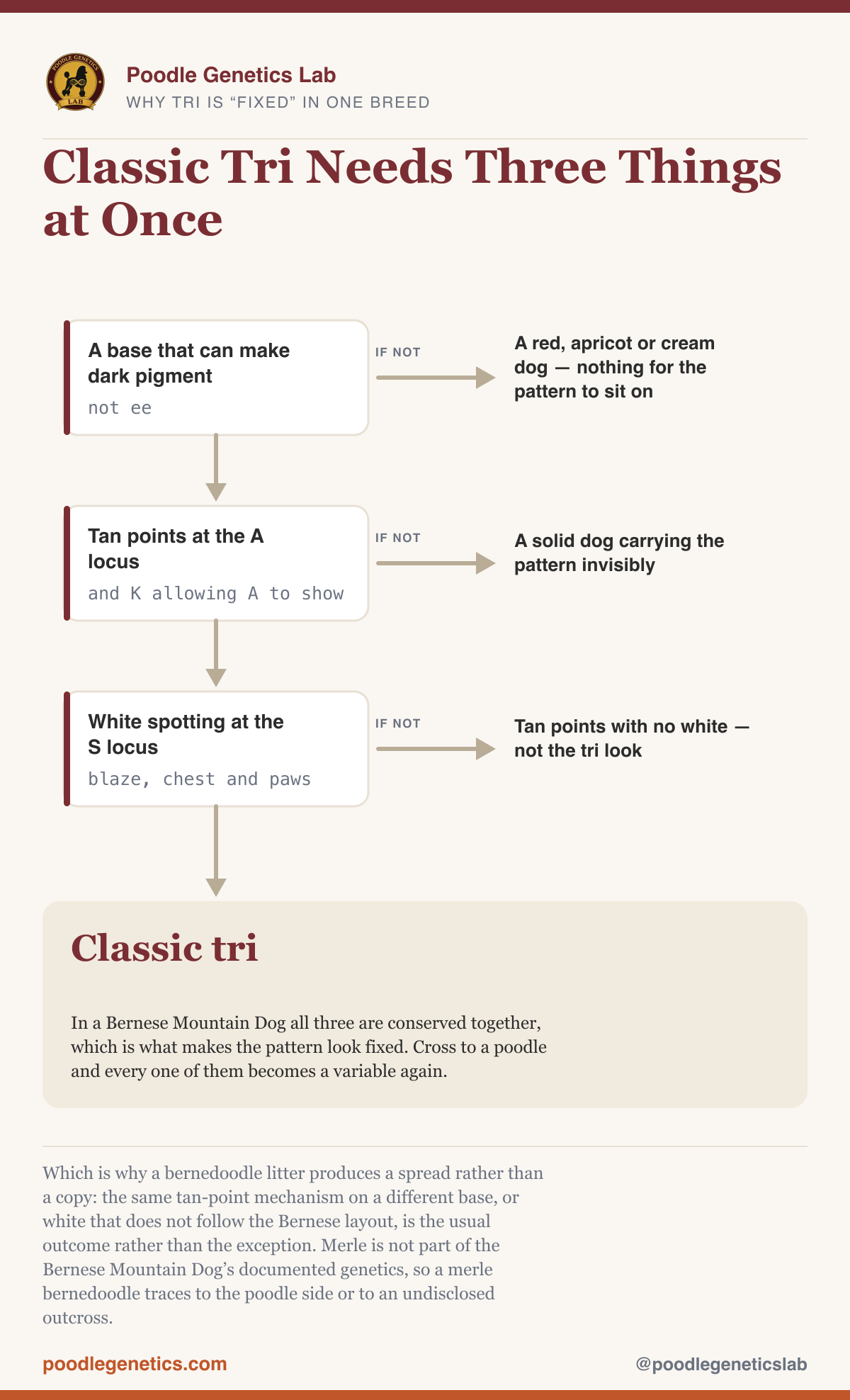
Why the Poodle side changes everything
Poodles do not have that kind of fixation. The breed carries a wide range of alleles at the A locus (solid, tan-point/phantom, sable), the K locus (which governs whether A-locus patterning shows through a solid coat at all), and the S locus (solid through heavily white parti). None of that is unique to Bernedoodles; it's the same variability documented across every Poodle cross this site covers.
When a Bernese Mountain Dog, whose A and S locus status is close to uniform across the breed, is crossed with a Poodle carrying a much wider range of alleles at those same loci, the puppy's outcome depends heavily on what the Poodle parent contributes. A Bernese parent reliably contributes a tan-point allele and a white-spotting allele; what the puppy ends up looking like depends on what pairs with those on the Poodle side, and which allele wins out in that particular pairing.
The outcomes people actually see
Classic tri. When the Poodle parent also carries tan-point and moderate white-spotting alleles, the puppy can land close to the Bernese pattern: dark base, tan points, white markings in the expected places. This is the outcome doodle breeders usually market as "tri" or "traditional."
Phantom. "Phantom" in the doodle world describes tan-point markings on a base color other than classic Bernese black, or white patterning that doesn't match the standard Bernese layout, usually because the Poodle parent contributed a different base color or K-locus status. The underlying mechanism is the same A-locus tan-point pattern discussed above; what changes is the base it sits on. Worth being precise: "phantom," like "tri" and other doodle-market terms, is descriptive shorthand, not a standardized genetic classification the way a lab-reported genotype is. Two sellers can mean slightly different things by it.
Sable. If the Poodle parent carries a dominant sable allele (Ay at the A locus), that allele can mask the Bernese tan-point pattern outright in a puppy that inherits it, producing a sable coat instead of visible tan points, since sable sits higher in the A-locus dominance order.
Solid or near-solid. A Poodle parent contributing a dominant black allele at the K locus (KB) can mask the A-locus tan-point pattern entirely, regardless of what the Bernese parent contributed there. The puppy can come out solid black, or with white spotting only, and no visible tan points at all, even though the Bernese side "should" have supplied them.
None of these outcomes require anything unusual on the Bernese side. They follow directly from ordinary Poodle-side variation meeting a much more fixed pattern from the other parent.
Merle is not part of this breed
One thing does not follow from ordinary variation: merle. Merle is not documented as part of Bernese Mountain Dog genetics. It is not part of the breed standard, and it is not a pattern the breed's fixed tricolor system produces under any combination of A- and S-locus alleles. A litter of two purebred Bernese Mountain Dogs does not produce merle puppies.
If a Bernedoodle is merle, that trait traces to the Poodle parent, where merle is a real, documented M-locus allele, or to an undisclosed ancestor somewhere in the pedigree that isn't a purebred Bernese or purebred Poodle. This second possibility is a known, general phenomenon in multi-generation doodle breeding, not an accusation against any specific breeder or program; it just needs to be named honestly. For the full mechanics of how merle works, including why a solid-looking Poodle can still carry it invisibly, see Merle Poodles: The Complete Guide.
Merle Bernedoodles are a real presence in the doodle market, which means double-merle risk is a real, practical concern whenever a merle-marketed Bernedoodle is paired with another merle dog, doodle or otherwise. Because merle can be invisible on a cryptic-length Poodle parent, "the other parent looks solid" is not a safe basis for ruling out that risk. If merle status is a live question for a specific pairing you're evaluating, run it through the Merle Calculator using each parent's tested M-locus length rather than a coat guess.
Testing beats guessing
The practical takeaway is straightforward. The Bernese Mountain Dog contributes a reliable, well-conserved tan-point-and-white-spotting pattern to a Bernedoodle litter. The Poodle parent contributes the variation that actually determines whether puppies land as classic tri, phantom, sable, or solid, and whether merle enters the picture at all. Coat guessing from either parent's appearance, especially the Poodle parent's, isn't reliable because K-locus masking and cryptic merle can both hide real genotype behind a plain-looking coat.
Download the Doodle Coat Genetics Reference for a printable summary of which parent breed typically contributes which trait across a doodle cross.
Model a real Bernedoodle pairing in the Coat Color Calculator →
Credible evidence supports what is described here, but the mechanism, the population studied, or its application to Poodles still has limits. The literature below is real and cited in full; where it stops short, the article says so rather than rounding up.
- Published
- November 3, 2026
- Last reviewed
- August 25, 2026
References
- Bannasch DL, Kaelin CB, Letko A, et al. (2021). Dog colour patterns explained by modular promoters of ancient canid origin. Nature Ecology & Evolution 5(10):1415–1423. doi:10.1038/s41559-021-01524-x
- Langevin M, Synková H, Jančušková T, Pekova S (2018). Merle phenotypes in dogs — SILV SINE insertions from Mc to Mh. PLoS ONE 13(9):e0198536. doi:10.1371/journal.pone.0198536
Free Tool
Apply This Knowledge
Model any parent pair with our interactive genetics calculator.