What Grizzle Actually Is
Grizzle is a real allele, not folklore and not a loose synonym for agouti banding. It sits at the E locus, the same MC1R gene already covered in depth on this site, and it has a formal place in the modern allelic series. The 2024 paper that updated the E-locus dominance hierarchy (Honkanen and colleagues, published in Animal Genetics) describes roughly seven alleles at this locus, arranged from most to least dominant, and grizzle, written eG, is one of them, sitting below the wild-type E allele and above the recessive e alleles that produce red, apricot, and cream.
The E-locus explainer on this site already names it in passing, as part of the wider allelic series that the practical E/e discussion simplifies for breeding purposes. This article exists to say more about that one allele specifically, and to be honest about how far the evidence actually reaches.
Phenotypically, grizzle produces a coat where eumelanin is patchy rather than absent, hairs of dark and light pigment mixed together rather than a clean red/cream coat from ee, and rather than the even, fully-enabled eumelanin of E_. Reported presentations include a shaded or "salt and pepper" look, and in Afghan Hounds the same allele produces what that breed's community calls "domino," a lighter mask and underside pattern. Its exact expression also depends on what a dog carries at the A and K loci, the same interaction that determines whether a phantom pattern shows or gets masked, described in the phantom poodle article.
Where It's Actually Been Found — and Where It Hasn't
This is the part that matters most for a poodle breeder, and it's also the part most likely to get skipped by anything written to chase the search term "grizzle poodle."
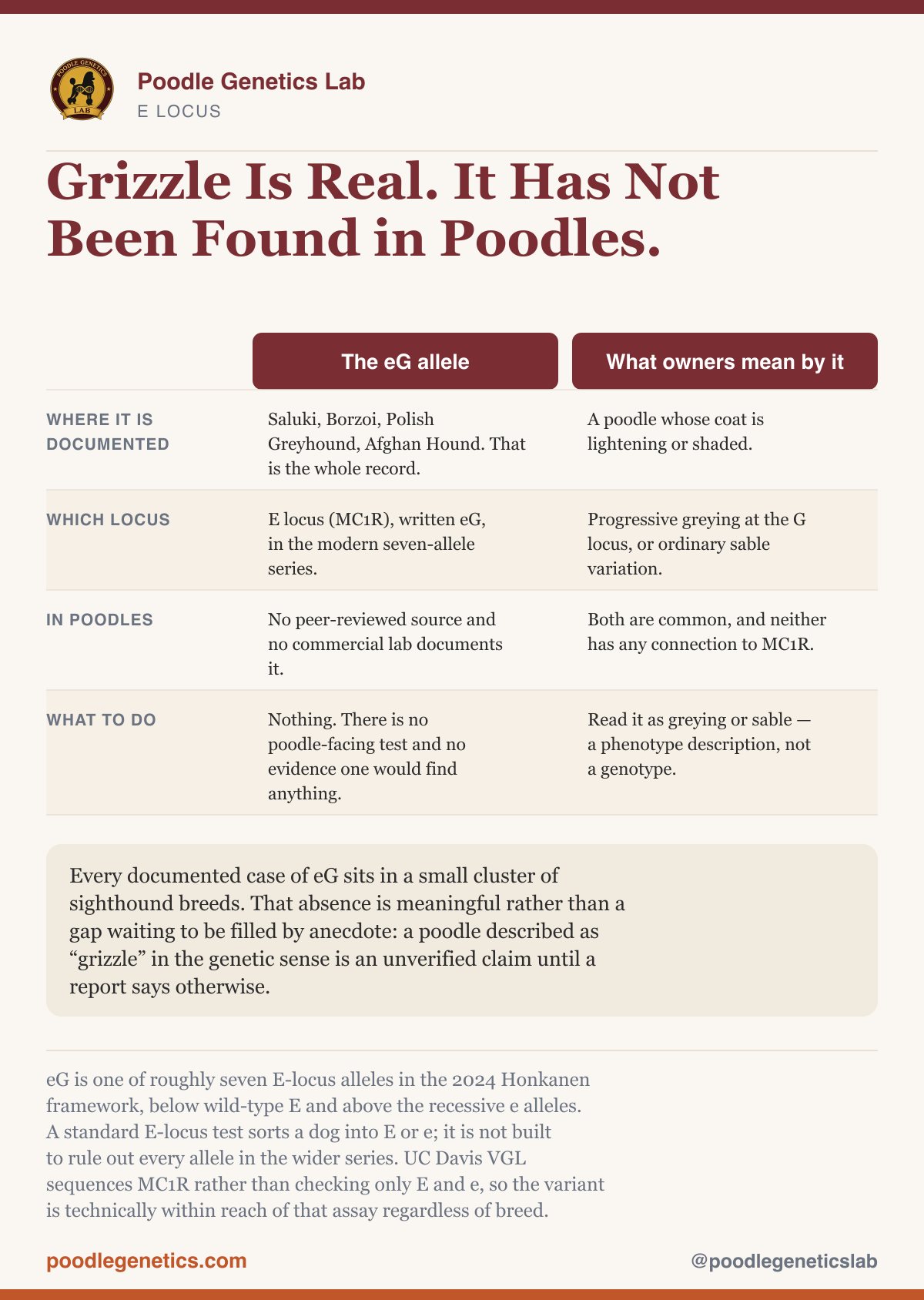
Every documented case of the eG allele is in a small cluster of sighthound breeds: Saluki, Borzoi, Polish Greyhound, and Afghan Hound. That is not a partial list padded down for space, it is the actual extent of the published and commercial-lab record. Poodles are not sighthounds, and their documented ancestry runs through European water dogs, not the Middle Eastern and Central Asian sighthound lines where grizzle has been found and studied.
No peer-reviewed source and no commercial testing lab currently documents the eG allele occurring in poodles. That is a meaningful absence, not a gap waiting to be filled by anecdote. If you have read anything, anywhere, describing a poodle as "grizzle" in the genetic sense described above, treat that as an unverified claim rather than an established phenotype, in the same way this site treats any unverified color claim: the DNA report is the source of truth, not the label on a listing.
Why So Few Labs Report It
The lab comparison on this site already lays out the practical reality: for the E locus, the three major labs poodle breeders use, UC Davis VGL, Embark, and Wisdom Panel, all report the standard E/e distinction that this site's E-locus article covers. None of them market a poodle-facing grizzle result, because there is no known reason to. Testing for an allele nobody has found in the breed isn't a service gap, it's simply not a documented need.
That said, the underlying assay matters more than the marketing copy. UC Davis VGL's MC1R test, bundled into its all-breeds basic coat color panel, sequences the gene itself rather than checking only for E and e. That means the eG variant is technically within reach of that particular test regardless of breed, even though it isn't called out as a poodle-relevant result. Most consumer panels, by contrast, are built and reported around the alleles a breed is actually known to carry, which is a reasonable design choice right up until a genuinely novel result shows up in a breed nobody expected it in.
What This Means for Reading a Poodle's Report
Practically, close to nothing changes for a poodle breeder today. Don't test for grizzle specifically, there's no dedicated poodle product for it and no evidence it would find anything. Don't relabel a lightening or shaded coat as "grizzle," that's a phenotype description, not a genotype, and it's almost certainly greying or ordinary sable variation instead.
The one honest, useful takeaway is interpretive caution: a standard E-locus test is built to sort a dog into E or e, not to positively rule out every allele in the wider seven-allele series. If a report ever comes back genuinely unresolvable against the E/e framework this site describes, that's a case for going back to the lab for clarification or running it through the DNA Interpreter, rather than assuming the panel simply made an error. That scenario remains hypothetical for poodles as of this writing, and this article should be read as background on a real allele, not a warning about an active risk.
The Bottom Line
Grizzle is a genuine, published E-locus allele, distinct from red/cream ee and from the standard dominant E, and it has a real place in the modern allelic series this site already references. It has never been documented in poodles. Until that changes, the practical guidance for poodle breeders is simple: understand that the E locus is more complex than a two-letter test result, know that this particular allele belongs to a different group of breeds entirely, and don't let an unfamiliar term on a forum or a listing get treated as a diagnosis your dog's actual DNA report never made.
Download the Doodle Coat Genetics Reference for a printable summary of grizzle and other alleles a standard E/e panel isn't built to catch.
This article is educational and is not veterinary advice. Discuss breeding and testing decisions with your veterinarian.
Based on current research that is still developing. The direction is supported by the literature below, but details may be refined as more work is published.
- Published
- October 30, 2026
- Last reviewed
- September 3, 2026
References
- Honkanen L, Loechel R, Davison S, Donner J, Anderson H (2024). Canine coat color E locus updates: identification of a new MC1R variant causing ‘sable’ coat color in English Cocker Spaniels and a proposed update to the E locus dominance hierarchy. Animal Genetics 55(2):291–295. doi:10.1111/age.13398
Free Tool
Apply This Knowledge
Model any parent pair with our interactive genetics calculator.